NEW YORK (AP) — A Post-it note sat near Ari Aster while he wrote “Eddington”: “Remember the phones.”
“Eddington” may be set during the pandemic, but the onset of COVID-19 isn't its inciting incident. Outside the fictional New Mexico town, a data center is being built. Inside Eddington, its residents — their brains increasingly addled by the internet, social media, smartphones and whatever is ominously emanating from that data center — are growing increasingly detached from one another, and from each other’s sense of reality.
“We’re living in such a weird time and we forget how weird it is,” Aster says. “Things have been weird ever since we were able to carry the internet on our person. Ever since we began living in the internet, things have gotten weirder and weirder.”
“It’s important to keep reminding ourselves: This is weird.”
Moviegoers have grown accustomed to expecting a lack of normalcy in Aster's movies. His first three films — “Hereditary,”“Midsommar,”“Beau Is Afraid” — have vividly charted strange new pathways of dread and deep-rooted anxiety. Those fixations make Aster, a master of nightmare and farce, uniquely suited to capturing the current American moment.
“Eddington,” which A24 releases in theaters Friday, may be the most prominent American movie yet to explicitly wrestle with social and political division in the U.S. In a showdown between Joaquin Phoenix’s bumbling right-wing sheriff and Pedro Pascal’s elitist liberal mayor, arguments over mask mandates, Black Lives Matter protests and elections spiral into a demented Western fever dream.
At a time when our movie screens are filled with escapism and nostalgia, “Eddington” dares to diagnose something frightfully contemporary. Aster, in a recent interview at an East Village coffee shop he frequents, said he couldn’t imagine avoiding it. “To not be talking about it is insane,” he said.
“I’m desperate for work that’s wrestling with this moment because I don’t know where we are. I’ve never been here before,” says Aster. “I have projects that I’ve been planning for a long time. They make less sense to me right now. I don’t know why I would make those right now.”
“Eddington,” appropriately enough, has been divisive. Since its premiere at the Cannes Film Festival in May, Aster’s film has had one of the most polarizing receptions of the year among critics. Even in Cannes, Aster seemed to grasp its mixed response. “I don’t know what you think,” he told the crowd.
Some critics have suggested Aster's film is too satirical of the left. “Despite a pose of satirical neutrality, he mainly seems to want to score points off mask-wearers, young progressives, anti-racists and other targets beloved of reactionaries,” wrote The New Yorker’s Justin Chang. For The New York Times, Manohla Dargis wrote: “Aster knows how to grab your attention, but if he thinks he’s saying something about America, the joke is on him.”
Aster was expecting a divisive reaction. But he disputes some of the discourse around “Eddington.”
“I heard one person say it was harder on the left than the right, and I think that’s pretty disingenuous,” he says. “In the film, one side is kind of annoying and frustrating and hypocritical, and the other side is killing people and destroying lives.”
For Aster, satirizing the left doesn’t mean he doesn’t share their beliefs. “If there’s no self-reflection,” he says, “how are we ever going to get out of this?”
Aster began writing “Eddington” in June 2020. He set it in New Mexico, where his family moved when he was 10. Aster wanted to try to capture the disconnect that didn’t start with the pandemic but then reached a surreal crescendo. He styled “Eddington” as a Western with smartphones in place of guns — though there are definitely guns, too.
“The dread I was living with suddenly intensified. And to be honest, I’ve been living with that level of dread ever since,” Aster says. “I just wanted to see if I could capture what was in the air.”
Scripts that dive headlong into politics are far from regular in today’s corporate Hollywood. Most studios would be unlikely to distribute a film like “Eddington,” though A24, the indie powerhouse, has stood behind Aster even after 2023's $35 million-budgeted “Beau Is Afraid” struggled at the box office. A24 has shown a willingness to engage with political discord, backing last year’s speculative war drama, “Civil War.”
And Aster's screenplay resonated with Phoenix, who had starred in “Beau Is Afraid,” and with Pascal. In Cannes, Pascal noted that “it’s very scary to participate in a movie that speaks to issues like this.” For Phoenix, “Eddington” offered clarity and empathy for the pandemic experience.
“We were all terrified and we didn’t fully understand it. And instead of reaching out to each other in those moments, we kind of became antagonistic toward each other and self-righteous and certain of our position,” Phoenix earlier told The AP. “And in some ways it’s so obvious: Well, that’s not going to be helpful.”
Since Aster made “Eddington” — it was shot in 2024 — the second administration of President Donald Trump has ushered in a new political reality that Aster acknowledges would have reshaped his film.
“I would have made the movie more obscene,” he says. “And I would have made it angrier. I think the film is angry. But I think we’re living in a time of total obscenity, beyond anything I’ve seen.”
“Eddington” is designed to be argued over. Even those who find its first half well-observed may recoil at the violent absurdism of its second half. The movie, Aster says, pivots midway and, itself, becomes paranoid and gripped by differing world views. You can almost feel Aster struggling to bring any coherence to his, and our, modern-day Western.
But whatever you make of “Eddington,” you might grant it’s vitally important that we have more films like it — movies that don’t tiptoe around today in period-film metaphor or avoid it like the plague. Aster, at least, doesn’t sound finished with what he started.
“I’m feeling very heartbroken about where we are, and totally lost, so I’m looking for ways to go into those feelings but also to challenge them. What can be done?” Aster says. “Because this is a movie about people who are unreachable to each other and completely siloed off, or fortressed off, a question that kept coming to me was: What would an olive branch look like? How do we find a way to reengage with each other?”
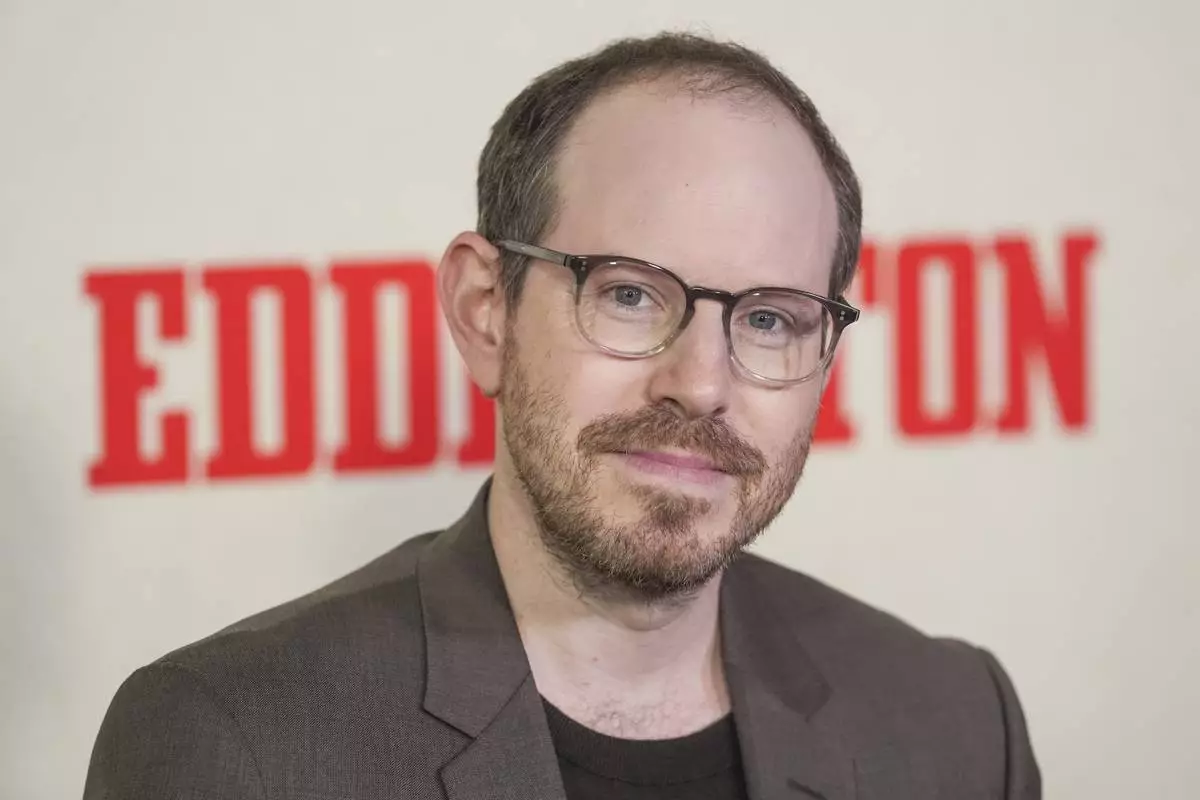
FILE - Ari Aster arrives at the premiere of "Eddington" on Thursday, June 26, 2025, at the DGA Theater Complex in Los Angeles. (AP Photo/Chris Pizzello, File)
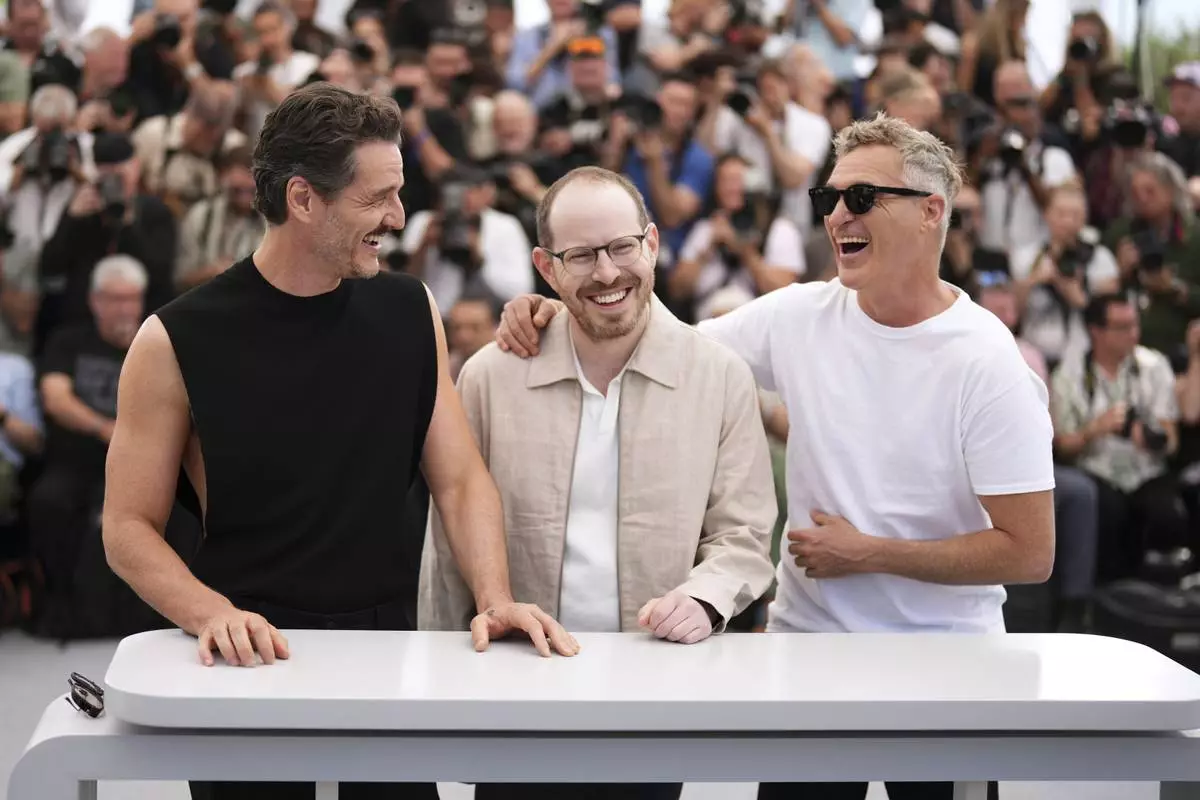
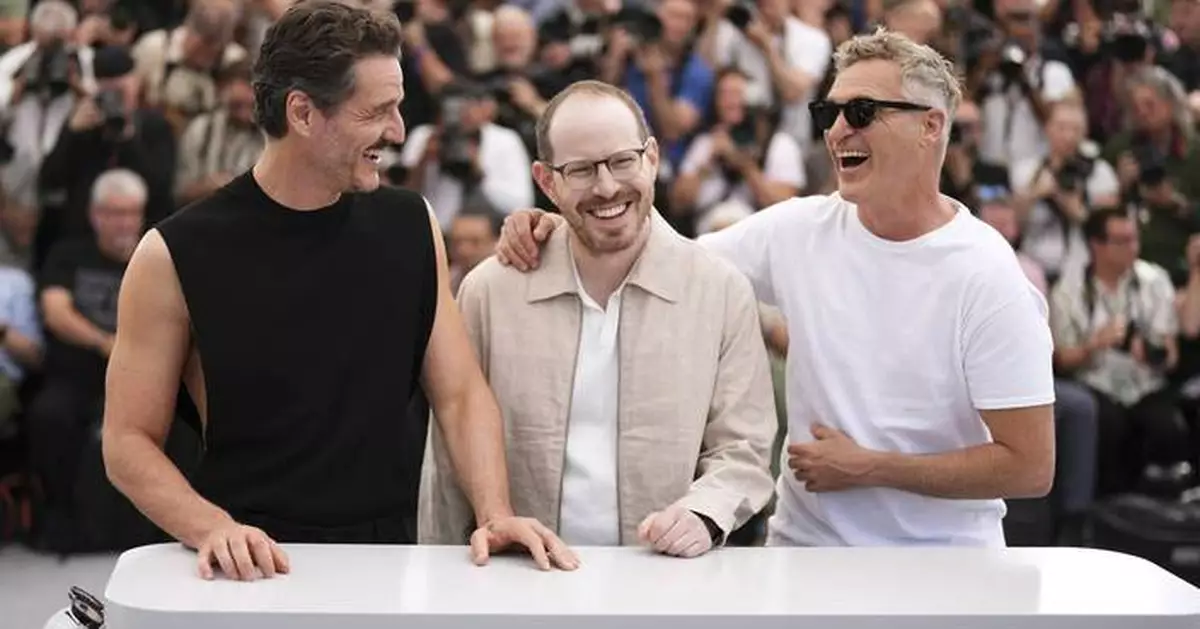
FILE - Pedro Pascal, from left, director Ari Aster and Joaquin Phoenix pose for photographers at the photo call for the film 'Eddington' at the 78th international film festival, Cannes, southern France, Saturday, May 17, 2025. (Photo by Scott A Garfitt/Invision/AP, File)
MINNEAPOLIS (AP) — Hennepin County Attorney Mary Moriarty on Friday called on members of the public to send any video or other evidence in the fatal shooting of Renee Good directly to her office, challenging the Trump administration's decision to leave the investigation solely to the FBI.
Moriarty said that although her office has collaborated effectively with the FBI in past cases, she is concerned by the Trump administration's decision to bar state and local agencies from playing any role in the investigation into Wednesday's killing of Good by an Immigration and Customs Enforcement officer in Minneapolis.
She also said that despite the Trump administration’s insistence that the officer who shot Good has complete legal immunity, that isn’t the case.
“We do have jurisdiction to make this decision with what happened in this case,” she said at a news conference. “It does not matter that it was a federal law enforcement agent.”
Moriarty said her office would post a link for the public to submit footage of the shooting, even though she acknowledged that she wasn't sure what legal outcome submissions might produce.
The prosecutor's announcement came on a third day of Minneapolis protests over Good's killing and a day after federal immigration officers shot and wounded two people in Portland, Oregon.
Good's wife, Becca Good, released a statement to Minnesota Public Radio on Friday saying, “kindness radiated out of her.”
"On Wednesday, January 7th, we stopped to support our neighbors. We had whistles. They had guns," Becca Good said.
“I am now left to raise our son and to continue teaching him, as Renee believed, that there are people building a better world for him,” she wrote. “That the people who did this had fear and anger in their hearts, and we need to show them a better way.”
The reaction to the Good's shooting was immediate in the city where police killed George Floyd in 2020, with hundreds of protesters converging on the shooting scene and the school district canceling classes for the rest of the week as a precaution.
On Thursday night, hundreds marched in freezing rain down one of Minneapolis’ major thoroughfares, chanting “ICE out now!” and holding signs saying, “Killer ice off our streets." And on Friday, protesters were out again demonstrating outside of a federal facility that is serving as a hub for the immigration crackdown that began Tuesday in the Twin Cities of Minneapolis and St. Paul. Authorities erected barricades outside the facility Friday.
City workers, meanwhile, removed makeshift barricades made of old Christmas trees and other debris that had been blocking the streets near the scene of Good's shooting. Officials said they would leave up a shrine to the 37-year-old mother of three.
The Portland shootings happened outside a hospital Thursday afternoon. Federal immigration officers shot and wounded a man and woman, identified by the Department of Homeland Security as Venezuela nationals Luis David Nico Moncada and Yorlenys Betzabeth Zambrano-Contreras, who were inside a vehicle, and their conditions weren't immediately known. The FBI and the Oregon Department of Justice were investigating.
Portland Mayor Keith Wilson and the city council called on ICE to end all operations in the city until a full investigation is completed. Hundreds protested Thursday night at a local ICE building. Early Friday, Portland police reported that officers had arrested several protesters after asking the to get out of a street to allow traffic to flow.
Just as it did following Good's shooting, DHS defended the actions of the officers in Portland, saying it occurred after a Venezuelan man with alleged gang ties and who was involved in a recent shooting tried to “weaponize” his vehicle to hit the officers. It wasn't immediately clear if the shootings were captured on video, as Good's was.
The Minneapolis shooting happened on the second day of the immigration crackdown in the Twin Cities, which Homeland Security said is the biggest immigration enforcement operation ever. More than 2,000 officers are taking part and Noem said they have made more than 1,500 arrests.
The government is also shifting immigration officers to Minneapolis from sweeps in Louisiana, according to documents obtained by The Associated Press. This represents a pivot, as the Louisiana crackdown that began in December had been expected to last into February.
Good's death — at least the fifth tied to immigration sweeps since Trump took office — has resonated far beyond Minneapolis, as protests happening in other places, including Texas, California, Detroit and Missouri.
In Washington, D.C., on Thursday, a woman held a sign that said, “Stop Trump’s Gestapo,” as hundreds of people marched to the White House. Protesters in Pflugerville, Texas, north of Austin, banged on the walls of an ICE facility. And a man in Los Angeles burned an American flag in front of federal detention center.
Homeland Security Secretary Kristi Noem, President Donald Trump and others in his administration have repeatedly characterized the Minneapolis shooting as an act of self-defense and cast Good as a villain, suggesting she used her vehicle as a weapon to attack the officer who shot her.
But state and local officials and protesters rejected that characterization, with Minneapolis Mayor Jacob Frey saying videos show the self-defense argument is “garbage.”
Several bystanders captured footage of Good's killing, which happened in a neighborhood south of downtown.
The recordings show an officer approaching an SUV stopped across the middle of the road, demanding the driver open the door and grabbing the handle. The Honda Pilot begins to pull forward and a different ICE officer standing in front of it pulls his weapon and immediately fires at least two shots at close range, jumping back as the vehicle moves toward him.
It is not clear from the videos if the vehicle makes contact with the officer, and there is no indication of whether the woman had interactions with agents earlier. After the shooting, the SUV speeds into two cars parked on a curb before crashing to a stop.
The federal agent who fatally shot Good is an Iraq War veteran who has served for nearly two decades in the Border Patrol and ICE, according to records obtained by AP.
Noem has not publicly named him, but a Homeland Security spokesperson said her description of his injuries last summer refers to an incident in Bloomington, Minnesota, in which court documents identify him as Jonathan Ross.
Ross got his arm stuck in the window of a vehicle whose driver was fleeing arrest on an immigration violation. Ross was dragged and fired his Taser. A jury found the driver guilty of assaulting a federal officer with a dangerous weapon.
Attempts to reach Ross, 43, at phone numbers and email addresses associated with him were not successful.
Associated Press reporters Steve Karnowski and Mark Vancleave in Minneapolis; Ed White in Detroit; Valerie Gonzalez in Brownsville, Texas; Graham Lee Brewer in Norman, Oklahoma; Michael Biesecker in Washington; Jim Mustian and Safiyah Riddle in New York; Ryan Foley in Iowa City, Iowa; and Hallie Golden in Seattle contributed to this report.
Protesters confront law enforcement outside the Bishop Henry Whipple Federal Building in Minneapolis, Friday, Jan. 9, 2026.(AP Photo/Adam Bettcher)
Protesters' shadows are cast on the street near law enforcement outside the Bishop Henry Whipple Federal Building in Minneapolis, Friday, Jan. 9, 2026. (AP Photo/Adam Bettcher)
Protesters confront law enforcement outside the Bishop Henry Whipple Federal Building in Minneapolis, Friday, Jan. 9, 2026.(AP Photo/Adam Bettcher)
An American flag burns outside the U.S. Immigration and Customs Enforcement facility on Thursday, Jan. 8, 2026, in Portland, Ore. (AP Photo/Jenny Kane)
Two protesters are lit by a police light as they walk outside the U.S. Immigration and Customs Enforcement facility on Thursday, Jan. 8, 2026, in Portland, Ore. (AP Photo/Jenny Kane)
Protesters are arrested by federal agents outside the Bishop Henry Whipple Federal Building in Minneapolis, Friday, Jan. 9, 2026. (AP Photo/Adam Bettcher)
Protesters sit on a barrier that is being assembled outside the Bishop Henry Whipple Federal Building as protesters gather in Minneapolis, Friday, Jan. 9, 2026. (AP Photo/Adam Bettcher)
Protesters stand off against law enforcement outside the U.S. Immigration and Customs Enforcement facility in Portland, Ore., Thursday, Jan. 8, 2026. (AP Photo/Jenny Kane)
Demonstrators protest outside the White House in Washington, Thursday, Jan. 8, 2026, against the Immigration and Customs Enforcement (ICE) agent who fatally shot Renee Nicole Good in Minneapolis. (AP Photo/Jose Luis Magana)
Protesters chant and march during a rally for Renee Good, who was fatally shot by an ICE officer the day before, Thursday, Jan. 8, 2026, in Minneapolis. (AP Photo/John Locher)
Protesters gather during a rally for Renee Good, Thursday, Jan. 8, 2026, in Minneapolis, after she was fatally shot by an ICE officer the day before. (AP Photo/Adam Bettcher)
Protesters confront federal agents outside the Bishop Henry Whipple Federal Building, Thursday, Jan. 8, 2026, in Minneapolis, Minn. (AP Photo/Tom Baker)
People gather around a makeshift memorial honoring the victim of a fatal shooting involving federal law enforcement agents, near the site of the shooting, Thursday, Jan. 8, 2026, in Minneapolis. (AP Photo/Tom Baker)
U.S. Border Patrol Cmdr. Gregory Bovino arrives as protesters gather outside the Bishop Henry Whipple Federal Building, Thursday, Jan. 8, 2026, in Minneapolis, Minn. (AP Photo/Tom Baker)
A protester pours water in their eye after confronting law enforcement outside the Bishop Henry Whipple Federal Building, Thursday, Jan. 8, 2026, in Minneapolis, Minn. (AP Photo/Tom Baker)
People gather around a makeshift memorial honoring the victim of a fatal shooting involving federal law enforcement agents, near the site of the shooting, Thursday, Jan. 8, 2026, in Minneapolis. (AP Photo/Tom Baker)