When Ichiro Suzuki landed in Seattle and became an instant star in 2001, captivating a city and helping his new team win an AL-record 116 games, he acclimated to his new life in practically no time largely because he had already been around the club during spring training a couple of years before.
As Suzuki looks back decades later on those early days in a Mariners uniform, now a Hall of Famer and 51 years old still giving himself to the game at every chance, the speedy leadoff hitter is beyond grateful for the bonds then between Seattle and his previous club in Japan, Orix Blue Wave.
Click to Gallery

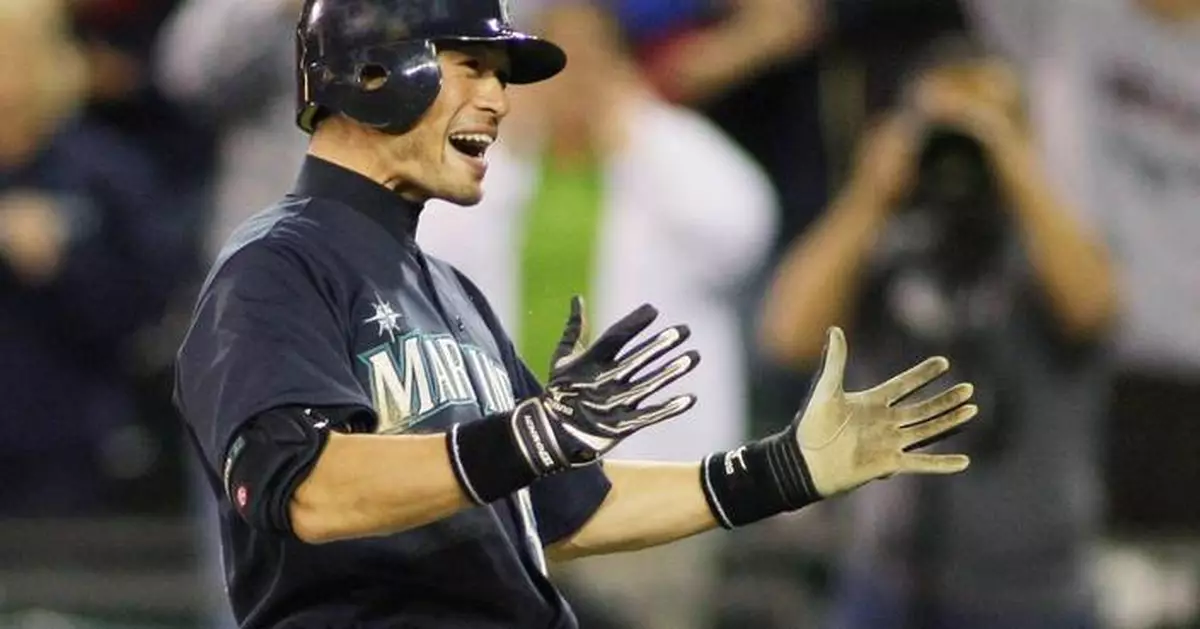
FILE - Seattle Mariners' Ichiro Suzuki hits a home run in the first inning of a baseball game against the Cleveland Indians, Wednesday, April 18, 2012, in Seattle. (AP Photo/Elaine Thompson, File)
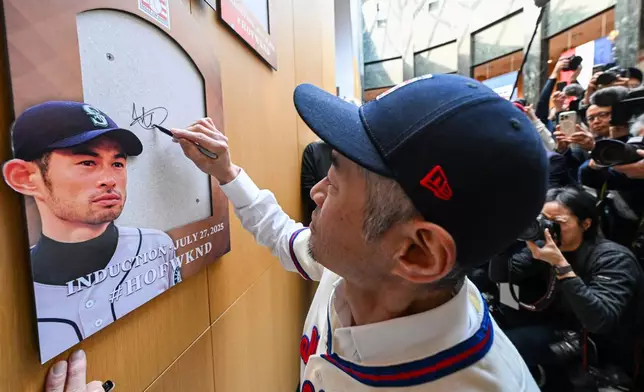
FILE - Newly-elected Baseball Hall of Fame member Ichiro Suzuki signs the backer board where his plaque will hang during a news conference Thursday, Jan. 23, 2025, in Cooperstown, N.Y. (AP Photo/Hans Pennink, File)
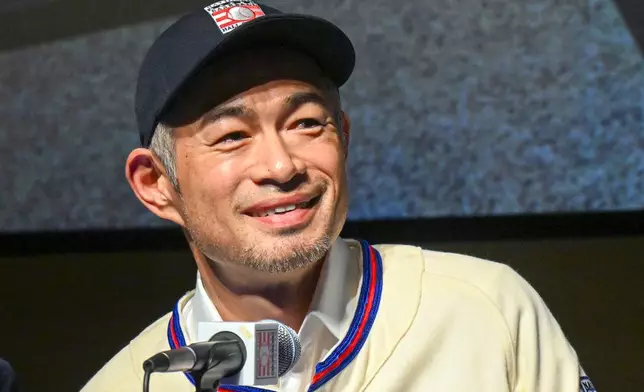
FILE - Newly elected Baseball Hall of Fame inductee Ichiro Suzuki talks to reporters during a news conference Thursday, Jan. 23, 2025, in Cooperstown, N.Y. (AP Photo/Hans Pennink, File)

FILE - Seattle Mariners Ichiro Suzuki celebrates after he hit a two-run home run in the ninth inning to give the Mariners a 3-2 win over the New York Yankees in a baseball game, Friday, Sept. 18, 2009, in Seattle. (AP Photo/Ted S. Warren, File)
“That whole relationship before even coming over to Seattle in 2001, it was already there, that relationship was set,” Suzuki said Friday, speaking through interpreter Allen Turner on a call organized by the Hall of Fame.
“In 2001 when I came I didn’t feel like this was the first time being in America playing baseball because I had that experience and I had that connection with the Mariners. So it was a great start to coming to Seattle. And obviously having the 2001 season, being able to play in front of the great fans here and having that great of a season, that really kind of started the great career here in Seattle.”
He would go on to win AL Rookie of the Year and MVP honors playing for Lou Piniella during that emotional season — when the Sept. 11 terrorist attacks were cause for a subdued celebration of the AL West title barely more than a week later — making the Mariners' $13 million-plus payment to Orix for the rights to Ichiro an investment for the ages.
Suzuki cherishes baseball history so much to this day he has taken previous trips to Cooperstown, New York, to honor the players who made a difference long before he left his lasting mark across the globe.
Now it’s his turn to be enshrined in the Hall of Fame, his time to make a speech about a brilliant baseball career that brought him from Japan to the big leagues and far beyond. Suzuki will be side by side with pitchers Billy Wagner and CC Sabathia to be honored at the July 27 induction ceremony.
Suzuki considers it a responsibility, perhaps even a calling, to continue spreading the word on baseball over the years — “We’re able to play this game because of players of the past,” he said. He hopes the sport never strays too far from its foundation, either.
“Baseball is human beings playing against human beings, and to have the passion and the energy that is created by that is something that I really hope is still part of the game,” he said. “That’s what I really value and it is very important to me that baseball continues to be a game that has the human element to it, with all the emotions and everything that comes along with having humans play this game.”
Suzuki wound up with 3,089 hits over a remarkable 19-year major league career including 14 total seasons with Seattle. There were separate three-year stints with the New York Yankees and Miami before he spent his final two seasons back in the familiar Pacific Northwest on the Mariners. Three different times he played all 162 games, in 2005 and 2010 for Seattle, then in '12 between the Mariners and Yankees.
The left-handed hitter will long be remembered for his meticulous attention to every detail, from that iconic batting stance featuring a deep knee bend to loosen up and then a stretch to fully extend his right arm before making a slight tug at his sleeve with the left hand, to extreme care for his body — he regularly used a small wooden tool to massage his feet while sitting at his locker.
He's embracing being a mentor now, for anybody who asks, that is. He isn't one to offer unsolicited advice. And, no, the younger generation doesn't have to do it exactly his way, he will offer his wisdom regardless.
“Anybody has an opportunity to ask me,” he said, “If I can be of any help to the players that’s why I’m here.”
AP MLB: https://apnews.com/hub/MLB

FILE - Seattle Mariners' Ichiro Suzuki hits a home run in the first inning of a baseball game against the Cleveland Indians, Wednesday, April 18, 2012, in Seattle. (AP Photo/Elaine Thompson, File)

FILE - Newly-elected Baseball Hall of Fame member Ichiro Suzuki signs the backer board where his plaque will hang during a news conference Thursday, Jan. 23, 2025, in Cooperstown, N.Y. (AP Photo/Hans Pennink, File)
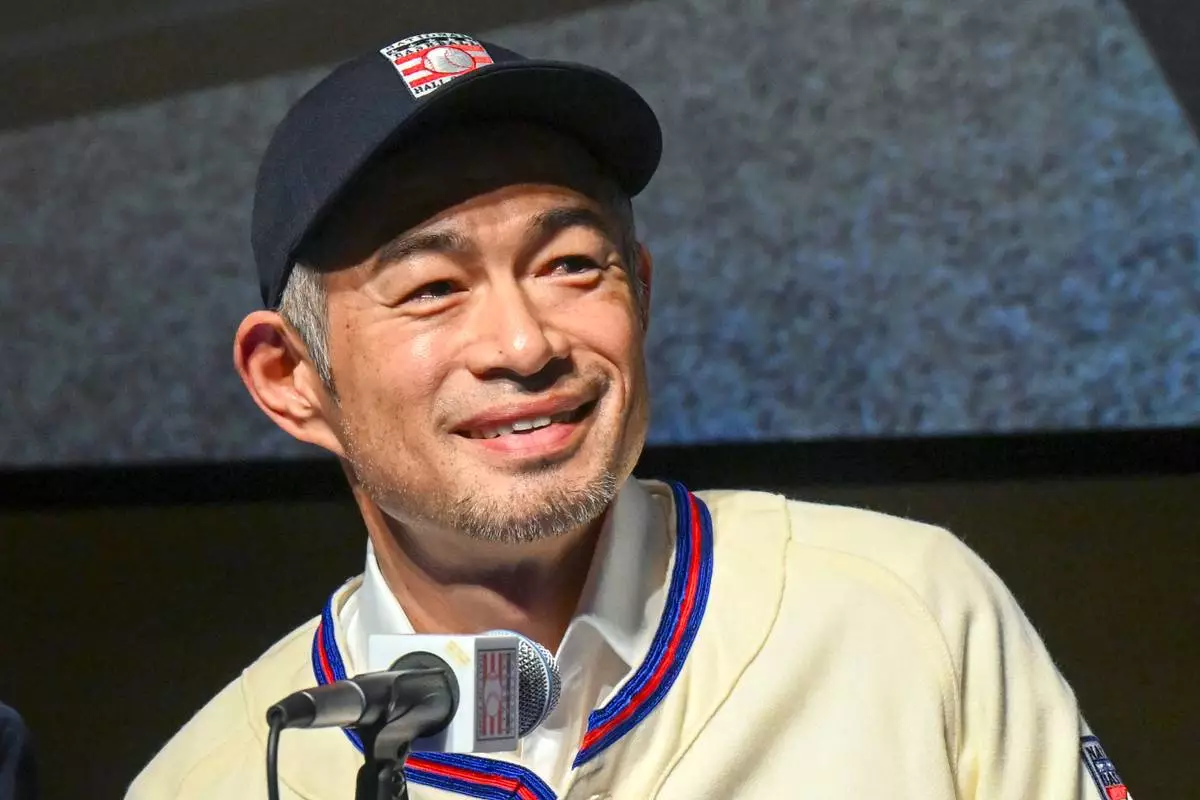
FILE - Newly elected Baseball Hall of Fame inductee Ichiro Suzuki talks to reporters during a news conference Thursday, Jan. 23, 2025, in Cooperstown, N.Y. (AP Photo/Hans Pennink, File)

FILE - Seattle Mariners Ichiro Suzuki celebrates after he hit a two-run home run in the ninth inning to give the Mariners a 3-2 win over the New York Yankees in a baseball game, Friday, Sept. 18, 2009, in Seattle. (AP Photo/Ted S. Warren, File)
SAN FRANCISCO (AP) — Wildlife crews are no longer actively searching for two juvenile gray wolves who were part of a pack that killed dozens of cows and calves last summer in Northern California’s Sierra Valley, an official said Tuesday.
The two wolves were members of the Beyem Seyo pack that in 2025 killed or injured at least 92 calves and cows in a seven-month period, according to a report released last week by two researchers with the University of California, Davis.
Wolves in the state are protected under California law and the federal Endangered Species Act. Under former President Joe Biden, officials said they planned a first-ever national recovery plan for wolves, but President Donald Trump’s administration ended that initiative in November.
In October, the California Department of Fish and Wildlife announced it had euthanized four gray wolves — three adults and a juvenile — from the Beyem Seyo pack after “an unprecedented level of livestock attacks across the Sierra Valley” by a single wolf pack since the canids returned to the state. It also said it planned to capture and relocate the remaining two wolves to wildlife facilities to prevent their behavior from spreading to other wolves in California.
Gray wolves primarily prey on wild animals like deer and elk, not livestock, but the pack became used to killing cows and calves, the department said.
“These wolves had become habituated to preying on cattle, a feeding pattern that persisted and was being taught to their offspring which would leave to form their own packs and could teach them the same cattle-preying behavior,” the department said at the time.
But following weeks of searching for the remaining two wolves, officials have “reduced efforts to capture” them, Katie Talbot, CDFW Deputy Director of Public Affairs, said in a statement.
“Despite best efforts from CDFW’s expert wolf biologists and law enforcement officers, we have not been able to find or get close enough to these young wolves to safely capture them,” Talbot said.
“We remain hopeful our continued remote monitoring will allow for sightings that will lead to safe capture of these juveniles," she added.
Talbot said that CDFW crews will be working this week on capturing wolves and collaring them throughout the state, including in the Sierra Valley.
Wildlife officials tried for months to prevent the pack from attacking farm animals by using drones, nonlethal bean bags, installing flags or rope to deter them and having officers in the field 24 hours a day, seven days a week, but their efforts failed.
“The efforts that the (CDFW) made were tremendous and heroic but it was too late.” said Amaroq Weiss, senior wolf advocate for the Center for Biological Diversity.
She said that cattle ranchers in the area should have been taking proactive prevention measures for years, including increased human presence around the cattle, keeping the livestock bunched up instead of letting them loose on large grazing pastures, and calving at the same time of year that deer and elk are birthing so wolves have a source of wild prey.
“Ranchers in California have been on notice that wolves were coming since late December 2011, when we got our first wolf. They have been on notice they would establish packs since 2015,” when the first pack was confirmed in Siskiyou County, Weiss said.
Gray wolves were eradicated in California early in the last century because of their perceived threat to livestock, with the last known native wolf killed in 1924 in Lassen County. Since their reintroduction in Idaho and at Yellowstone National Park in the mid-1990s, they’ve proliferated throughout the West. The recovering population has meant increasing conflict with ranchers.
“It was a horrible summer here for everybody and the emotional strain was probably worse than the financial strain for most people. They did the right thing. We couldn’t go on living the way we were living,” said Rick Roberti, a cattle rancher in Plumas County and president of the California Cattlemen’s Association, who lost several animals.
Economist Tina Saitone and researcher Tracy Schohr said in UC Davis’ quarterly agricultural economics update released Friday that the Beyem Seyo pack killed more livestock than the entire wolf population of Montana killed in 2024 and the killings of farm animals by the wolves in Wyoming in 2023.
In Montana, the state’s 1,100 wolves killed 54 domestic animals in 2024, and Wyoming’s 352 wolves killed 49 livestock in 2023, the scientists said.
In California, about 70 gray wolves were responsible for 175 livestock kills between January and October of last year, with the Beyem Seyo pack responsible for half of the killings, according to CDFW data.
Roberti said the attacks on livestock in Plumas and Sierra counties left many ranchers angry. He said he would like to see certain areas in the state declared “special zones” where people are allowed to hunt wolves that attack livestock.
“We’re pretty much in unison about thinking that it would help if we started taking out the ones that are just killing cattle and are too habituated to man or they’re not afraid of us,” he said.
The predators are a long way from recovery, Weiss said, adding that killing them is not a long-term solution.
“The scientific literature is pretty conclusory that killing wolves to resolve conflicts with livestock is not a solution. It can actually be counterproductive. It can result in there being more conflicts with livestock," she said.
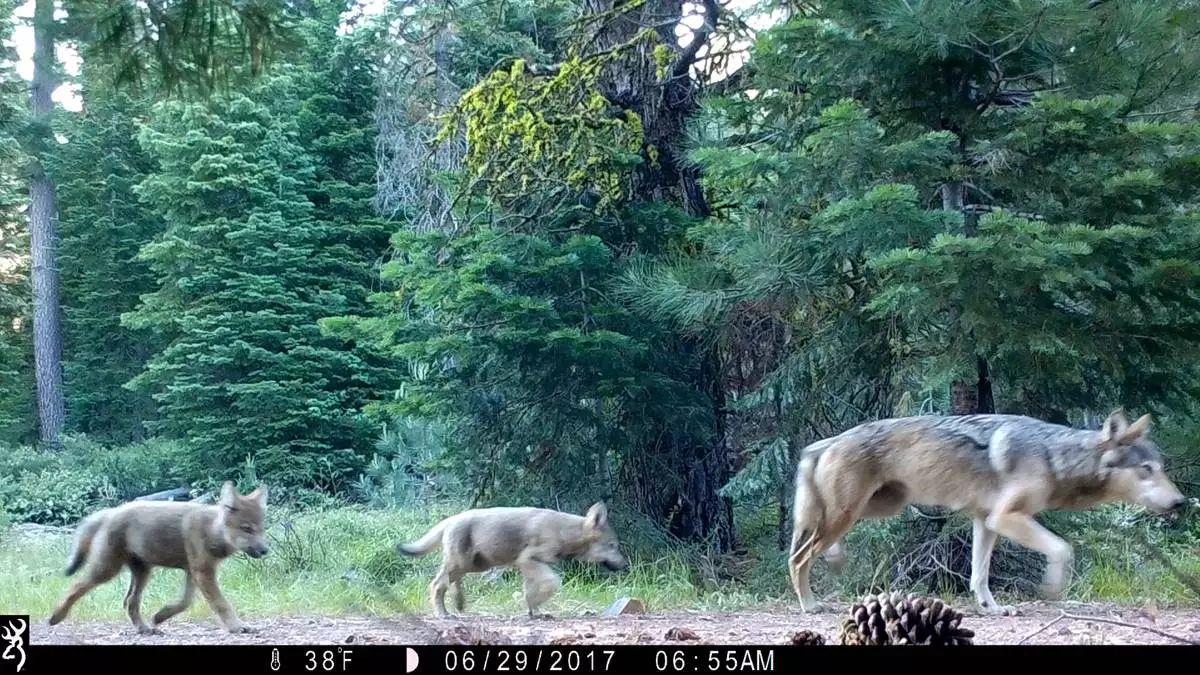
FILE - This remote camera image provided by the U.S. Forest Service shows a female gray wolf and two of the three pups born in 2017 in the wilds of Lassen National Forest in northern California on June 29, 2017. (U.S. Forest Service via AP, File)