Skip to Content Facebook Feature Image

Monsoon floods test Pakistan's climate resilience

China

China

China

Monsoon floods test Pakistan's climate resilience

2025-07-20 00:36 Last Updated At:04:17

Floodwaters have once again swept through villages in Pakistan that were already devastated by catastrophic flooding in 2022, reigniting urgent concerns about the country's climate resilience and the effectiveness of the government's response to recurring disasters.

Pakistan's National Disaster Management Authority said Friday that at least 193 people were killed and 544 others injured across the country between June 26 and July 18 as heavy monsoon rains triggered widespread flooding and rain-related accidents. The eastern province of Punjab was the hardest hit, with 114 deaths and 437 injuries reported.

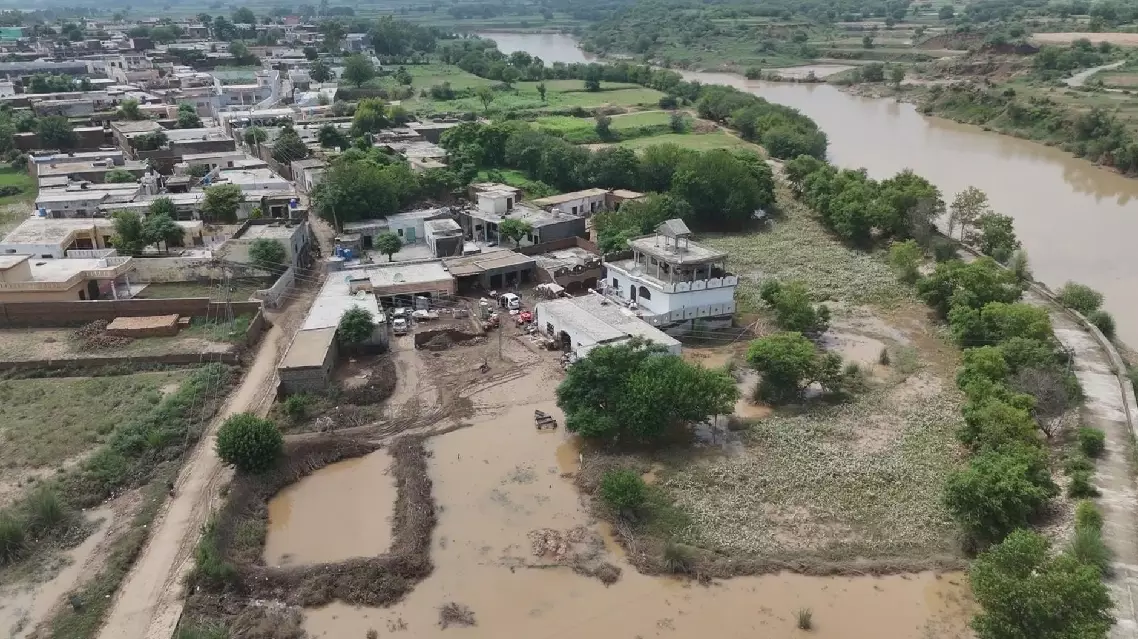
Parts of Punjab and Sindh provinces remain submerged, with the same villages and the same people once again at the mercy of swollen rivers and seasonal streams.

This year's monsoon rains triggered flash floods that left families stranded for hours. Even as the waters receded, they left behind widespread destruction.

In Chakwal, a city in northwestern Punjab, 80-year-old Muhammad Nazir and his family are still living among the remains of their home, which was wrecked in the 2022 floods and has now been struck again.

"A lot has happened in the area. What happened to us is that many houses collapsed because of the floods. The roofs came crashing down. Now the water has moved away from the house," said Nazir.

Pakistan's 2022 floods displaced more than 33 million people. Billions of dollars in aid were pledged, but recovery has been slow, and many communities were never truly rebuilt.

Climate experts warn that heavier, more erratic monsoon rains are Pakistan's new normal, and that poor planning and weak infrastructure keep pushing vulnerable families into the flood's path.

"All these houses have collapsed. Water has entered the houses. There is no drinking water. There is no water for anyone. Children are suffering from itching because of rashes, and the place is swarming with mosquitoes," said Abdul Rahman, another resident in Chakwal.

Pakistan is among the world's most climate-vulnerable countries, yet the slow pace of recovery and repeated disasters raise hard questions about its resilience.

For families like Nazir's, rebuilding is no longer enough -- what they need now is protection from the next flood, before it comes.
Monsoon floods test Pakistan's climate resilience

Monsoon floods test Pakistan's climate resilience
Chinese Foreign Minister Wang Yi said Sunday that the international landscape should be based on an equal and orderly multipolar world where every nation can find its place and play its role, stressing that global affairs cannot be dominated by a handful of major countries.

Wang was speaking at a press conference on the sidelines of the ongoing fourth session of the 14th National People's Congress, China’s national legislature, during which he elaborated on China’s proposition on how the international landscape should evolve.

"There is no doubt that China and the United States have a significant impact on the world, but we should not forget there are more than 190 countries on our planet. World history has always been written by all the countries together, and the future of humanity will be forged through the collective efforts of all nations. Diversity is the inherent nature of human society, and multipolarity is what the international landscape should look like," he said.

Wang said China rejects the path of hegemony and the idea that global governance can be run by a few powerful states.

"Looking back into history, great-power rivalry and bloc confrontation have invariably inflicted disaster and pain on humanity. Therefore, China will never take the beaten path of seeking hegemony as its strength grows, nor do we subscribe to the logic that the world can be run by major countries. China has inscribed in its Constitution that it follows an independent foreign policy and is committed to pursuing a path of peaceful development. Chinese leaders have often declared to the world that no matter how the international situation evolves and how strong China becomes, it will never seek hegemony or expansion," Wang said.

The foreign minister also outlined China's vision for the international landscape, where all nations, regardless of size or strength, are equal members of the international community.

"As for how the international landscape should evolve, China's proposal is to build an equal and orderly multipolar world. 'Equal' means every nation, regardless of size or strength, is an equal member of the international community, and can find its place and play its role in a multipolar world. 'Orderly' means all countries should uphold the widely recognized international rules, namely the purposes and principles of the UN Charter and the basic norms of international relations," said Wang.

He also said countries around the globe should shoulder their responsibilities to build a multipolar, rules-based world, underpinned by international law.

"Building an equal and orderly multipolar world should be the common responsibility of all countries. With more resources and capabilities, major countries should be more generous, shoulder more responsibilities, and set an example of observing rules, honoring commitments and upholding international law. China will continue to play a constructive role in reforming global governance, and work with all countries toward a multipolar world," Wang said.

Int’l landscape should be based on equal, orderly multipolar world: Chinese FM

Int’l landscape should be based on equal, orderly multipolar world: Chinese FM

Recommended Articles