China has seen 260 million railway passenger trips so far in this year's summer travel rush, a increase of four percent year on year, according to figures from the China State Railway Group released on Friday.
The average number of daily passenger trips exceeded 14.4 million since the summer travel season began on July 1, 13.2 percent higher than the average of daily passenger trips during this year's Spring Festival travel rush.
Analysts said the launch of new rail routes and the improvement of railway services have driven the increase of the passenger flow.
Wu Guoying, an official of the China Railway Chengdu Group, said the Chongqing-Xiamen high-speed railway, newly inaugurated last month, has brought more tourists to Chongqing City.
"The opening of the new rail route has filled a gap in high-speed train transportation service in the southeastern parts of Chongqing. It has efficiently connected the rich tourism resources along the route and presented new summer tourism destinations for travelers," she said.
Extra Fuxing model bullet trains, which can reach speeds of 350 kilometers per hour, have been marshaled for the summer travel rush to expand rail transport capacity.
Convenient services of car transport by rail have also attracted tourists who favor self-driving tours to remote tourism destinations in Xinjiang, Xizang and many other parts of western China.
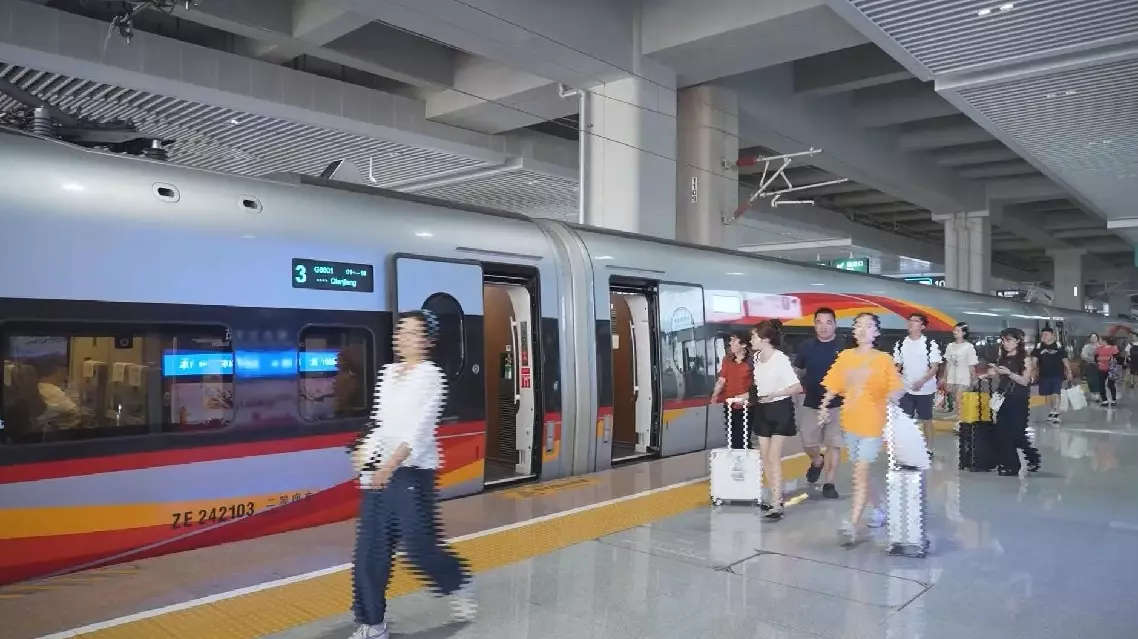
China sees surge in railway passenger trips in summer travel rush
China's two major power grid operators -- the State Grid Corporation of China (State Grid) and China Southern Power Grid (CSG) -- reported a surge in investment in the first quarter of 2026, underscoring efforts to strengthen infrastructure construction and support high-quality socioeconomic development in China.
The State Grid said it completed fixed-asset investment worth 129 billion yuan (about 18.77 billion U.S. dollars) in the first three months of this year, up 37 percent the corresponding period of the previous year. The spending has driven more than 250 billion yuan (36 billion U.S. dollars) of investment across the wider industrial chain.
Key projects such as the Panxi ultra-high-voltage (UHV) alternating current (AC) line and the Anhui-Hubei back-to-back direct current (DC) project have seen ground broken for their construction, while several west-to-east power transmission projects have been upgraded.
Investment in connecting renewable energy generation to the grid was reported to have exceeded 10 billion yuan (1.45 billion U.S. dollars) from January to March, a year-on-year rise of more than 50 percent.
The CSG also reported robust growth in investment in the three-month period, with fixed-asset investment reaching 38.45 billion yuan (5.58 billion U.S. dollars), up about 50 percent from a year earlier.
Among its achievements, the company completed and commissioned 80 key projects, including the 220 kV cross-sea power grid interconnection project, which was officially put into operation on March 20. The project ended years of grid isolation on the Weizhou Island in south China by linking it to the main power system of the Guangxi Zhuang Autonomous Region.
The construction of 17 other major energy projects, including one linking the power grid of the Xizang Autonomous Region in southwest China with that of Guangdong Province in south China, is advancing rapidly. These projects are expected to bolster regional industries, the maritime economy, digital collaboration and the transition to green energy.
"By accelerating major project construction, investment during the 15th Five-Year Plan period (2026-2030) is expected to approach 1 trillion yuan (145 billion U.S. dollars), driving a further 2 trillion yuan (290 billion U.S. dollars) of investment across upstream and downstream industries," said Dong Yanle, deputy general manager of the Engineering Construction Department under the China Southern Power Grid.
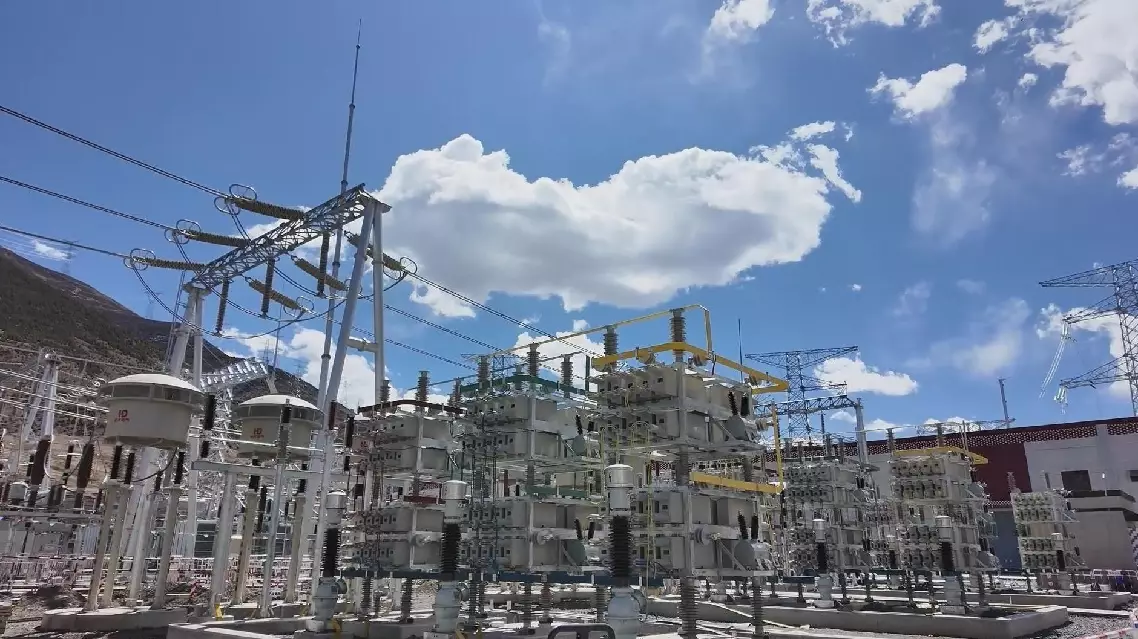
China ramps up power grid investment in January-March to boost growth