Northwest China's Xinjiang Uygur Autonomous Region has intensified efforts to conserve wild snow lotus, a rare flora species growing in high-altitude areas, preventing illegal picking and animal grazing.
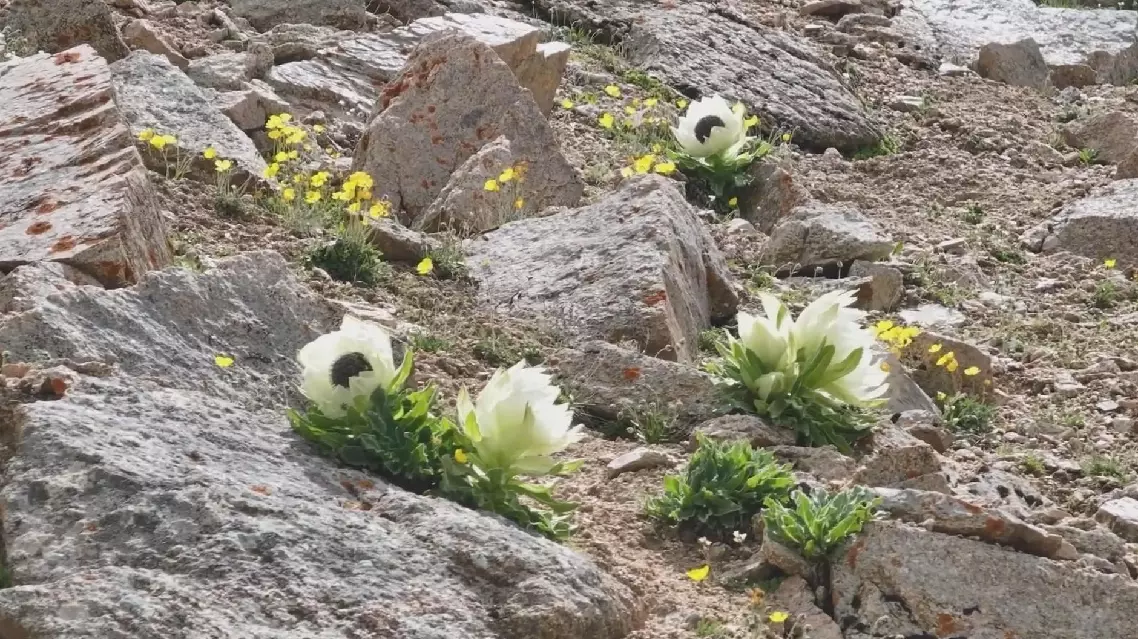
Every year from July to September is the blooming season for wild snow lotus, or saussurea, in Xinjiang's majestic Tianshan Mountains. Clusters of snow lotus are now in full bloom on the Karlik Glacier, which is part of the Eastern Tianshan Mountains, creating a unique beauty of the plateau.
The Karlik Glacier is the easternmost end of the Tianshan Mountains, with a peak elevation of 4,888 meters. Its rocky cliffs and outcrops provide the ideal growing conditions for wild snow lotus.
At an altitude of over 3,600 meters, snow lotus blooms proudly in the thin air and cold mountain winds, radiating purity and grace under the sunlight. Glaciers, rivers, snow lotus and various moss-like ground flowers jointly give rise to a unique plateau ecosystem.
Snow lotus is a rare plant that grows in high-altitude areas. In China, it is primarily found near the snow line of the Tianshan Mountains, the Kunlun Mountains, the Altai Mountains and the Pamir Plateau in Xinjiang.
With extremely strong vitality, snow lotus is able to thrive tenaciously in extreme cold and the thin air on the plateau, but its life cycle is also very short, blooming only once in its lifetime. Therefore, it is rare for people to see the snow lotus blooming in the snowy highlands.
Snow lotus has significant medicinal value, so the number of this rare wild plant used to decrease sharply due to excessive picking.
In 2018, Xinxing, a county-level city in Xinjiang, designated protective boundaries at a location known as the snow lotus slope, located at the foot of the Karlik Glacier within the Huangtian Town in Huangtian Farm, organizing a special team to patrol during spring and summer seasons to prevent illegal picking and animal grazing.
Additionally, many areas in Xinjiang have also conducted research on artificial breeding of the species through alpine bionic cultivation techniques, aiming to establish sustainable industrial cultivation bases to meet reasonable demands and address resource predicaments.
Protecting snow lotus on the Tianshan Mountains is about not only preserving this rare flora species, but also maintaining the ecological chain of the Eastern Tianshan Mountains, which originates from the snowy peaks and is vital for the future of all living creatures.
Therefore, from June to September each year, a protection team of Huangtian Town will traverse mountains to patrol and safeguard the areas where snow lotus grow the most densely.
Classifies as a wild flora species under national Grade-II protection, and a Grade-III endangered species, snow lotus flowers grow slowly and are rare. As local authorities continued to strengthen protection efforts over the past few years, less and less people were caught illegally picking snow lotus flowers, but nearby cattle seem to recognize the flowers' delicacy and rarity.
Grazing ban can only restraint local herdsmen to graze their livestock outside the designated protection area, but it cannot stop the livestock from coming into this area. Therefore, driving the cattle away has become an important task for the protection team.
The Karlik Mountains features craggy cliffs and a landscape strewn with loose rocks, making the ascent increasingly perilous for the team, with many sections of the trail being prone to landslides, which presents significant risks.
"During our patrols, the most feared hazard is landslides, as this area is located at a high altitude and could experience what appears to be all four seasons in a single day, which increases the possibility of landslides. Throughout the patrol process, we constantly remind our members to prioritize safety," said Wang Ning, head of the protection team.
Since 2019, the area of snow lotus growth within Huangtian Farm has been steadily enlarging, increasing from the previous about 62 hectares to the current 87 hectares.
Northwest China's Xinjiang intensify efforts to conserve wild snow lotus