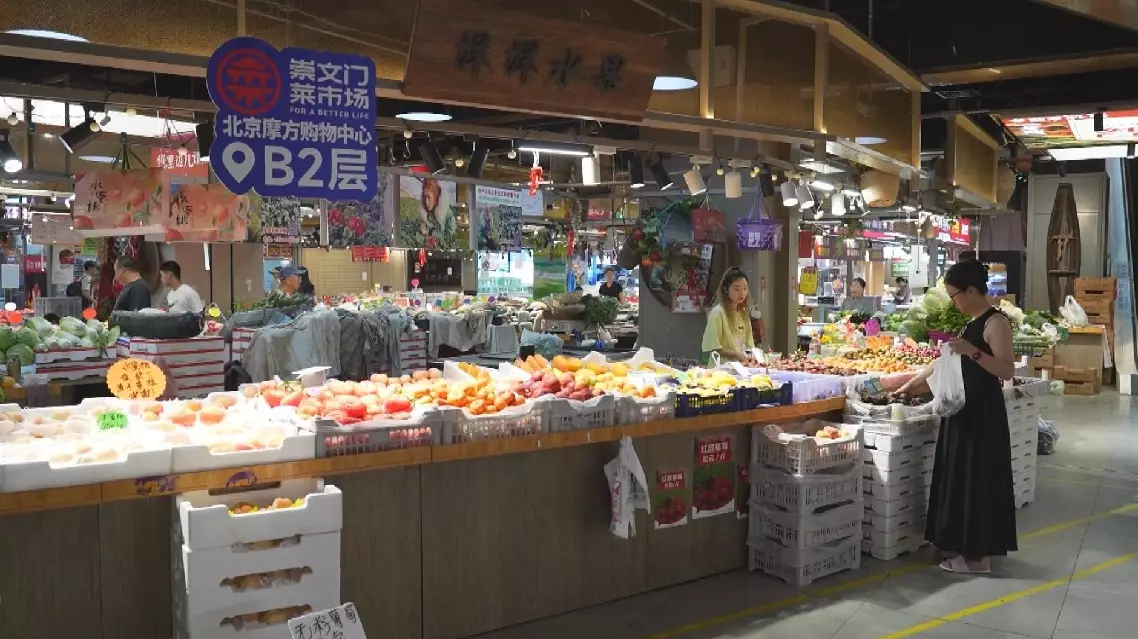
A traditional wet market in Beijing has undergone trendy makeovers to reconnect with the community and revive the familiar flavors and atmosphere that locals have cherished for generations.
As summer heats up, Chongwenmen Market -- one of the oldest in Beijing -- has launched an outdoor night market, drawing both locals and tourists.
After a 15-year absence, the historic site has made a triumphant return to its original location. The revitalized space preserves the authentic charm of old Beijing’s neighborhood culture while blending in contemporary design elements.
With its traditional counter-style service, vintage lightbox signage, and nostalgic slogan displays, the market offers a rich, multi-layered shopping experience that resonates with both longtime patrons and first-time visitors.
"When I was a child, residents from the neighborhood would line up here to buy vegetables, meat, and fish when the Spring Festival came around. Chongwenmen Market has always held a special place in our hearts. Now it's much bigger than before. As soon as it opens in the morning, elderly men and women rush in to buy tomatoes, cucumbers, and other vegetables. Prices are quite good. For example, high-quality salted duck eggs are only one yuan each (about 0.14 U.S. dollars). I bought 1.5 kilograms this time. The atmosphere here is really nice," a customer said.
The barbecue skewers remain an unforgettable flavor memory for loyal customers. Since the renovation, the popular stall has expanded its space and introduced new varieties, but the one thing that hasn't changed is that iconic original taste.
"Many people say they used to eat here when they were young and often come to eat here to relive the original taste," said Ma Jinghuai, the man behind a popular skewer stall.
"I can sell at least 150-160 barbecue skewers a day, and even more on weekends. Among old markets, Chongwenmen Market already had a reputation. The name itself attracts people here. But ultimately, your food has to win people over. If they think it tastes good, they’ll come back a second or third time, and eventually become regulars," he said.
Although new to the market, some tenants have already built their customer base. One of them is Liu Fugui, who has traded store reviews for running his own stall, and thanks to savvy use of social media, her products are now reaching customers across China.
"I used to be a self-media content creator, mainly doing store visits. Now I run my own small shop and promote it on platforms like WeChat, Kuaishou, and Douyin. At one point, one of my videos gained over 600 followers in a single day. I've shipped orders to Hangzhou, Chengdu, and even northeast China. The audience for new media is no longer limited to just young people; it spans everyone from kids to the elderly. As long as you identify which demographic your product appeals to, there will be a market for you," said Liu.
Traditional market in Beijing gets trendy makeover, rekindles community spirit
The Strait of Hormuz, one of the world's most important energy shipping routes, is fully open to commercial vessels, the U.S. and Iran confirmed separately on Tuesday after negotiators from the two countries, under Qatari and Pakistani mediation, concluded the first round of talks in central Switzerland.
The developments came a day after mediators announced encouraging outcomes from the first round of indirect U.S.-Iran talks in Switzerland, including a 60-day roadmap toward a final agreement and mechanisms to ensure commercial shipping security through the strait and end hostilities in Lebanon.
U.S. and Iranian negotiators began their talks on Sunday at the Buergenstock mountain resort in central Switzerland, marking the first direct talks between the two sides since the signing of the Islamabad Memorandum of Understanding (MoU) last week.
According to the MoU, the United States and Iran declare an immediate and permanent termination of military operations on all fronts, including in Lebanon, and commit to negotiating and achieving the final peace agreement in maximum 60 days.
Ali Bahreini, Iranian ambassador and permanent representative to the United Nations (UN) Office at Geneva, announced on Tuesday that the Strait of Hormuz is fully open to commercial vessels without tolls.
He said the two sides have decided to set up a communication line to ensure the safe passage of commercial ships through the Strait of Hormuz.
Bahreini said that the situation will be reviewed after 60 days, depending on negotiations between Iran and the United States.
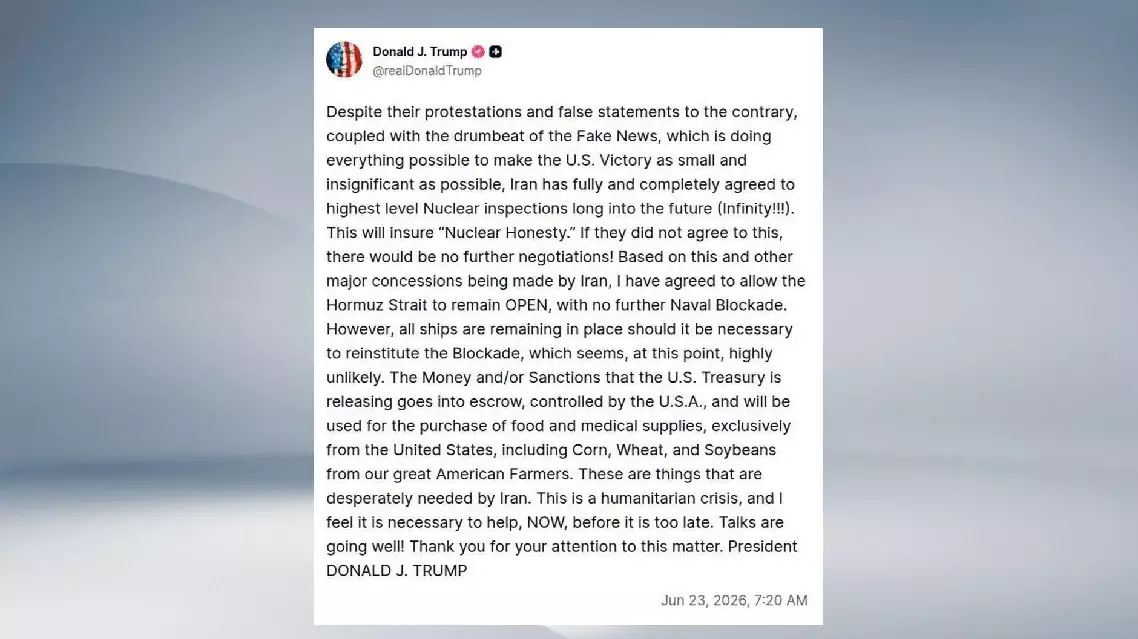
Separately, U.S. President Donald Trump said on a social media post the same day that given "major concessions" by Iran, including Iran's consent to the highest-level nuclear inspections, the U.S. will "allow the Hormuz Strait to remain open, with no further blockade."
Iran and Oman issued a joint statement on Tuesday affirming their commitment to ensuring safe passage through the Strait of Hormuz, stressing that all arrangements relating to the waterway "must fully respect their sovereignty and sovereign rights."
The two countries agreed to continue discussions through a joint working team between their foreign ministries to reach an understanding on the future management of navigation in the strait and the related charging service "costs," read the statement.
Beyond the political statements, data from maritime analysts confirmed the resurgence in traffic through the Strait of Hormuz.
Shipping analytics firm Kpler reported that at least 36 commercial vessels transited the strait on Monday, the highest single-day tally since the war began last February, signaling that traffic had rebounded to nearly one-third of the strait's normal peacetime traffic, which averages around 120 vessel crossings per day.
On Tuesday, two more supertankers that had been stranded in the Persian Gulf sailed through the waterway, each loaded with 2 million barrels of crude, according to data from the London Stock Exchange Group and Kpler.
Before the conflict, more than one-fifth of global oil and liquefied natural gas moved through the waterway, which is also important for grain and consumer goods shipments into the Gulf.
Despite the tangible progress on maritime access, the U.S. and Iran remain at odds on key elements of the broader deal, issuing conflicting accounts over whether Iran has agreed to full IAEA nuclear inspections and how unfrozen Iranian assets may be used.
Iran, US separately confirm Strait of Hormuz reopened to commercial shipping