Peru's Chancay Port, a flagship project under China’s Belt and Road Initiative, has not only enhanced bilateral trade, but also benefited broader South American markets through efficient operations, secured by Chinese expertise that leverages advanced digital technologies to optimize port operation.
At the first smart and green port in South America, driverless trucks and automated cranes work in sync, while big data and AI generate optimal loading plans within three minutes.
"(This system) excels at solving complex tasks by breaking them down and assigning them to peripheral systems. It reduces yard rehandling and onboard reshuffling rates, shortening operations and boosting efficiency," said He Bo, executive deputy general manager of COSCO Shipping Ports Chancay Peru.
Located about 78 kilometers north of the capital Lima, the port officially opened in 2024 and has quickly gained momentum. In the first half of 2025, Chancay Port handled 117,000 TEUs (twenty-foot equivalent units), achieving stable operations across three main and three feeder routes.
"We have brought China's advanced technologies and equipment to Chancay and introduced numerous innovations that were implemented for the first time in Peru and even South America. Continuous introduction (of technologies) and localized application have secured the high-quality development of Chancay Port," said Wang Lei, general manager of the information development department of COSCO SHIPPING Ports Limited.
With a total length of 1,500 meters and four berths, the port is capable of handling ships carrying up to 18,000 TEUs. It is projected to process 1 million TEUs annually, with the capacity to scale up to 1,500,000 TEUs in the long run.
Chinese engineers have not only brought advanced technologies, but also trained over 700 local workers by June.
"Thanks to the daily training and guidance provided by those specialists, we have been able to keep learning and correctly mastered the skills," said Andrea, a staffer of Chancay Port.

Chinese expertise secures efficient operation of Peru's Chancay Port
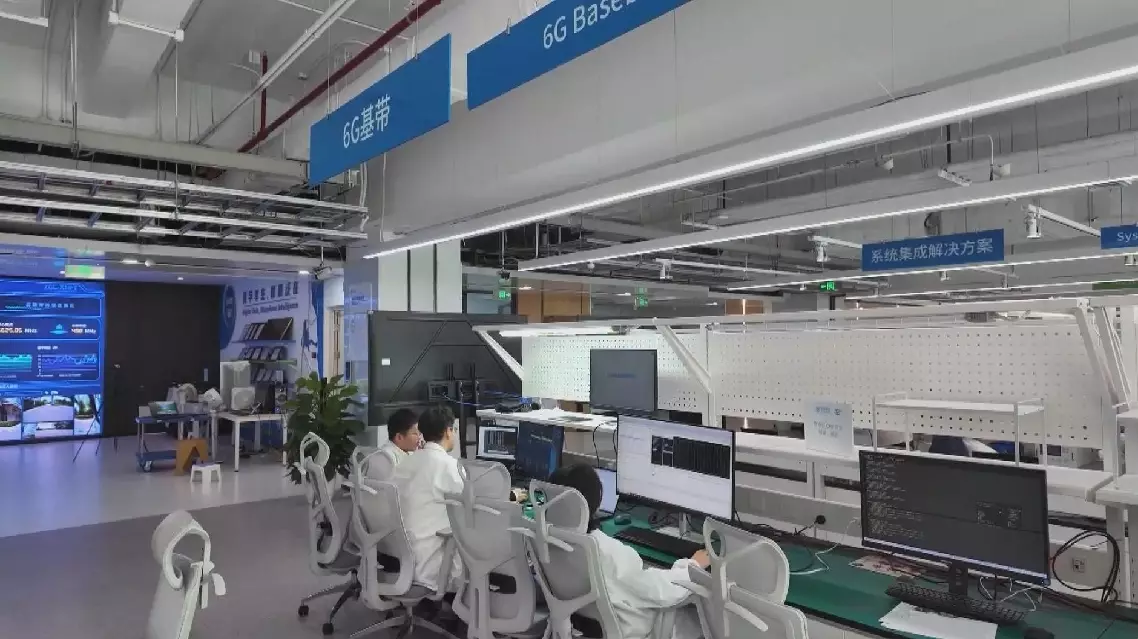
China's approval of the 6GHz band trial spectrum for 6G application will promote development of the 6G technology from laboratories to real-life scenario applications, marking another step forward in next-generation telecommunications, industrial experts say.
China's Ministry of Industry and Information Technology (MIIT) officially approved the trial spectrum in the 6GHz band for 6G technology development on May 8, signifying that China has taken a step forward in next-generation telecommunications.
The approval, granted to the IMT-2030 (6G) promotion group, authorizes 6G technology trials in selected regions. The move is aimed at advancing technical research, testing and validation based on the key scenarios and performance indicators defined by the International Telecommunication Union for 6G.
According to MIIT officials, the 6G will face the development trend of technological integration and rapid evolution, such as the integration of space, air and ground, the integration of communication and intelligence, and the integration of communication and sensing. Therefore, it has put forward higher requirements for spectrum resources, such as continuous large bandwidth and wide coverage across the entire region.
"The 6GHz band is a scarce, high-bandwidth, high-quality resource in the mid-band, offering advantages such as wide coverage, large capacity and high reliability. Furthermore, this band is highly compatible with the existing 5G mid-band industry ecosystem, allowing it to fully leverage a mature global industry base, effectively reducing network deployment and construction costs in smooth transition from the 5G to the 6G," said Wang Tan, director of the frequency planning division of the radio administration bureau under the MIIT.
Following this approval, 6G technology research and development will gradually move from laboratory simulation and indoor prototype testing to real-world scenarios such as cities and industries to complete performance verification, according to MIIT officials.
"The approval is conducive to integrating the efforts of industry, academia, research and application, leading domestic industrial forces to make early arrangements for key links such as 6G chips, terminals and instruments, and accelerating the maturity of the industrial chain," Wang said.
China has commenced the second phase of 6G technical trials following the completion of the first phase from 2022 to 2025, which had yielded a reserve of over 300 key 6G technologies, and industry experts generally expect the 6G to be officially commercialized around 2030.
"In general, the 6G development roadmap and technical framework are relatively clear. According to international consensus, our standardization process will complete the first version of the 6G standards in about two years. Technical standards are generally upgraded once every 18 months. After another one to two years, we will have commercially available products," said You Xiaohu, an academician with the Chinese Academy of Sciences.
China's approval of 6G trial spectrum to accelerate real-life applications: experts