China's successful tests of its new-generation heavy-lift rocket and next-generation manned spacecraft mark a significant step forward for the country's crewed lunar program, space technology experts say.
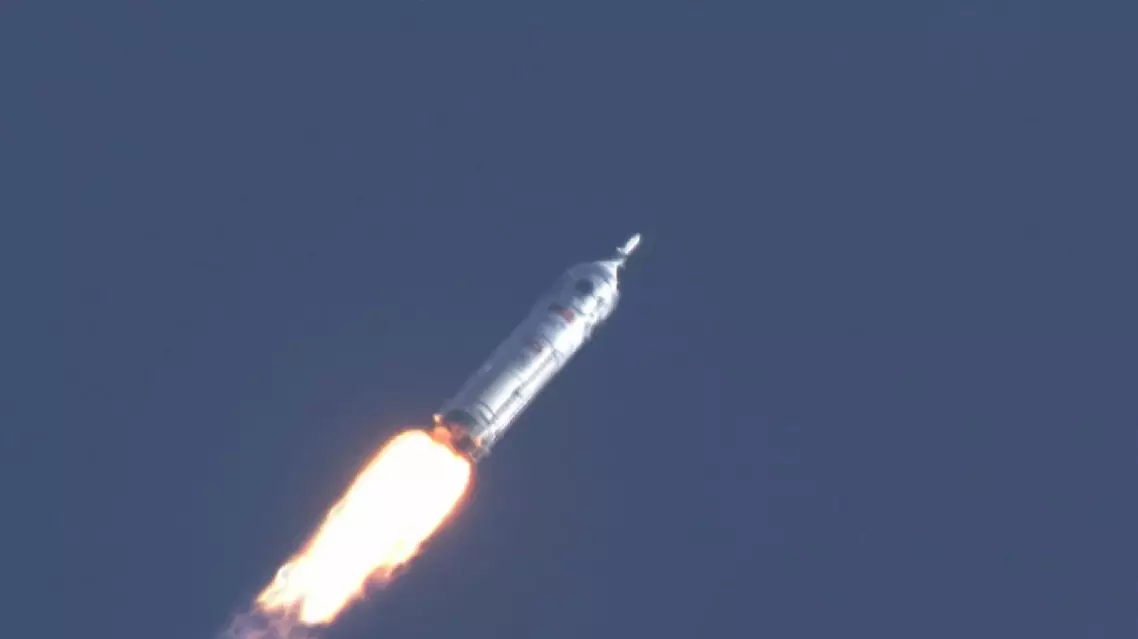
A low-altitude demonstration and verification flight test for the Long March-10 carrier rocket and a maximum dynamic pressure abort flight test for the new-generation crewed spaceship system Mengzhou are successfully conducted at the Wenchang Spacecraft Launch Site in south China's Hainan Province on Wednesday.
It was the first ignition flight of the Long March-10 rocket, and saw the spacecraft power through Max Q -- the most dangerous phase of ascent, when aerodynamic stress reaches its peak.
Both the return capsule and the rocket's first stage landed in their designated recovery zones.
It was also the first completion of a sea landing and recovery of Mengzhou's return capsule, which will bring China's spacefarers back to earth.
Mengzhou, which means "Dream Vessel" in Chinese, is designed mainly for China's crewed lunar exploration but can also be used for space station operation. Its return capsule is capable of multiple reuses.
"We have successfully achieved a soft splashdown and retrieval from the sea. This marks a crucial and significant breakthrough in China's reusable carrier rocket technology and will also greatly promote the upgrading of China's carrier rocket technology," said Wang Zhifei, a researcher at China Aerospace Science and Technology Corporation.
Zhong Wen'an, who works at the Wenchang Spacecraft Launch Site, said the mission laid a foundation for China to advance its crewed lunar exploration program.
"This laid the foundation for completing verification flights for the crewed lunar exploration program, and eventually, lunar landings. Efforts to build the equipment and facilities required for a comprehensive launch and test system are progressing as planned. It is estimated that by the end of this year, China will fully achieve testing and launch capabilities for the crewed lunar exploration program," said Zhong.
Zhou Jianping, chief designer of China's manned space program, underscored the significance of Wednesday’s successful tests.
"This was a highly significant flight test, especially the retrieval technologies, which are entirely new to us. Achieving success on the very first attempt represents a leapfrog development," said Zhou.
Experts hail China’s successful tests of heavy-lift rocket and manned spacecraft