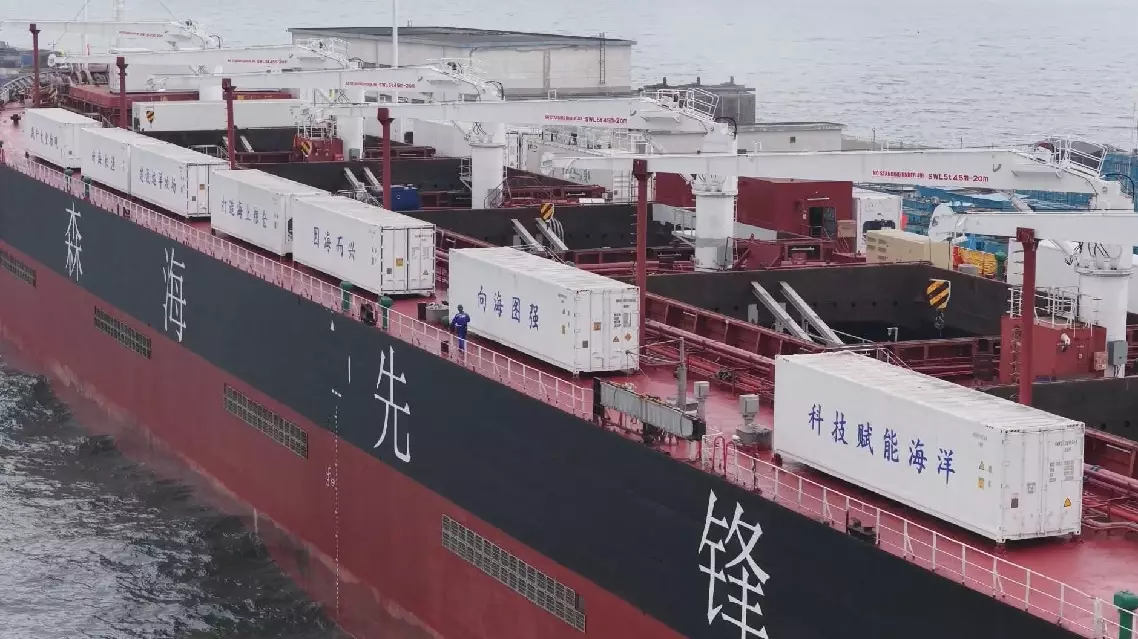
A large ocean-going open-sea aquaculture vessel, the first of its kind in the world, was delivered on Sunday in Qinhuangdao City of Hebei Province in north China.
The vessel, named Senhai Pioneer, measures 224.9 meters in length, 32.2 meters in width, and 18.5 meters in depth, with seven aquaculture tanks which could hold a total of nearly 80,000 cubic meters of water.
Converted from a 70,000-ton class ocean-going merchant ship, the vessel's patented open-sea design transforms it into a large "hard-shell net cage". The 18.5-meter deep hull contains seven "breathing aquaculture tanks" with water capacity equivalent to 42 standard swimming pools.
Unlike closed aquaculture vessels, it is capable of resisting storms while featuring an intelligent aquaculture system and innovative natural water exchange technology.
The vessel can cultivate cold-water and warm-water economic fish species such as Atlantic salmon, yellow croaker, and groupers. By operating in different northern and southern fishing grounds, it allows efficient year-round aquaculture across three seasons.
"This represents a special vessel type pioneered by China, offering the world a new Chinese solution for deep-sea aquaculture. It serves as an important initiative for China's marine industry to implement the 'big food concept,' facilitate the transformation from old to new growth drivers, develop new quality productive forces, and achieve green, high-quality development," said Pan Ying, a senior engineer at Shanghai Rules and Research Institute of China Classification Society, developer of the vessel.
New aquaculture vessel delivered in Hebei
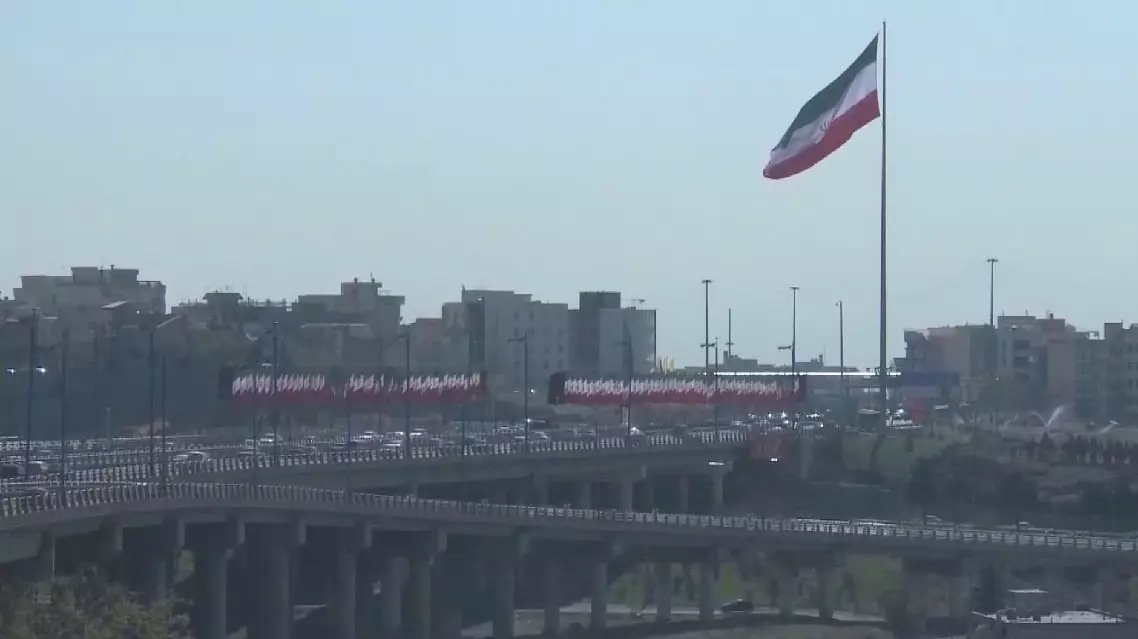
Iranian Parliament Speaker Mohammad Baqer Qalibaf warned on Sunday that Tehran would view the United States and Israel's military bases and facilities in the Middle East as "legitimate targets" should Washington take military action against Iran.
At a parliamentary session convened to review an emergency proposal on assembly regulations, Qalibaf emphasized that, at this highly sensitive juncture, Iran must accurately and thoroughly identify the schemes of its adversaries.
Qalibaf said that Iran is currently confronting Israel and the United States simultaneously on four fronts: economic, cognitive, military, and counterterrorism. Of them, the economic warfare and the cognitive and psychological warfare began many years ago and have persisted to this day, growing increasingly complex and intense in recent years.
The remarks came as U.S. President Donald Trump is reportedly "seriously considering authorizing a strike" against Iran, taking advantage of its nationwide unrest.
Protests have erupted in several Iranian cities since late December over the sharp fall of the rial and long-standing economic hardship. Iranian authorities have acknowledged the demonstrations and voiced willingness to address economic grievances, while warning against violence and vandalism.
Amid the ongoing protests, deadly clashes have been reported lately between police and what the government described as "rioters." However, no official death toll has been released.
Also on Sunday, Iran's semi-official Tasnim news agency reported that Iranian President Masoud Pezeshkian will address the country's economic situation and political environment in a televised interview later that day.
Iran swears to counterattack if attacked