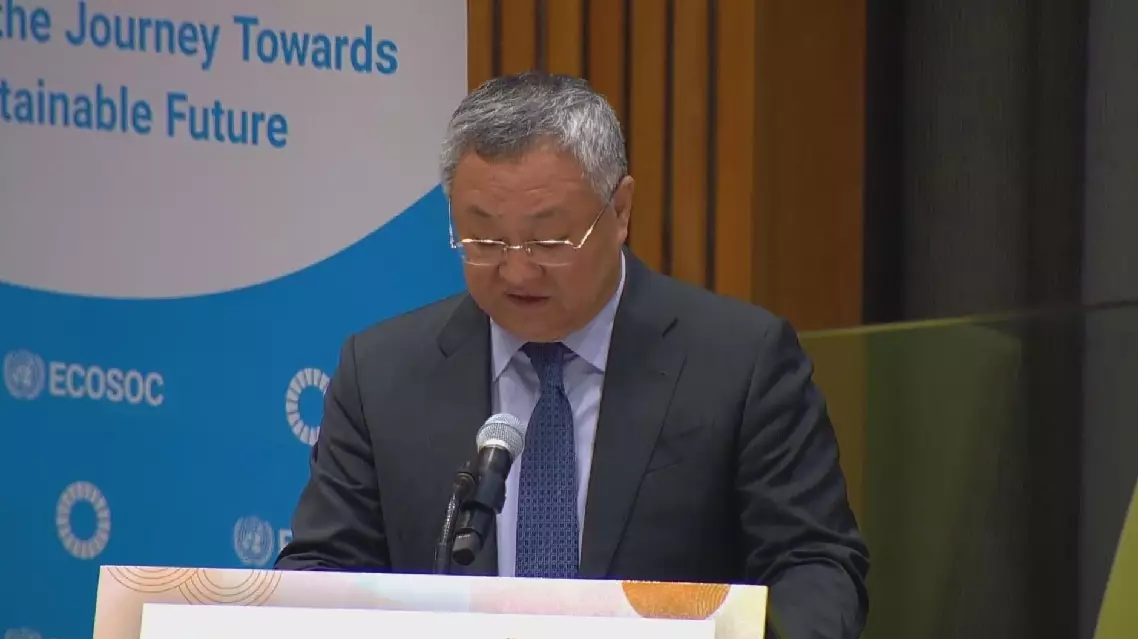
China's permanent representative to the United Nations (UN) Fu Cong warned against unilateral protectionist measures during the general debate at the 2025 UN High-Level Political Forum on Sustainable Development on Monday.
Speaking on behalf of the 83 member states of the Group of Friends of the Global Development Initiative, Fu stated that such measures, including tariff impositions, are undermining progress toward the Sustainable Development Goals (SDGs).
Fu highlighted serious delays in implementing the 2030 Agenda for Sustainable Development, with widening financing gaps and growing unilateralism threatening multilateral cooperation. He called on the international community to uphold multilateralism, strengthen solidarity, improve global economic governance, and revitalize momentum for achieving the 2030 Agenda.
"The (UN Development) Group is deeply concerned about the increasing unilateral protectionism measures, including the imposition of tariffs, which are undermining the achievement of SDGs. The international community must recommit to the rule-based multilateral trading system and eliminate these measures. We reiterate as well our call to remove all unilateral coercive measures that impede the full achievement of economic and social development, particularly in developing countries," said Fu.
The Chinese envoy emphasized that development should remain at the core of the UN agenda. Facing multiple challenges, especially the multidimensional difficulties of developing countries, Fu stressed that achieving common development and mutual benefits should become a shared goal for all nations.
China calls for end to unilateral protectionism at UN development forum
South China's Guangdong Province is promoting bird-friendly netting in agricultural fields to protect migratory birds while safeguarding farmers' livelihoods.
Since the beginning of this month, nearly 130,000 migratory birds have arrived in Guangdong, using the region's farmlands, orchards, and fishponds as natural feeding grounds.
This has led to significant crop damage for local farmers.
"Sometimes, over 100 birds descend on our fields. They completely ruin the vegetable leaves, making them unfit for human consumption," said Zhong Jinchuan, a farmer from Huidong County in the province's Huizhou City.
As it is the peak season for winter vegetable planting, many farmers have erected simple anti-bird netting in their fields to protect their crops. However, these nets often pose serious risks to wildlife.
"Once erected, birds could only see the poles. The netting itself isn't always easily visible. If birds fly into it, their claws, feathers, and beaks can become entangled, causing them serious injury," said Li Yi, an official with the Forestry Bureau of Huizhou City.
Recognizing the challenge, local authorities have replaced these harmful nets with safe, bird-friendly alternatives. These new nets feature thicker cords and smaller mesh sizes, which deter birds without trapping them.
"This net uses thicker cords and has smaller mesh openings, so when birds hit it, their feet don't get caught. They just bounce off and fly away. Our vegetables stay safe, and the birds aren't harmed either," said Zhong.
Guangdong has also introduced policies to compensate farmers for crop losses caused by protected wildlife, including migratory birds.

Guangdong promotes bird-friendly netting to protect migratory birds, farm fields