Startup companies in the United States have been engaged in fierce competition to seek artificial intelligence talents as tech giants like Meta have increased investments in hiring top AI researchers from across the world.
U.S. media have widely reported that Meta CEO Mark Zuckerberg spent months putting together a list of top AI researchers from across the globe to target for poaching and hiring. They're reportedly being offered pay packages of up to 100 million dollars.
For young and aspiring scholars in the field, those figures are spurring excitement.
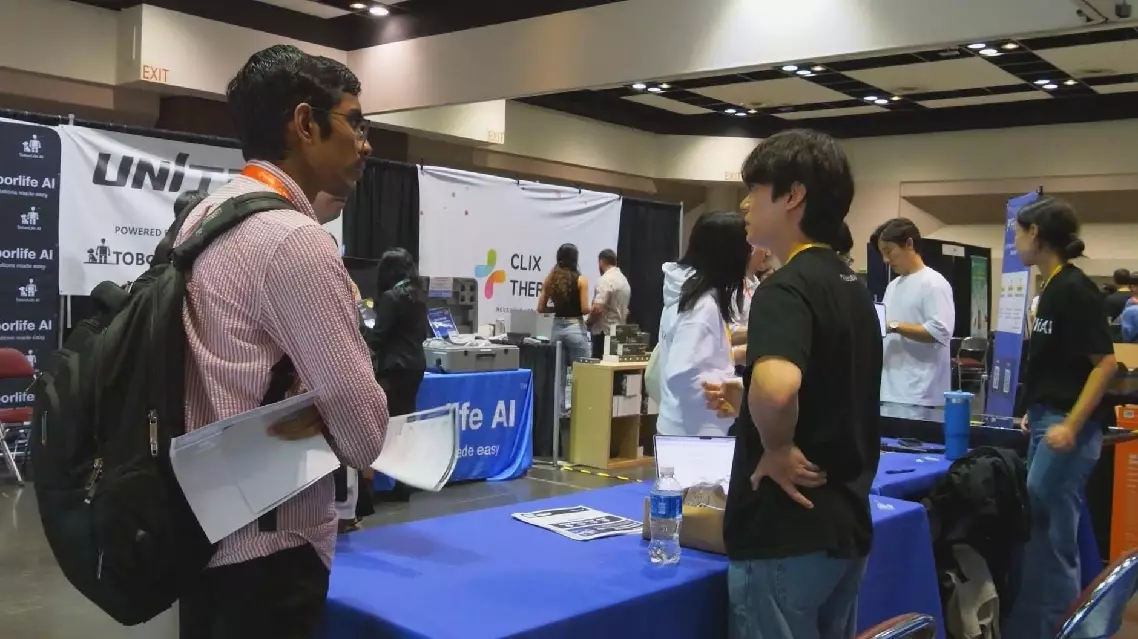
"AI researchers, they are very popular right now. You see, like Meta -- they are offering ridiculous amount of package to top AI researchers," said Kai Zou, a PhD Student in AI, as he attended the GenAI Week 2025 Silicon Valley.
"If you look at a professional athlete like NBA and NFL, they also get paid tons of money. They are like the top players in their domains. I do feel like (in the) AI domain, if you're a top player, I would not say it's overcompensating. I would say it's just the nature of the market," Zou added.
As Meta raises the cost to hire, some analysts said that startups, one of the key generators of AI innovation, will feel the talent squeeze.
"It's definitely getting difficult to find really good, smart people that actually goes with the vision and everything. So, it's not just the money sometimes. And for a startup, it's going to be a little bit tough to fight with the big boys that are paying millions and millions," said Elvin Siew, founder and CEO of Avio Health.
Other entrepreneurs in the field, however, believe there is still scope for smaller companies to bring in capable AI engineers and experts.
"You could be a small fish in a big pond, as in a big company. Or you could be a big fish. You can establish yourself as a thought leader and a leader in general at a small company. So, there is still a scope for smaller companies to attract talent," said Hemant Joshi, chief technological officer of FloTorch.
Meanwhile, Meta has already managed to poach top talent from competitors like Apple, Google, and OpenAI.
"I think that's actually a key to their success, because often times people don't look at systems from a holistic standpoint. And so, if you don't have people that come in with different ways of thinking or different ways of studying, then you're missing things because you're building tools for the world," said Cloud Force, owner of Cloud Force Unlimited.
With the AI race still in its early stages, many experts say there's no way to predict if Meta's AI spending spree will produce revolutionary breakthroughs with long-term value.
Startups feel talent squeeze as Meta ramps up AI spending spree
A former television host from Taiwan, Zhai Xuan, has made a pivotal decision to leave mainstream broadcasting in order to create content that provides a better understanding of the Chinese mainland and cross-strait relations.
Zhai, a seasoned television host with over a decade of experience in Taiwan's media landscape, recently addressed an audience at an event in Beijing, where she revealed her complete transition into independent online media.
In her remarks, she articulated her aspiration to bridge what she perceives as a significant information gap between audiences on both sides of the Strait, highlighting her commitment to fostering a deeper understanding and connection through her new endeavors.
"I was really surprised by all the fake news. There were stories saying people on the mainland can't afford tea eggs or that they live in mud houses and in Taiwan, this was the main information many people received," said Zhai.
Zhai said she initially began producing online videos to challenge such perceptions while continuing her work as a television host.
In April 2025, she travelled to the mainland with her father to fulfill her late grandfather's wish to return to his hometown. The trip, which reunited family members separated since 1949, was recorded in a video series titled "Journey to Find Our Roots", drawing attention from viewers in both Taiwan and the mainland.
"Many people in Taiwan told me that after watching, they wanted to apply for a mainland travel permit immediately and go looking for their relatives. Some had long forgotten these things, but after seeing my story, they began thinking about their hometowns and family members they had never met and decided to search for their roots," Zhai shared her story at the event.
By mid-2025, Zhai said she began to feel increasing pressure amid rising political tensions and a tightening atmosphere around cross-Strait exchanges in Taiwan.
After more than 12 years in the industry, Zhai resigned from her position, believing it was the right thing to do.
"At that moment, I felt this was a major issue,not just for me, but for Chinese people on both sides of the Strait. If I backed down then, I wouldn’t be standing on the right side," said Zhai.
Since leaving television, Zhai has broadened her online programming to encompass a range of daily-life topics, including practical guidance on applying for a mainland travel permit and using commonly employed mobile applications, in addition to content that delves into historical memory and cultural connections across the Strait.
As the debate over cross-Strait relations continues in Taiwan, Zhai said she remains committed to her current path.

Former Taiwan TV host bridges cross-Strait divide via online media