DHAKA, Bangladesh (AP) — Opener Sahibzada Farhan struck a brilliant fifty as Pakistan thrashed Bangladesh by 74 runs in the third and final T20 on Thursday to prevent a series sweep for the hosts.
Farhan’s 63 runs off 41 balls, with six fours and five sixes, helped Pakistan post a respectable 178-7 after it was asked to bat first in the Dhaka suburb of Mirpur.
Pakistan new-ball bowlers Salman Mirza (3-20) and Faheem Ashraf (2-13) then caused the damage as Bangladesh slumped to 41-7 inside the eighth over.
No. 8 batter Mohammad Saifuddin, one of the five changes of the side from the previous match, hit an unbeaten 35 to guide the side past 100.
Bangladesh was out for 104 in 16.4 overs. Left-arm spinner Mohammad Nawaz took 2-4.
Bangladesh won the series 2-1. It won the first T20 by seven wickets and the second match by eight runs for its first T20 series win over Pakistan.
Farhan and Saim Ayub (21) gave Pakistan a solid start, unlike the first two matches, with 82 runs in almost eight overs.
Farhan raised his fifty from 29 balls.
Left-arm spinner Nasum Ahmed (2-22) broke through with the wicket of Ayub, and then dismissed Farhan who holed out to midwicket after trying for a slog-sweep six.
Fast bowler Taskin Ahmed, who was inconsistent in his first spell, came back to dismiss Mohammad Haris and led the middle overs bowling to stifle Pakistan and finished with 3-38.
Hasan Nawaz had a flurry of sixes before pacer Shoriful Islam baffled him with a slower delivery to end his 17 ball-33.
Mohammad Nawaz hit 27 off 16 and led Pakistan to a strong finish before being removed by Taskin in the last over.
Bangladesh’s chase never took off with five of their top seven batters out for single digits.
Saifuddin helped Bangladesh go past their lowest score of 70 against West Indies in 2016 and eventually 100.
AP cricket: https://apnews.com/hub/cricket
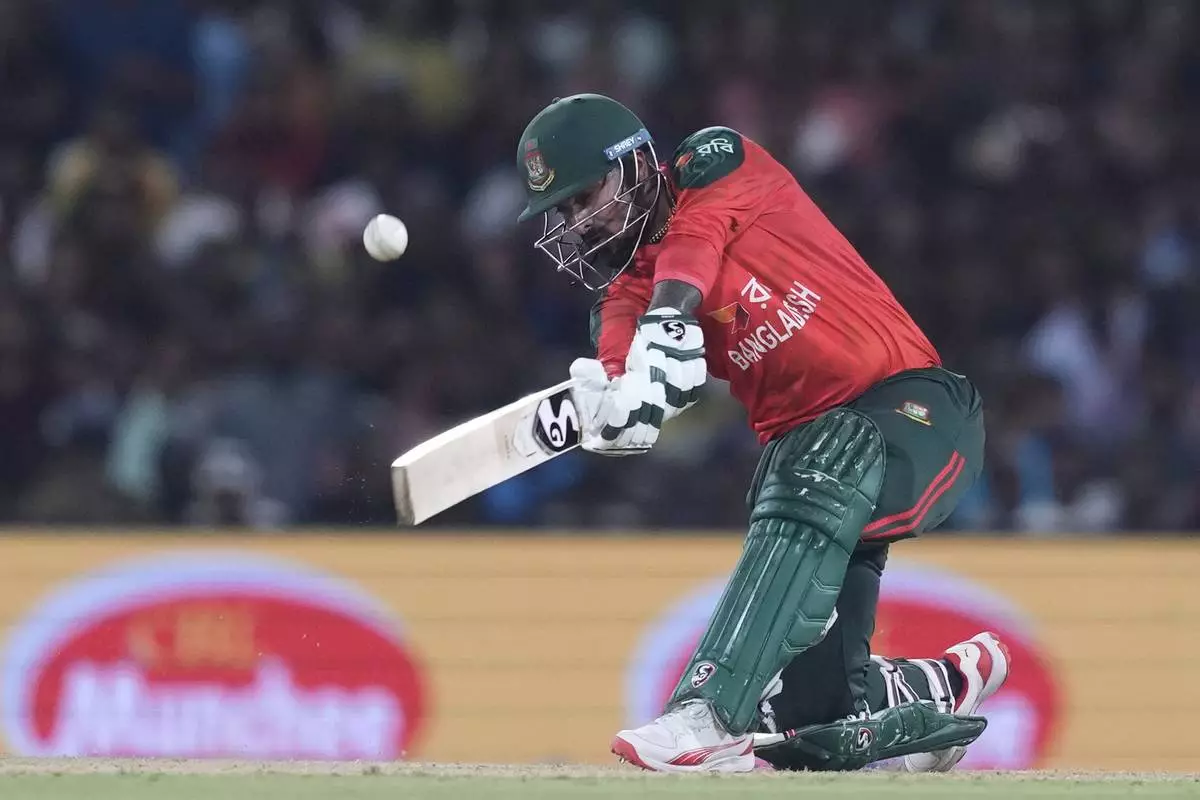
FILE - Bangladesh's Litton Das plays a shot during the second Twenty20 cricket match between Sri Lanka and Bangladesh in Dambulla, Sri Lanka, July 13, 2025. (AP Photo/Eranga Jayawardena, file)
THE HAGUE, Netherlands (AP) — Myanmar insisted Friday that its deadly military campaign against the Rohingya ethnic minority was a legitimate counter-terrorism operation and did not amount to genocide, as it defended itself at the top United Nations court against an allegation of breaching the genocide convention.
Myanmar launched the campaign in Rakhine state in 2017 after an attack by a Rohingya insurgent group. Security forces were accused of mass rapes, killings and torching thousands of homes as more than 700,000 Rohingya fled into neighboring Bangladesh.
“Myanmar was not obliged to remain idle and allow terrorists to have free reign of northern Rakhine state,” the country’s representative Ko Ko Hlaing told black-robed judges at the International Court of Justice.
African nation Gambia brought a case at the court in 2019 alleging that Myanmar's military actions amount to a breach of the Genocide Convention that was drawn up in the aftermath of World War II and the Holocaust.
Some 1.2 million members of the Rohingya minority are still languishing in chaotic, overcrowded camps in Bangladesh, where armed groups recruit children and girls as young as 12 are forced into prostitution. The sudden and severe foreign aid cuts imposed last year by U.S. President Donald Trump shuttered thousands of the camps’ schools and have caused children to starve to death.
Buddhist-majority Myanmar has long considered the Rohingya Muslim minority to be “Bengalis” from Bangladesh even though their families have lived in the country for generations. Nearly all have been denied citizenship since 1982.
As hearings opened Monday, Gambian Justice Minister Dawda Jallow said his nation filed the case after the Rohingya “endured decades of appalling persecution, and years of dehumanizing propaganda. This culminated in the savage, genocidal ‘clearance operations’ of 2016 and 2017, which were followed by continued genocidal policies meant to erase their existence in Myanmar.”
Hlaing disputed the evidence Gambia cited in its case, including the findings of an international fact-finding mission set up by the U.N.'s Human Rights Council.
“Myanmar’s position is that the Gambia has failed to meet its burden of proof," he said. "This case will be decided on the basis of proven facts, not unsubstantiated allegations. Emotional anguish and blurry factual pictures are not a substitute for rigorous presentation of facts.”
Nobel Peace Prize winner Aung San Suu Kyi represented her country at jurisdiction hearings in the case in 2019, denying that Myanmar armed forces committed genocide and instead casting the mass exodus of Rohingya people from the country she led as an unfortunate result of a battle with insurgents.
The pro-democracy icon is now in prison after being convicted of what her supporters call trumped-up charges after a military takeover of power.
Myanmar contested the court’s jurisdiction, saying Gambia was not directly involved in the conflict and therefore could not initiate a case. Both countries are signatories to the genocide convention, and in 2022, judges rejected the argument, allowing the case to move forward.
Gambia rejects Myanmar's claims that it was combating terrorism, with Jallow telling judges on Monday that “genocidal intent is the only reasonable inference that can be drawn from Myanmar’s pattern of conduct.”
In late 2024, prosecutors at another Hague-based tribunal, the International Criminal Court, requested an arrest warrant for the head of Myanmar’s military regime for crimes committed against the country’s Rohingya Muslim minority. Senior Gen. Min Aung Hlaing, who seized power from Suu Kyi in 2021, is accused of crimes against humanity for the persecution of the Rohingya. The request is still pending.

FILE - In this Sept. 7, 2017, file photo, smoke rises from a burned house in Gawdu Zara village, northern Rakhine state, where the vast majority of the country's 1.1 million Rohingya lived, Myanmar. (AP Photo, File)