LOUISVILLE, Ky.--(BUSINESS WIRE)--Jul 24, 2025--
Doe-Anderson, the nation's oldest employee-owned advertising agency, proudly announced today it has been named "Best Agency Culture Silver" at the 2025 Ad Age Small Agency Awards in Toronto. This award recognizes the agency's commitment to fostering a workplace where employees thrive and are empowered to do their best work.
This press release features multimedia. View the full release here: https://www.businesswire.com/news/home/20250724225145/en/
The Ad Age Best Agency Culture awards acknowledge agencies that nurture talent and create the space for bold, meaningful creativity, while providing meaningful benefits and a focus on employee well-being. Doe-Anderson's win highlights its unique approach to talent retention and community impact.
"In an era when agencies across the country are competing harder than ever for talent, retention, and relevance, culture is more important than ever," said John Birnsteel, EVP, Chief Executive Officer of Doe-Anderson. "This recognition affirms that the steps we’re taking to build an agency where people can show up as their authentic selves—and do their best work—are making a real impact."
Doe-Anderson's culture is distinguished by several key initiatives and benefits:
High Retention Rates: The independent agency achieved a 6% staff turnover rate in 2024, significantly lower than the industry average, with an average employee tenure three times the industry norm. This continuity ensures clients work with deeply knowledgeable and collaborative teams.
Employee Ownership: As a 100% employee-owned agency, over half of Doe-Anderson's current employees hold shares in the company, allowing them to collectively guide its long-term vision.
DEI Commitment: Doe-Anderson actively prioritizes diversity and inclusion, most recently evidenced by co-founding the University of Louisville's Multicultural Marketing program in 2024.
Work-Life Balance: Employee well-being is paramount, with a hybrid work model, four "Work From Anywhere" weeks per year, and two fully paid agency-wide "Recharge Weeks."
Community Engagement: As a newly certified B Corp, Doe-Anderson demonstrates a transparent standard of sustainability and inclusivity. Initiatives include the "All Hands" pro bono program providing pro-bono marketing services to Black-owned small businesses and a tree-planting effort in underserved neighborhoods.
This recognition underscores Doe-Anderson's philosophy of "Work. People. Love." The agency believes that great creative work stems from brilliant people who are passionate about what they do and where they do it.
Doe-Anderson works with iconic brands including Maker's Mark, Jim Beam, and Louisville Slugger bats and equipment. Client partners also include Georgia Aquarium, Carrier, Roto-Rooter, and several healthcare and financial sector brands. Doe-Anderson has 137 employees spanning offices in Louisville, KY and Columbus, OH. It offers integrated communication services including brand and digital strategy, creative execution, media buying and planning, analytics, digital design and development, content production and public relations. Founded in 1915, the agency is a Certified BCorp and is a member of AMIN Worldwide, a global peer group of independent agencies, and the American Association of Advertising Agencies (4As).

"Best Agency Culture Silver" at the 2025 Ad Age Small Agency Awards in Toronto. Left to right: Leyla Touma Dailey, John Birnsteel, Claire Tidmore
BRUGES, Belgium (AP) — The clatter of suitcases rolling over cobblestones, motorboats chugging along a canal and visitors chattering in a smattering of languages provide a soundtrack to Bruges that makes it clear you are in one of Belgium’s most touristic cities.
And yet, about two dozen women residents and visitors have found a hidden sanctuary from its bustle in a spot over a small bridge and under an ornate arch with an engraved Latin phrase “sauvegarde,” or “safe place” in English.
Nestled in a sea of yellow daffodils lies an oasis of calm and tranquility founded in 1245: the Princely Beguinage Ten Wijngaerde of Bruges.
For 22 years, Trees Dewever has called this beguinage her home. She said it provides "an overwhelming feeling of calm and I think we need that in this world.”
Her neighbor, 23-year beguinage resident Jo Verplaetsen, said the spirit of the medieval shelter is today soothing and social.
“Each day you are thankful to be here," she said.
However serene now, the beguinages emerged after the 12th century as an antidote to devastation.
Conflicts in the Middle Ages ravaged the male population, creating a glut of widows and single women who needed some kind of stability. They often chose the looser rules of the beguinages instead of stricter convents, said Michel Vanholder, a volunteer at the Grand Beguinage Church of Mechelen.
“They didn’t want to go become nuns but nevertheless they wanted to live together without men because there were not enough men to marry," he said.
Women who joined were called beguines, and while forbidden to marry while residing in the beguinages, they were allowed free egress, could own their own property and did not take religious vows of celibacy and poverty like nuns in adjacent convents.
“Women who didn’t want to become real nuns or religious could have an in-between form, becoming a beguine," said Brigitte Beernaert, who moved into the Bruges beguinage more than 20 years ago.
Women in the beguinage often worked caring for the sick and poor, but also earned money with needlework and weaving lace. Some plowed profits back into the community.
But the beguinages were at different times embraced and persecuted by the Vatican. One prominent beguine, the French Christian mystic Marguerite Porete, was condemned as a heretic and burned at the stake in 1310.
Novelists Ken Follett, Charlotte Brönte and Umberto Eco have written about the beguines and their male counterparts the beghards.
Architecturally, the beguinages were designed for like-minded women to live in comfort, quiet and safety, with small gardens tucked into either easily accessible alleys or around a main square with houses facing a common courtyard. The heart of the community was almost always a chapel or church.
Today, UNESCO recognizes as world heritage sites 13 beguinages in Flanders, the Dutch-speaking northern half of Belgium.
German tourist Biata Weissbaeker who was visiting Bruges with her husband Achim said that such spaces were and remain crucial.
“Women need a place like this: a safe place that gives them the possibility to go inside themselves.”
While the last beguine in Belgium, Marcella Pattijn, died in 2013 at the age of 92, the central tenet of the beguinage community has persevered over the past 800 years.
“Once you are in here, you are safe — that was of course literal in the Middle Ages, once you lived here, the law couldn’t take you away,” she said. “Today it’s more like a safe place for women alone.”
The beguinage of Bruges to this day still allows only women, although the grounds are now owned and maintained by the city itself, with residents renting from the city.
The beguinages of Belgium organize public activities hoping to foster community within through gardening, and outside through open houses.
A few of the Bruges residents recently planted raspberry bushes against the wall near the canal and they keep bee hives for honey. “The world is terrible for the moment, and this gives us the impression that it’s still safe here," said Beernaert. "This gives Bruges already a little bit of a small paradise, if you want. And living inside that paradise feels unbelievable.” —
Associated Press writer Sam McNeil in Brussels contributed to this report.
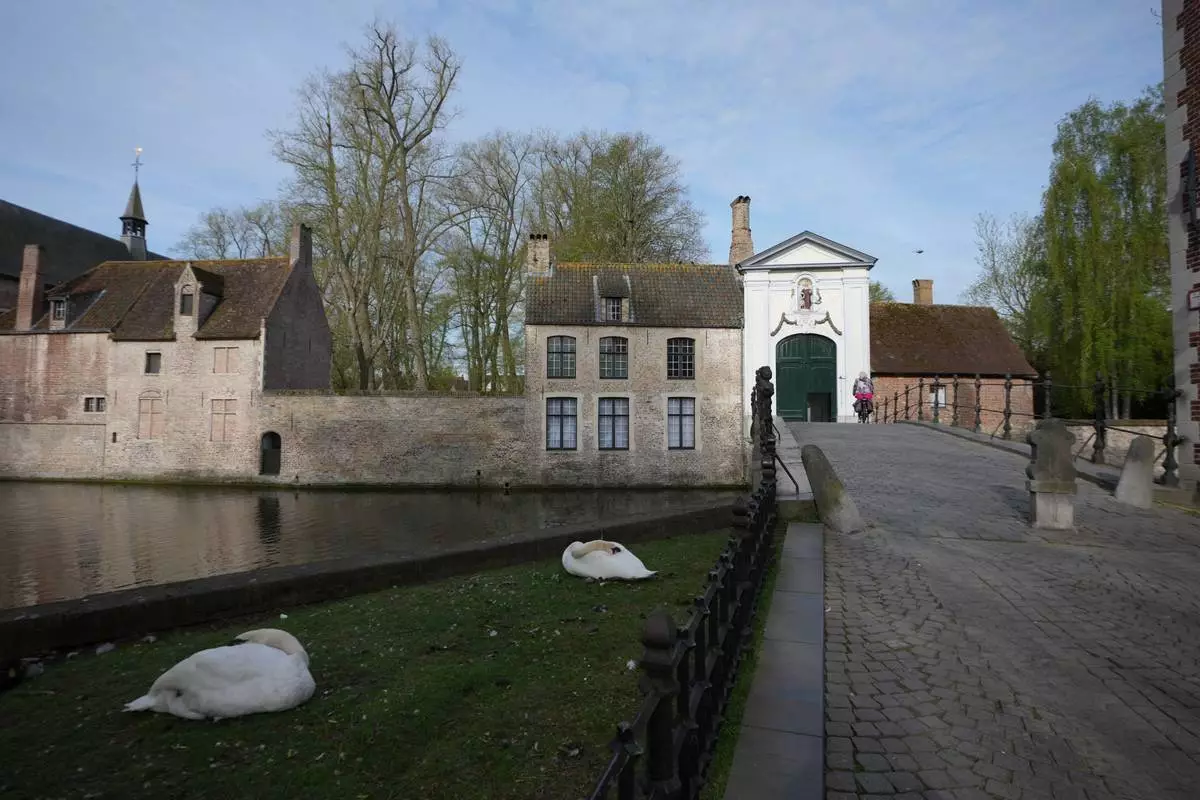
Swans sleep outside the gate of the Beguinage Ten Wijngaerde in Bruges, Belgium, Wednesday, April 15, 2026. (AP Photo/Virginia Mayo)
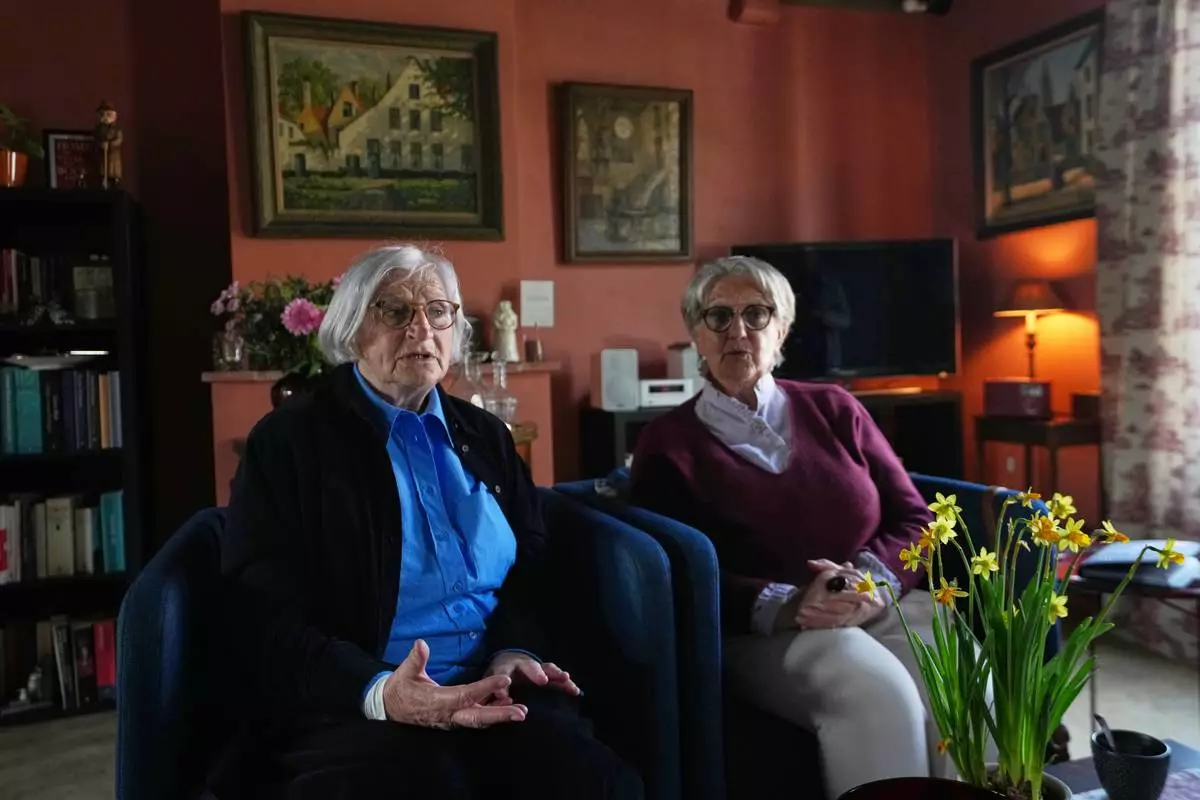
Brigitte Beernaert, left, and Jo Verplaetsen speak during an interview in a house inside the Beguinage Ten Wijngaerde in Bruges, Belgium, Wednesday, April 15, 2026. (AP Photo/Virginia Mayo)
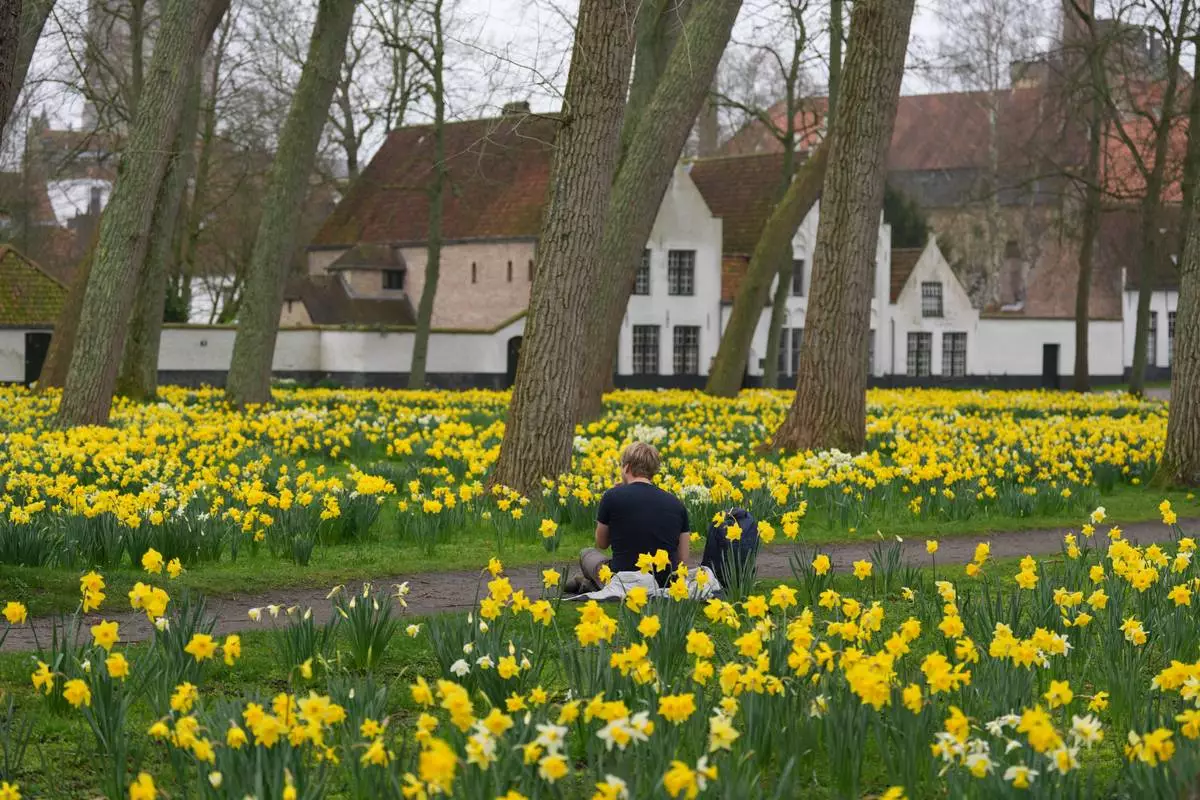
A visitor sits among the daffodils in the courtyard of the Beguinage Ten Wijngaerde of Bruges, Belgium, Tuesday March 10, 2026. (AP Photo/Virginia Mayo)