Skip to Content Facebook Feature Image

Guangdong, Hawaii join forces on agri-tech, climate solutions

China

China

China

Guangdong, Hawaii join forces on agri-tech, climate solutions

2025-07-25 17:28 Last Updated At:21:07

China's Guangdong Province and the U.S. state of Hawaii have joined forces on agricultural technology and climate resilience, aiming to tackle shared challenges through grassroots cooperation and innovation.

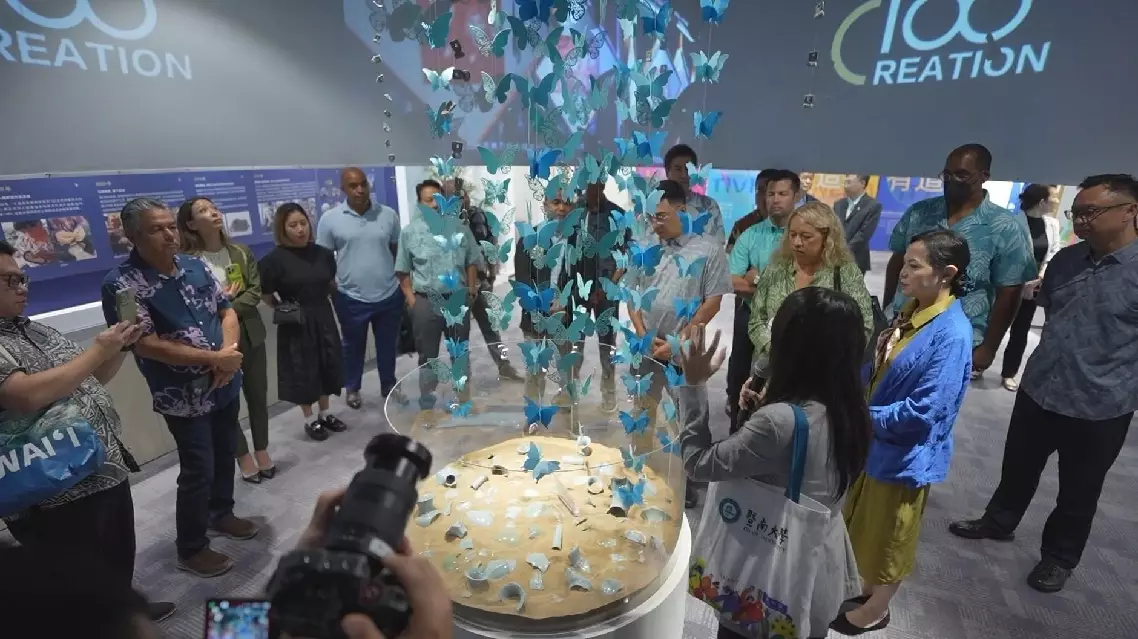
In south China's Guangdong Province, lawmakers from the U.S. state of Hawaii embraced state-level collaboration as a way to address shared global challenges. During a recent visit from Monday to Wednesday, the delegation explored how art, science, and policy can work hand in hand to create solutions with global impact.

At Jinan University in Guangzhou City, Hawaiian officials engaged with local educators and students to observe how cultural and academic bridges are being built through programs like the new "3+2" track, which will allow students to complete a bachelor's degree in China and a master's in Hawaii within five years.

Despite ongoing challenges in U.S.-China relations, members of the delegation emphasized that scientific cooperation remains essential.

"There's no doubt it's a difficult time for collaboration in some sectors and some partnerships. And I think at a scientist-to-scientist level, we've always collaborated. Politics come and go, but I think solving grand challenges in science and education will continue at a sort of person-to-person and student-to-student level," said Kevin Olival, professor at the University of Hawaii.

Food security was a key topic of discussion. With Hawaii importing the vast majority of its food supply, the state faces acute risks from global disruptions and natural disasters.

In response, Guangdong researchers are developing agricultural innovations from pest-resistant crops to smart farming technologies to drive both food and climate resilience.

"It's not just the large farmers, as the professor said, that we see in the continental U.S., where they have heavy, larger equipment, but you're going to have to coordinate the smaller farmers on the smaller acreage and leverage all their crops to build capacity," said Dane Wicker, official from Hawaii's Department of Business, Economic Development and Tourism.

The Hawaiian visitors also showed interest in Guangdong's value-added agricultural production practices, where food scientists help develop market-ready products before the industry even asks.

Hawaii State Senator Lynn Pualani DeCoite, who has a background in agriculture, said such innovations can inspire efforts back home.

"For us, it's always going to be the subsidizing, as we see the next generation more into the technology. At the end of the day, it's always been about feeding the world, through technology, through having options in what we grow. And research is a huge part of that," she said.

By advancing cooperation in food security and agricultural innovation, Guangdong and Hawaii are planting the seeds of sustainable trade and deeper trust across the Pacific.
Guangdong, Hawaii join forces on agri-tech, climate solutions

Guangdong, Hawaii join forces on agri-tech, climate solutions
A former television host from Taiwan, Zhai Xuan, has made a pivotal decision to leave mainstream broadcasting in order to create content that provides a better understanding of the Chinese mainland and cross-strait relations.

Zhai, a seasoned television host with over a decade of experience in Taiwan's media landscape, recently addressed an audience at an event in Beijing, where she revealed her complete transition into independent online media.

In her remarks, she articulated her aspiration to bridge what she perceives as a significant information gap between audiences on both sides of the Strait, highlighting her commitment to fostering a deeper understanding and connection through her new endeavors.

"I was really surprised by all the fake news. There were stories saying people on the mainland can't afford tea eggs or that they live in mud houses and in Taiwan, this was the main information many people received," said Zhai.

Zhai said she initially began producing online videos to challenge such perceptions while continuing her work as a television host.

In April 2025, she travelled to the mainland with her father to fulfill her late grandfather's wish to return to his hometown. The trip, which reunited family members separated since 1949, was recorded in a video series titled "Journey to Find Our Roots", drawing attention from viewers in both Taiwan and the mainland.

"Many people in Taiwan told me that after watching, they wanted to apply for a mainland travel permit immediately and go looking for their relatives. Some had long forgotten these things, but after seeing my story, they began thinking about their hometowns and family members they had never met and decided to search for their roots," Zhai shared her story at the event.

By mid-2025, Zhai said she began to feel increasing pressure amid rising political tensions and a tightening atmosphere around cross-Strait exchanges in Taiwan.

After more than 12 years in the industry, Zhai resigned from her position, believing it was the right thing to do.

"At that moment, I felt this was a major issue,not just for me, but for Chinese people on both sides of the Strait. If I backed down then, I wouldn’t be standing on the right side," said Zhai.

Since leaving television, Zhai has broadened her online programming to encompass a range of daily-life topics, including practical guidance on applying for a mainland travel permit and using commonly employed mobile applications, in addition to content that delves into historical memory and cultural connections across the Strait.

As the debate over cross-Strait relations continues in Taiwan, Zhai said she remains committed to her current path.

Former Taiwan TV host bridges cross-Strait divide via online media

Former Taiwan TV host bridges cross-Strait divide via online media

Recommended Articles