China's summer film market has been heating up gradually since July, with many cities launching promotions, including discount vouchers for movie screenings, to stimulate cultural consumption.
The country's summer box office revenue surpassed 4.7 billion yuan (about 657 million U.S. dollars) as of 11:56 local time on Saturday, according to data from online ticketing platforms.
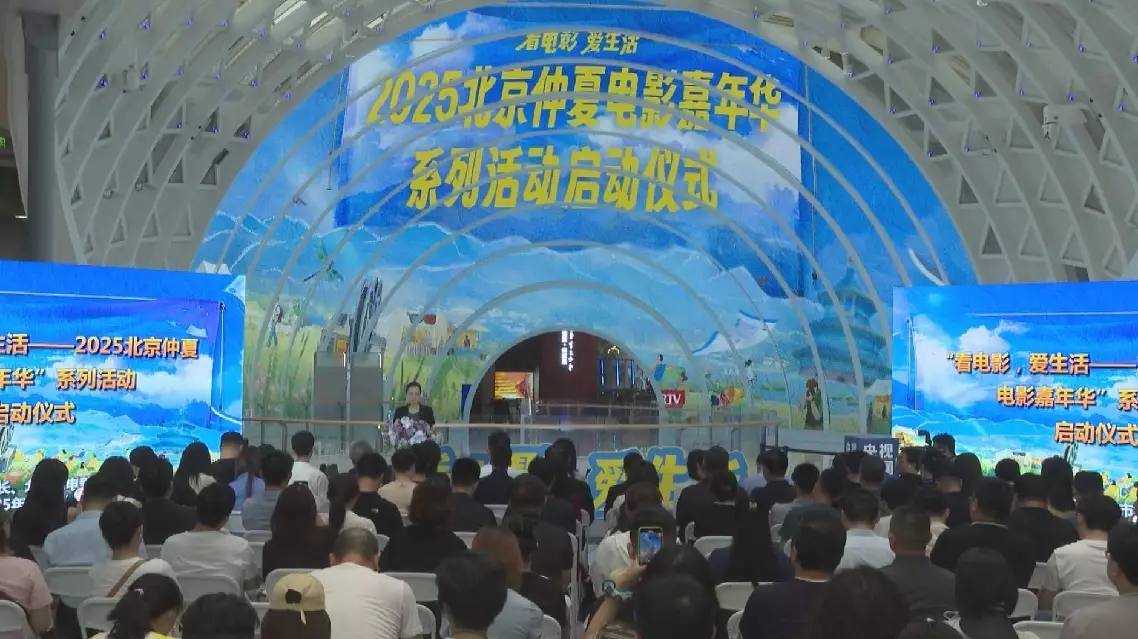
In Beijing, the "2025 Beijing Midsummer Film Carnival" was launched on Wednesday. During the event, Beijing has promoted diverse movie watching experiences, including outdoor screenings, to boost integrated cultural, commercial, tourism, and sports consumption.
"We have partnered with over 30 commercial districts in the city to promote 'ticket stub economy', meaning moviegoers can use their ticket stubs to enjoy discounts at restaurants and stores, maximizing the functions of a ticket," said Huo Zhijing, deputy director of the Publicity Department of Beijing Municipal Committee and director of the Beijing Municipal Film Administration.
To further energize the market, from the summer season to the National Day holiday (July 25 to October 8), Beijing plans to allocate 10 million yuan in consumer subsidies. Moviegoers can enjoy limited-time discounts, family packages, and promotions for specific films through online ticketing platforms, with tickets starting at 19.9 yuan.
In Xiongyue Town, Yingkou City, northeast China's Liaoning Province, local rural cinemas are experiencing a summer movie boom.
"There were no cinemas in Xiongyue before; We had to go to Bayuquan (a district in Dalian City) to watch movies, which took about an hour for the round trip. Now that we have our own cinema, it's much more convenient," said Zhang, a local moviegoer.
China's summer film market heats up since July
A former television host from Taiwan, Zhai Xuan, has made a pivotal decision to leave mainstream broadcasting in order to create content that provides a better understanding of the Chinese mainland and cross-strait relations.
Zhai, a seasoned television host with over a decade of experience in Taiwan's media landscape, recently addressed an audience at an event in Beijing, where she revealed her complete transition into independent online media.
In her remarks, she articulated her aspiration to bridge what she perceives as a significant information gap between audiences on both sides of the Strait, highlighting her commitment to fostering a deeper understanding and connection through her new endeavors.
"I was really surprised by all the fake news. There were stories saying people on the mainland can't afford tea eggs or that they live in mud houses and in Taiwan, this was the main information many people received," said Zhai.
Zhai said she initially began producing online videos to challenge such perceptions while continuing her work as a television host.
In April 2025, she travelled to the mainland with her father to fulfill her late grandfather's wish to return to his hometown. The trip, which reunited family members separated since 1949, was recorded in a video series titled "Journey to Find Our Roots", drawing attention from viewers in both Taiwan and the mainland.
"Many people in Taiwan told me that after watching, they wanted to apply for a mainland travel permit immediately and go looking for their relatives. Some had long forgotten these things, but after seeing my story, they began thinking about their hometowns and family members they had never met and decided to search for their roots," Zhai shared her story at the event.
By mid-2025, Zhai said she began to feel increasing pressure amid rising political tensions and a tightening atmosphere around cross-Strait exchanges in Taiwan.
After more than 12 years in the industry, Zhai resigned from her position, believing it was the right thing to do.
"At that moment, I felt this was a major issue,not just for me, but for Chinese people on both sides of the Strait. If I backed down then, I wouldn’t be standing on the right side," said Zhai.
Since leaving television, Zhai has broadened her online programming to encompass a range of daily-life topics, including practical guidance on applying for a mainland travel permit and using commonly employed mobile applications, in addition to content that delves into historical memory and cultural connections across the Strait.
As the debate over cross-Strait relations continues in Taiwan, Zhai said she remains committed to her current path.

Former Taiwan TV host bridges cross-Strait divide via online media