Over 80 years on, memories of a horrifying nine-month-long aerial bombing campaign by Nazi Germany against the United Kingdom during World War II still haunt the remaining British survivors and shape the national psyche.
From Sept 7, 1940 to May 11, 1941, Germany's air force launched the Blitz, which comes from the German word "Blitzkrieg," literally translating as lightning war, on towns and cities across the UK, in an attempt to crush the morale of the British people. The heavy and frequent raids flattened numerous residential homes, burned entire industrial centers to ashes, and left more than 43,000 people dead across the country.
London bored the brunt of the devastating assaults, with German bombers dropping waves of high explosives on the UK's capital city for 57 consecutive nights, and often during daytime as well. As a result, thousands of civilians were killed, and hundreds of firefighters died trying to protect the capital city and its residents.
However, when the German air raids were at their most extreme in the autumn of 1940, the St Paul's Cathedral was never directly hit, becoming a national symbol of survival and resistance.
Jeff Borsack was only three years old when the German air strikes pounded London in November 1940.
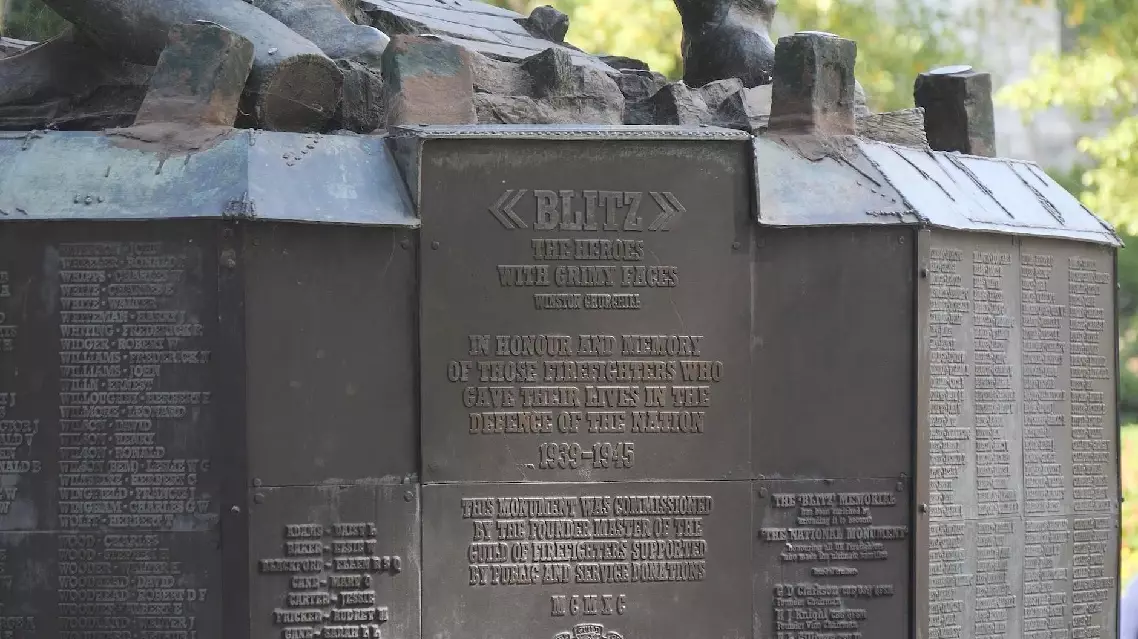
"My parents were killed in the Blitz in November 1940 when I was three years of age. And the reason I survived [was] that a few hours before I was taken to hospital with the measles. And I always remember, even at three, them saying, 'We'll see you in the morning'. And of course for them, the morning, it never happened," the 88-year-old recalled in an interview with China Global Television Network (CGTN), as he showed the St Paul's and a statue built to honor the firefighters.
Among the civilian fatalities in London during WWII, not all were caused directly by bombing.
On March 3, 1943, the Bethnal Green underground station witnessed the greatest single loss of life on the London tube system, when huge crowds of locals, on hearing the warning siren, raced down the steps into the bomb shelter. Confusion and panic conspired to trap hundreds on the staircase entrance. In the crush that ensued, 173 people, including 62 children, were killed.
Today, a memorial stands at entrance to the tube station in remembrance of 173 lost lives.
Recalling that day 82 years later, Ray Lechmere, 91, said he and his siblings narrowly avoided the crush behind them and survived. Their mother was injured, while their father and grandparents were all killed in the disaster.
"From the ceiling to the bottom [it] was full up with people. All the bodies, people laying on top of each other. They'd all suffocated. That's what killed them. Had we been five seconds, 10 seconds later, we wouldn't have come out of there," Lechmere said, as he showed the CGTN reporter a newspaper story about the tube station tragedy.
While London experienced a prolonged campaign of Nazi bombing over months, it was the city of Coventry whose name became synonymous with the pain the Nazis could inflict.
Deep into the night of Nov. 14, 1940, German bombers dropped 500 tons of high explosives and 36,000 incendiary bombs on Coventry. In the aftermath of the raid, two thirds of the city center burned to a crisp, around 500 people killed, and 1,000 others wounded.
"The intensity of the raid was absolutely unique. And indeed the Germans coined a word: to Coventriate or Koventrieren, which meant 'to utterly destroy'. Quite quickly, Coventry became a symbol for the horrors of war that could engulf any civilian target," said John Witcombe, dean of the Coventry Cathedral.
Meanwhile, at the Imperial War Museum in London, historians have worked hard to bring the reality of the war, including the devastating effects of the Blitz on London, to its visitors.
"The remaining houses that survived that bombing were no longer fit for purpose. So, there were large clearances of these areas. A lot of old houses were bulldozed and instead, multiple occupation buildings were created instead. A lot of the original families in the East End moved out or were moved into other areas, and that changed the whole community," Simon Offord, curator of the museum, told CGTN.
British survivors recall Blitz air raids, tube station tragedy during WWII