Skip to Content Facebook Feature Image

Technologies inject new impetus into cultural tourism boom

China

China

China

Technologies inject new impetus into cultural tourism boom

2025-07-27 02:52 Last Updated At:06:17

Mechanical art installations and manned aerial vehicles in China are not only captivating tourists but also injecting fresh momentum into the cultural tourism boom.

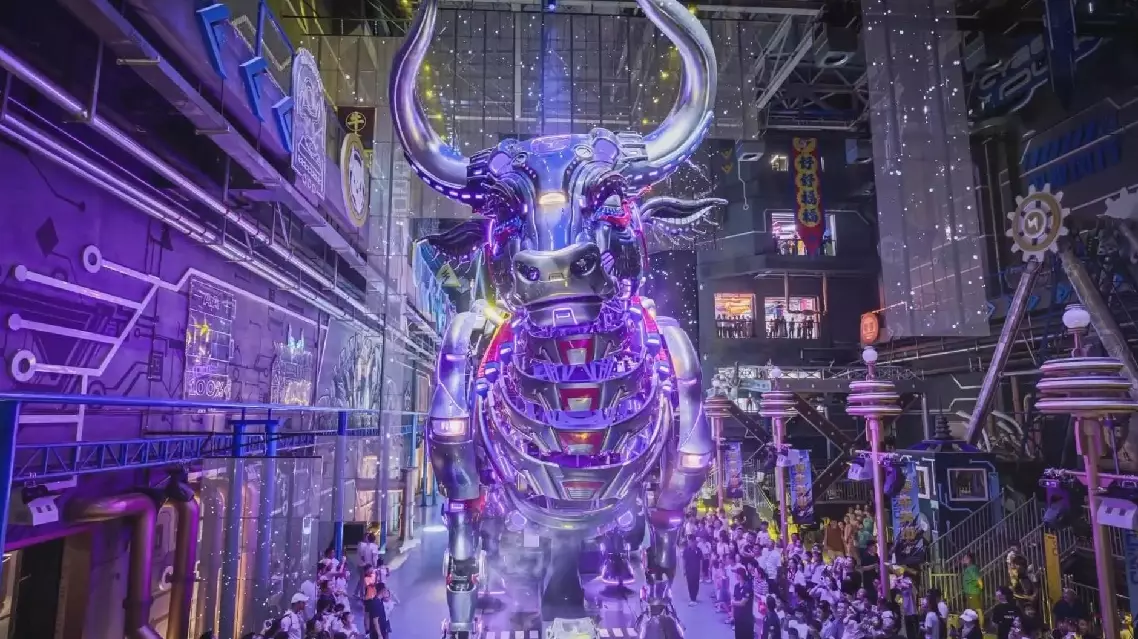
In Dalian, northeast China's Liaoning Province, for instance, a large-scale mechanical art installation in the shape of Kui Niu -- a legendary creature from ancient Chinese mythology -- has become a new landmark.

Measuring 21 meters long, six meters wide, and 10 meters high -- reaching up to 13 meters when rearing -- the mechanical Kui Niu is composed of hundreds of precisely engineered components. Each joint is fully articulated, allowing the structure to move with remarkable lifelikeness, capturing the powerful energy of a creature in motion.

Elsewhere in the city, a giant mechanical bear called "Xiong Bei Bei" has made the city’s industrial relic Xiongdong Street popular again.

"The giant mechanical beast 'Xiong Bei Bei' participated in the urban renewal and cultural transformation of Dalian, revitalizing an area spanning 180,000 square meters. Xiongdong Street has attracted 1.63 million visitors," said Xiao Di, co-founder of Dalian Betop Culture Technology Company.

As one of the first national-level technology innovation centers recognized by the Ministry of Culture and Tourism, Betop has developed a database featuring over 12,000 traditional patterns and 800 mythological characters based on classics like "Classic of Mountains and Seas" and "Investiture of the Gods." Currently, the research and development team is working on equipping these steel beasts with AI systems.

"The company will launch AI-powered giant mechanical devices that integrate multiple AI capabilities such as speech recognition, reasoning, memory, emotion analysis and output. Based on the conversations and emotional cues of visitors, these devices will respond with a wide range of micro-expressions, engaging in friendly and natural interactions with people," said Hu Yuan, another co-founder of Betop.

In Shenzhen, south China's Guangdong Province, the world's first electric vertical take-off and landing manned flying saucer developed by Shenzhen Smart Drone UAV Co., Ltd., has completed its maiden flight. Constructed with composite materials like carbon fiber and aerospace-grade aluminum alloy for the fuselage, it features a six-axis twelve-propeller propulsion system, a 360-degree panoramic view capability, and the ability to take off and land directly on the water surface.

"The flying saucer will be primarily used for aerial sightseeing tourism, thereby creating additional value for the low-altitude economy with our characteristic products," said Jin Liang, founder of Shenzhen Smart Drone UAV Co., Ltd.
Technologies inject new impetus into cultural tourism boom

Technologies inject new impetus into cultural tourism boom

A former television host from Taiwan, Zhai Xuan, has made a pivotal decision to leave mainstream broadcasting in order to create content that provides a better understanding of the Chinese mainland and cross-strait relations.

Zhai, a seasoned television host with over a decade of experience in Taiwan's media landscape, recently addressed an audience at an event in Beijing, where she revealed her complete transition into independent online media.

In her remarks, she articulated her aspiration to bridge what she perceives as a significant information gap between audiences on both sides of the Strait, highlighting her commitment to fostering a deeper understanding and connection through her new endeavors.

"I was really surprised by all the fake news. There were stories saying people on the mainland can't afford tea eggs or that they live in mud houses and in Taiwan, this was the main information many people received," said Zhai.

Zhai said she initially began producing online videos to challenge such perceptions while continuing her work as a television host.

In April 2025, she travelled to the mainland with her father to fulfill her late grandfather's wish to return to his hometown. The trip, which reunited family members separated since 1949, was recorded in a video series titled "Journey to Find Our Roots", drawing attention from viewers in both Taiwan and the mainland.

"Many people in Taiwan told me that after watching, they wanted to apply for a mainland travel permit immediately and go looking for their relatives. Some had long forgotten these things, but after seeing my story, they began thinking about their hometowns and family members they had never met and decided to search for their roots," Zhai shared her story at the event.

By mid-2025, Zhai said she began to feel increasing pressure amid rising political tensions and a tightening atmosphere around cross-Strait exchanges in Taiwan.

After more than 12 years in the industry, Zhai resigned from her position, believing it was the right thing to do.

"At that moment, I felt this was a major issue,not just for me, but for Chinese people on both sides of the Strait. If I backed down then, I wouldn’t be standing on the right side," said Zhai.

Since leaving television, Zhai has broadened her online programming to encompass a range of daily-life topics, including practical guidance on applying for a mainland travel permit and using commonly employed mobile applications, in addition to content that delves into historical memory and cultural connections across the Strait.

As the debate over cross-Strait relations continues in Taiwan, Zhai said she remains committed to her current path.

Former Taiwan TV host bridges cross-Strait divide via online media

Former Taiwan TV host bridges cross-Strait divide via online media

Recommended Articles