Skip to Content Facebook Feature Image

Chinese films build fresh momentum in Europe

China

China

China

Chinese films build fresh momentum in Europe

2025-07-27 08:08 Last Updated At:08:17

Chinese films are expanding their foothold in European cinemas, raking in both box office revenues and rave reviews with premium production values.

In recent years, Chinese cinema has steadily expanded its footprint on the international stage, and Europe has proven an especially fertile market.

An ever-growing number of Mandarin-language titles have not only premiered at top-tier European festivals but also secured wide theatrical runs.

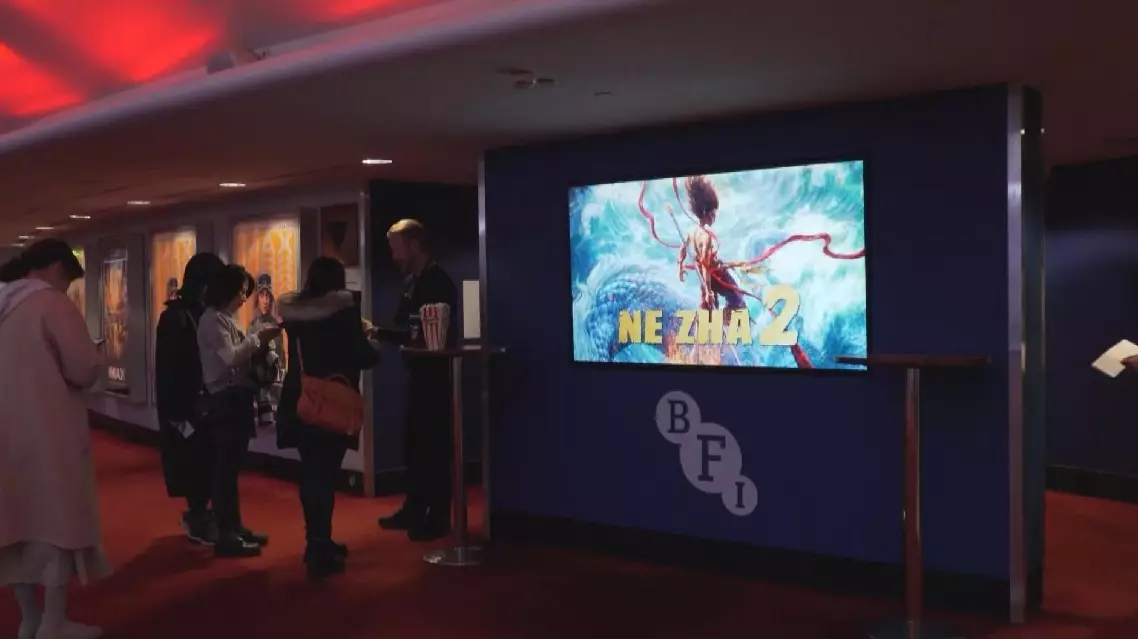
Chinese animated movie "Ne Zha 2" is the latest success story, posting robust box-office returns and glowing reviews across the continent.

As China's film industry evolves both in storytelling sophistication and technical polish, more home-grown titles are winning the hearts of European moviegoers.

"Ne Zha 2," distributed in Europe by Trinity CineAsia, exceeded all commercial expectations. Its triumph demonstrates that stories rooted in Chinese culture can resonate far beyond China's borders, and it has emboldened stakeholders on both sides to deepen Sino-European collaboration.

"Really, Ne Zha, in all the territories that we did, which is across the whole of western, northern and eastern and southern Europe, is very challenging of course because there are many countries and specificities and each country has its own requirements. But it's been very successful. I think it's going to be releasing over 1,000 screens," said Cedric Behrel, managing director of Trinity CineAsia.

Next up, to mark the 80th anniversary of the victory in the World Anti-Fascist War, Trinity CineAsia will roll out Dongji Island, a Chinese feature set against that historic backdrop, in the United Kingdom and other European markets.

Chinese films are becoming a fixture in European cultural life. Titles regularly appear in the main slates of Cannes, Berlin and other A-list festivals, while co-productions are emerging as new bridges for cultural exchange.

The influence now extends beyond the screen: merchandising and lifestyle products tied to Chinese film IPs are turning up in European shops, extending the lifecycle of these properties and opening fresh channels for collaboration.

"Yeah, if there's something she's [my daughter] interested and I see her watching it, then I'm happy to buy it," said a consumer of cultural and creative products.

"Yeah I think they are really cute and he [my friend] collected them. And I want to give this for him," said another.

Behrel says that if the merchandising potential of Chinese film IPs could be activated well before theatrical release, the upside for Chinese cinema in Europe would be enormous.

"We are seeing that there's a lot of potential opportunities to really use Chinese IPs here not just in film also in the wider media like in games for example and in live entertainment," he said.

Behrel also sees untapped potential in China-Europe co-productions, which would allow Chinese projects to integrate international market planning at the production stage rather than during post-release distribution.
Chinese films build fresh momentum in Europe

Chinese films build fresh momentum in Europe
A former television host from Taiwan, Zhai Xuan, has made a pivotal decision to leave mainstream broadcasting in order to create content that provides a better understanding of the Chinese mainland and cross-strait relations.

Zhai, a seasoned television host with over a decade of experience in Taiwan's media landscape, recently addressed an audience at an event in Beijing, where she revealed her complete transition into independent online media.

In her remarks, she articulated her aspiration to bridge what she perceives as a significant information gap between audiences on both sides of the Strait, highlighting her commitment to fostering a deeper understanding and connection through her new endeavors.

"I was really surprised by all the fake news. There were stories saying people on the mainland can't afford tea eggs or that they live in mud houses and in Taiwan, this was the main information many people received," said Zhai.

Zhai said she initially began producing online videos to challenge such perceptions while continuing her work as a television host.

In April 2025, she travelled to the mainland with her father to fulfill her late grandfather's wish to return to his hometown. The trip, which reunited family members separated since 1949, was recorded in a video series titled "Journey to Find Our Roots", drawing attention from viewers in both Taiwan and the mainland.

"Many people in Taiwan told me that after watching, they wanted to apply for a mainland travel permit immediately and go looking for their relatives. Some had long forgotten these things, but after seeing my story, they began thinking about their hometowns and family members they had never met and decided to search for their roots," Zhai shared her story at the event.

By mid-2025, Zhai said she began to feel increasing pressure amid rising political tensions and a tightening atmosphere around cross-Strait exchanges in Taiwan.

After more than 12 years in the industry, Zhai resigned from her position, believing it was the right thing to do.

"At that moment, I felt this was a major issue,not just for me, but for Chinese people on both sides of the Strait. If I backed down then, I wouldn’t be standing on the right side," said Zhai.

Since leaving television, Zhai has broadened her online programming to encompass a range of daily-life topics, including practical guidance on applying for a mainland travel permit and using commonly employed mobile applications, in addition to content that delves into historical memory and cultural connections across the Strait.

As the debate over cross-Strait relations continues in Taiwan, Zhai said she remains committed to her current path.

Former Taiwan TV host bridges cross-Strait divide via online media

Former Taiwan TV host bridges cross-Strait divide via online media

Recommended Articles