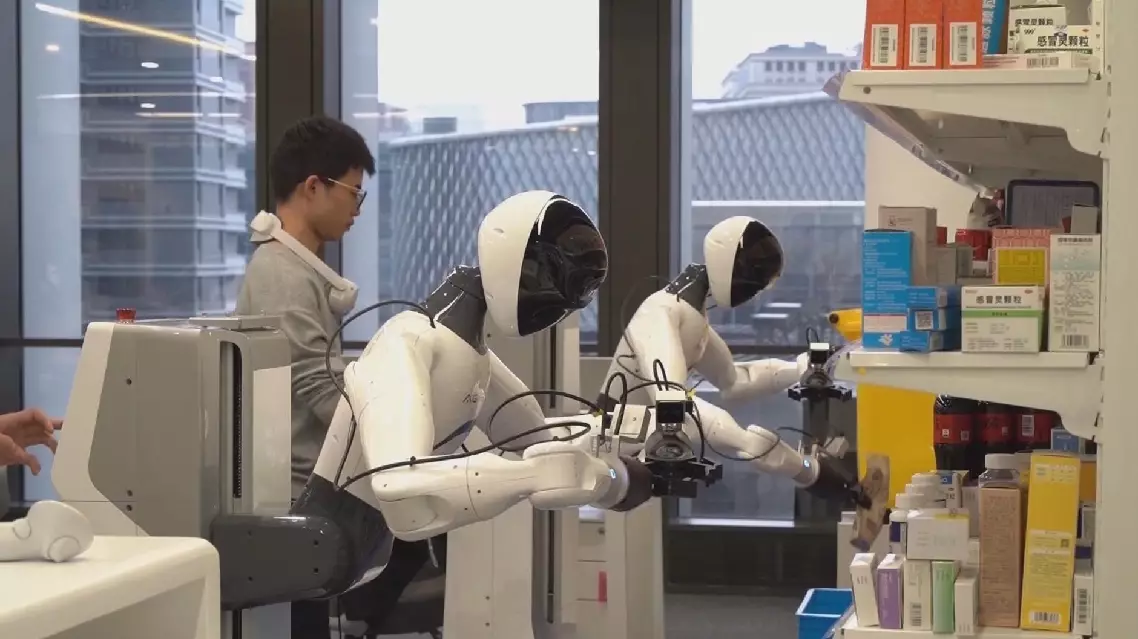
China's humanoid robot industry saw accelerated development this year, with more than 15 billion yuan (about 2.09 billion U.S. dollars) already invested and financed.
Since June, more than 10 humanoid robot enterprises have announced the completion of their new round of financing, with each financing surpassing hundreds of millions of yuan, according to statistics.
"We just completed a new round of financing of nearly 500 million yuan (about 69.75 million U.S. dollars) in early July. We are using it primarily on three areas, namely the research and development of humanoid robot products and technological breakthroughs, the expansion of the production line for quadruped robots, and the recruitment of talents," said Li Yang, brand director of DEEP Robotics, a high-tech enterprise specialized in innovation and application of "embodied AI technology."
On the one hand, many venture capital institutions and equity investment funds are accelerating their layout in the industries of embodied intelligence and humanoid robots. On the other hand, local governments have also increased their financial support, many planning to establish relevant industrial funds to guide more funds to be invested in key areas of humanoid robots.
"Since April this year, we promptly laid out several important industrial funds related to artificial intelligence and embodied intelligence. In the entire field of artificial intelligence and embodied intelligence, over 100 companies have made direct investments and fund investments, of which 20 percent is our own direct investment, with nearly one billion yuan focusing on embodied intelligence," said Zhu Min, director for science, technology, and innovation at Shanghai State-owned Capital Investment Co., Ltd., and president of Shanghai Science and Technology Innovation Group. "Our first step now is to accelerate the industrialization and application. That is to say, we need such a training ground to support the data reasoning model and apply it in various scenarios. By the end of this year, we aim to collect 10 million pieces of data," said Yang Zhengye, marketing director of Shanghai-based National and Local Co-Built Humanoid Robotics Innovation Center.
Data shows that China has seen 108 rounds of investment and financing in the field of humanoid robots in 2025, with a total amount of 15.35 billion yuan (about 2.14 billion U.S. dollars), while 41,696 new Chinese invention patents have been added.
"I believe that in the process of obtaining large-scale financing and in their practice, enterprises have seen the future of this industry. Humanoid robots can make up for the technological bottleneck in the past in the field of industrial automation, which was insufficient in intelligence, weak in perception and insufficient in generalization. It is believed that within three years, humanoid robots can be able to enter the service industry, such as supermarkets and banks," said Jiang Lei, principal investigator of the National and Local Co-Built Humanoid Robotics Innovation Center.
China invests over 15 billion yuan in humanoid robot industry this year
China invests over 15 billion yuan in humanoid robot industry this year
China invests over 15 billion yuan in humanoid robot industry this year