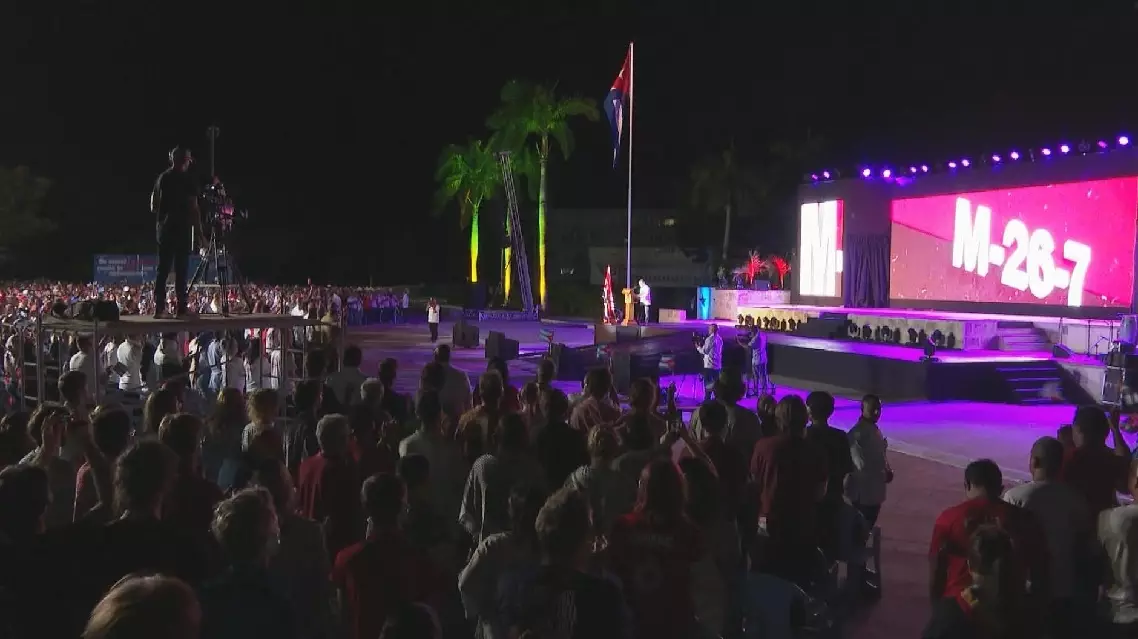
Cuban party and government leaders, along with legions of citizens, gathered solemnly to commemorate the "National Rebellion Day" in Ciego de Avila, Cuba, on Saturday, recalling the armed attacks of 70 years ago against army strongholds in eastern Cuba.
The rebellion by a group of revolutionaries was led by Fidel Castro to overthrow the government of then-President Fulgencio Batista.
The armed action was the beginning of the 1959 Cuban Revolution.
On Saturday morning, Cuban Revolution leader Raul Castro, Cuban President Miguel Diaz-Canel, Cuban Prime Minister Manuel Marrero, and other national leaders joined roughly 10,000 Cubans and supporters from around the world in downtown Ciego de Avila for the commemoration.
The ceremony began in early morning to echo the time of the rebellion at 5:00, the exact hour Fidel Castro and the revolutionaries led by him launched their audacious attack 72 years ago.
Prime Minister Manuel Marrero said in his address that the event is a landmark in the Cuban people's struggle for genuine independence.
Thanks to that first act of defiance, he said, Cuba has become a prosperous, sustainable and sovereign socialist state. Yet U.S. interference has never ceased and over the past 63 years the economic blockade has expanded into every sphere of Cuba.
"This brutal blockade remains in force. The current U.S. administration has not altered the tactic of strangling Cuba economically and fomenting despair and internal discontent. Administration after administration, especially the present one, has insisted, from its very first hours in the White House, on subduing the Cuban people through hunger and hardship. They have never achieved that goal, and they never will," he said.
The Cubans at the event also said they will not bow to pressure.
"Every day we keep facing challenges and overcoming them. We Cubans will not yield," said a local resident.
On July 26, 1953, then-leader Fidel Castro led more than 100 young revolutionaries against the Moncada Barracks - the second-largest stronghold of the Batista dictatorship - firing the opening shot of the revolution that would ultimately topple the U.S.-backed regime.
Although the assault itself failed, it awakened the Cuban people, and July 26 has since become one of the nation's most important anniversaries.
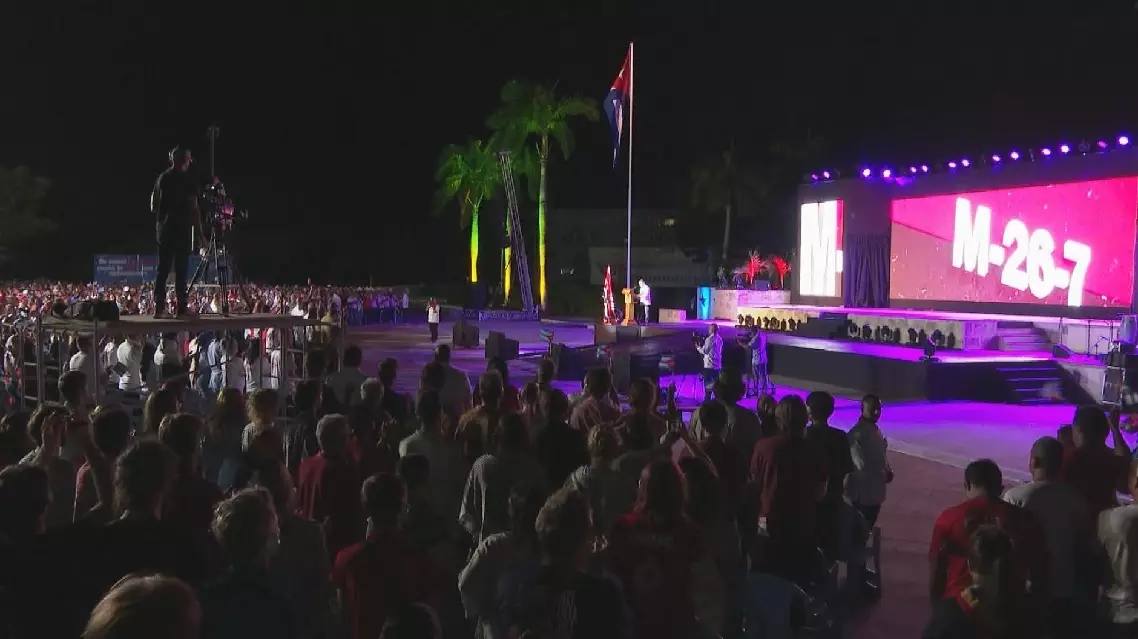
Cuba commemorates National Rebellion Day
A former television host from Taiwan, Zhai Xuan, has made a pivotal decision to leave mainstream broadcasting in order to create content that provides a better understanding of the Chinese mainland and cross-strait relations.
Zhai, a seasoned television host with over a decade of experience in Taiwan's media landscape, recently addressed an audience at an event in Beijing, where she revealed her complete transition into independent online media.
In her remarks, she articulated her aspiration to bridge what she perceives as a significant information gap between audiences on both sides of the Strait, highlighting her commitment to fostering a deeper understanding and connection through her new endeavors.
"I was really surprised by all the fake news. There were stories saying people on the mainland can't afford tea eggs or that they live in mud houses and in Taiwan, this was the main information many people received," said Zhai.
Zhai said she initially began producing online videos to challenge such perceptions while continuing her work as a television host.
In April 2025, she travelled to the mainland with her father to fulfill her late grandfather's wish to return to his hometown. The trip, which reunited family members separated since 1949, was recorded in a video series titled "Journey to Find Our Roots", drawing attention from viewers in both Taiwan and the mainland.
"Many people in Taiwan told me that after watching, they wanted to apply for a mainland travel permit immediately and go looking for their relatives. Some had long forgotten these things, but after seeing my story, they began thinking about their hometowns and family members they had never met and decided to search for their roots," Zhai shared her story at the event.
By mid-2025, Zhai said she began to feel increasing pressure amid rising political tensions and a tightening atmosphere around cross-Strait exchanges in Taiwan.
After more than 12 years in the industry, Zhai resigned from her position, believing it was the right thing to do.
"At that moment, I felt this was a major issue,not just for me, but for Chinese people on both sides of the Strait. If I backed down then, I wouldn’t be standing on the right side," said Zhai.
Since leaving television, Zhai has broadened her online programming to encompass a range of daily-life topics, including practical guidance on applying for a mainland travel permit and using commonly employed mobile applications, in addition to content that delves into historical memory and cultural connections across the Strait.
As the debate over cross-Strait relations continues in Taiwan, Zhai said she remains committed to her current path.
Former Taiwan TV host bridges cross-Strait divide via online media