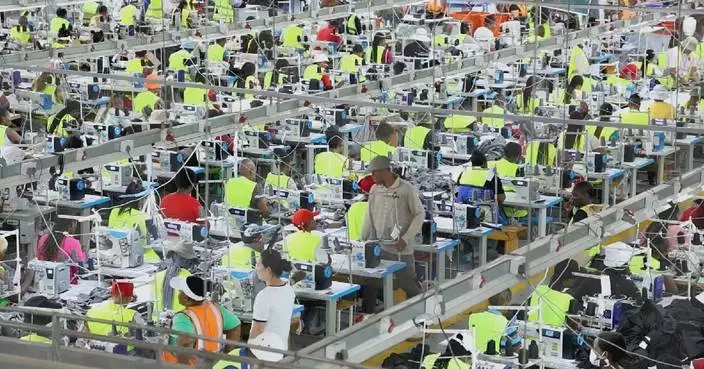
Foreign-funded companies have been increasing their reinvestment and expanding production in China, indicating strong confidence in the Chinese market amid the country's efforts to promote opening up.
In the Suzhou Industrial Park, east China's Jiangsu Province, Germany-based home appliance manufacturer Vorwerk recently announced an additional investment of 500 million yuan (around 69.89 million U.S. dollars) through profit reinvestment to further boost production capacity and research and development efficiency of new energy vehicle components.
"Chinese market is a very big market and it's growing very fast, and we also want to participate in this growing of the market. And therefore we are also now building a second building on the other side of the street, a second factory to fulfill the demands of our customers," said Martin Gluchowski, manager of global operations controlling systems at Vorwerk.
This marks Vorwerk's fourth investment capital increase in China. In 2008, Vorwerk first established a factory in the country, starting with just a handful of employees in a rented facility. Since then, the company has built its own factory and has formed a local research and development team.
With the rapid development of the Chinese automotive market, the company's annual sales have increased from an initial 200 million yuan (around 27.96 million U.S. dollars) to one billion yuan (around 139.78 million U.S. dollars), and its current production capacity can no longer meet market demand. Therefore, expanding production has become imperative.
"I use a lot of data to discuss our product direction and customer needs with the executives at headquarters, focusing on how to align these aspects, which is crucial. He (the executive at headquarters) believes that, given the rapid development in China, there is a need to better meet local demands," said Huang Wenbiao, general manager of Vorwerk Autotec Suzhou Limited.
Swedish company Alfa Laval provides heat transfer, separation, and fluid handling products and solutions worldwide. The company has operated in China for over 40 years.
Mattias Andersson, President of Alfa Laval China Operations, said that over the past five years, the company has repeatedly reinvested its profits in China. Notably, in 2022, 2023, and 2024, the company has consistently reinvested for three consecutive years, bringing about tangible changes.
"So we have in the last five years built five new factories. In the last five years, we have invested around one point five billion rmb," said Andersson.
The continuous increase in investment stems from a strong confidence in the Chinese market. In 2024, the Chinese market surpassed the United States for the first time, becoming the company's largest single market globally.
This year, the company also plans to reinvest profits to establish new production lines and implement smart upgrades.
"Chinese are the most profitable market, so we have a good business here and we're growing very well. So we are very happy with the developments. But at the same time, we can also see that competition increases. It is getting harder and harder to differentiate yourself from competition. So we have to invest more and more to make sure that we have this gap due to competition. When you make an investment, that's a prediction of the future. If you believe in the future, you are willing to invest. If you don't believe in the future, not willing to invest. I mean the investments we do that always to predict the future and we believe strongly in the Chinese markets," he said.
Foreign-funded companies ramp up reinvestment in China