Skip to Content Facebook Feature Image

US, EU reach trade deal: Trump, EU chief

China

China

China

US, EU reach trade deal: Trump, EU chief

2025-07-28 09:05 Last Updated At:12:37

U.S. President Donald Trump and European Commission President Ursula von der Leyen claimed Sunday that they had reached a trade deal under which the United States would impose a baseline tariff of 15 percent on European Union (EU) goods.

The announcement was made at a joint press briefing Sunday afternoon following trade talks at the Trump Turnberry in South Ayrshire, Scotland.

Pharmaceuticals were excluded from the agreement, while existing 50 percent tariffs on EU steel and aluminium exports to the United States will remain in place.

Although both leaders described the deal as a step toward restoring "trade balance" and promoting more equitable two-way commerce, the agreement allows the United States to impose a broad 15 percent tariff on EU goods while securing zero-tariff access for a range of strategic American exports. In contrast, the EU has pledged to purchase 750 billion U.S. dollars' worth of American energy, and commit an additional 600 billion U.S. dollars in investments in the United States.

At the press briefing, Trump claimed the agreement would enable American cars to re-enter the European market and make U.S. agricultural exports more accessible in the EU.

Noting that the 15 percent tariff is the ceiling, von der Leyen said the deal delivers stability and predictability to the two sides.

She added that no final decisions had been made regarding the spirits sector, and further details of Sunday's deal are expected to be released in the coming weeks.

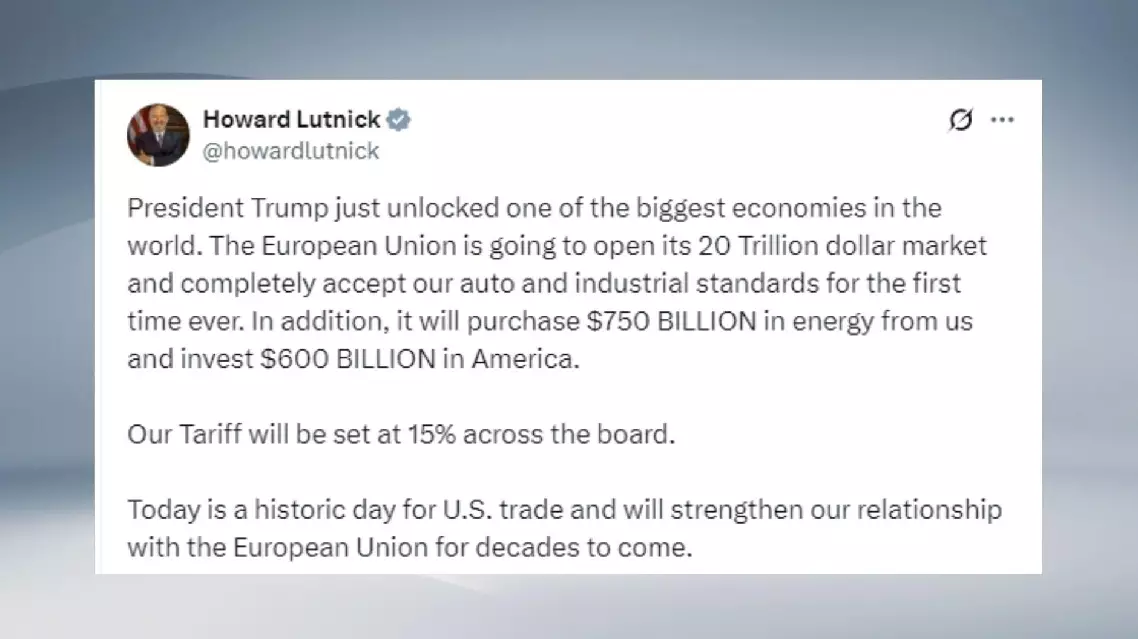
U.S. Commerce Secretary Howard Lutnick hailed the deal on social media, stating that President Trump had unlocked one of the biggest economies in the world.

According to Lutnick, the EU will open its 20-trillion-dollar market and adopt U.S. auto and industrial standards for the first time ever.

However, the trade agreement has attracted criticism from some European officials.

Bernd Lange, chair of the European Parliament's Committee on International Trade, criticized the 600 billion dollars in planned additional investments, including increased funding for U.S. military technology, calling such measures contrary to European economic interests.

Describing the proposed framework as "unsatisfactory" and "significantly imbalanced", Lange warned that the deal could weaken the EU's economic development and harm its GDP.

According to estimates by the Kiel Institute for the World Economy (IfW), a 15 percent general tariff, combined with higher tariffs on steel and aluminum, would reduce Germany's GDP by 0.15 percent within one year, equivalent to a loss of 6.5 billion euros, while the overall EU GDP would decline by 0.1 percent.

Finnish Minister of Foreign Trade and Development Ville Tavio expressed similar concerns on Sunday, saying even though the deal may calm the situation, the tariff level remains too high, giving little reason to celebrate.
US, EU reach trade deal: Trump, EU chief


US, EU reach trade deal: Trump, EU chief

A former television host from Taiwan, Zhai Xuan, has made a pivotal decision to leave mainstream broadcasting in order to create content that provides a better understanding of the Chinese mainland and cross-strait relations.

Zhai, a seasoned television host with over a decade of experience in Taiwan's media landscape, recently addressed an audience at an event in Beijing, where she revealed her complete transition into independent online media.

In her remarks, she articulated her aspiration to bridge what she perceives as a significant information gap between audiences on both sides of the Strait, highlighting her commitment to fostering a deeper understanding and connection through her new endeavors.

"I was really surprised by all the fake news. There were stories saying people on the mainland can't afford tea eggs or that they live in mud houses and in Taiwan, this was the main information many people received," said Zhai.

Zhai said she initially began producing online videos to challenge such perceptions while continuing her work as a television host.

In April 2025, she travelled to the mainland with her father to fulfill her late grandfather's wish to return to his hometown. The trip, which reunited family members separated since 1949, was recorded in a video series titled "Journey to Find Our Roots", drawing attention from viewers in both Taiwan and the mainland.

"Many people in Taiwan told me that after watching, they wanted to apply for a mainland travel permit immediately and go looking for their relatives. Some had long forgotten these things, but after seeing my story, they began thinking about their hometowns and family members they had never met and decided to search for their roots," Zhai shared her story at the event.

By mid-2025, Zhai said she began to feel increasing pressure amid rising political tensions and a tightening atmosphere around cross-Strait exchanges in Taiwan.

After more than 12 years in the industry, Zhai resigned from her position, believing it was the right thing to do.

"At that moment, I felt this was a major issue,not just for me, but for Chinese people on both sides of the Strait. If I backed down then, I wouldn’t be standing on the right side," said Zhai.

Since leaving television, Zhai has broadened her online programming to encompass a range of daily-life topics, including practical guidance on applying for a mainland travel permit and using commonly employed mobile applications, in addition to content that delves into historical memory and cultural connections across the Strait.

As the debate over cross-Strait relations continues in Taiwan, Zhai said she remains committed to her current path.

Former Taiwan TV host bridges cross-Strait divide via online media

Former Taiwan TV host bridges cross-Strait divide via online media

Recommended Articles