China's rural consumption has continued to expand and upgrade this year, boosted by the surging demand for smart appliances in rural areas.
In the first half of 2025, rural residents' per capita consumption expenditure reached 9,733 yuan (about 1,360 U.S. dollars), representing a real increase of 6.1 percent according to the National Bureau of Statistics.
In a home appliance e-commerce logistics warehouse in Huangwan Town of Haining City, east China's Zhejiang Province, 30 percent out of over 100 daily orders of the smart home appliances are destined for rural areas.
From January to June this year, orders for smart home appliances to rural areas in Zhejiang increased by 40 percent year on year. Orders from rural areas within Haining City specifically jumped by over 60 percent, averaging about 100 orders daily.
In Luwan Village of Haining, many villagers have purchased new smart home appliances, including Chu Xuefen. There are almost 10 types of smart home appliances in Chu's home, such as a smart fan, smart door lock, water purifier, and remotely-controlled curtains.
According to the 7th National Population Census, the proportion of people aged 60 and above and 65 and above in China's rural areas is 23.81 percent and 17.72 percent, respectively. These figures are 7.99 percent points and 6.61 percent points higher than in urban areas.
Empowered by new quality productive forces, the consumption potential for elderly-friendly smart products in rural areas accelerated its release in the first half of the year.
Meanwhile, as younger new-generation farmers gradually take charge of their households, rural consumers are paying more attention to quality and intelligence.
"Smart home appliances are now a standard feature of our young people's home renovations. Based on the information on your phone, you can see how much electricity was used this night," said Zhu Chengyan, a villager of Yongsheng Village.
National subsidy policies have also promoted the sales of home appliances.
"There was a promotion on the robotic vacuum cleaner. Together with the state subsidy, I saved over 800 yuan. Adding up various items like the lights, washing machine, and others, I actually saved nearly 10,000 yuan," said Zhu.
In Haining, 532 new entities registered to sell smart home appliances in the first half of the year, with rural store sales accounting for about 50 percent of the city's total.

Smart appliances ignite sustained upgrade in rural consumption
China's permanent representative to the United Nations Fu Cong on Thursday strongly condemned Japan's colonial atrocities in Taiwan and called for unwavering vigilance against the resurgence of militarism.
At the UN General Assembly high-level plenary meeting to commemorate the first International Day Against Colonialism in All Its Forms and Manifestations, Fu said the world has yet to emerge from the shadow of colonialism despite the end of colonial occupation and the collapse of colonial system.
He urged the international community to firmly oppose any words or actions that challenge or seek to subvert the post-war international order.
Fu noted that the International Day Against Colonialism in All Its Forms and Manifestations aims to urge the international community to remember the harm of colonialism, accelerate the ongoing decolonization process, and end colonialism in all its forms and manifestations.
Reflecting on the history of the World Anti-Fascist War, Fu stressed that peace needs to be striven for and safeguarded.
Following the victory of World War II, the trials of war criminals at the International Military Tribunal at Nuremberg and the International Military Tribunal for the Far East ensured that the principal perpetrators of the war of aggression, whose hands were stained with the blood of people of many nations, received the punishment they deserved. The justice and integrity of the trials are unshakable and beyond challenge, Fu said.
"In history, Japan invaded China, the Korean Peninsula, and Southeast Asia, imposing horrendous colonial rule. Japanese aggressors committed innumerable crimes and atrocities in Taiwan, killing over 650,000 compatriots in Taiwan, forcibly recruiting around 200,000 young people to serve in the military, forcing more than 2,000 Taiwan women to become sexual slavery, or 'Comfort Women', occupying 70 percent of Taiwan's land, and destructively exploiting natural resources, including coal and gold mines. It was the darkest page in Taiwan's history," Fu said.
Fu called on the international community to resolutely defend the victorious outcomes of the Chinese People's War of Resistance Against Japanese Aggression and the World Anti-Fascist War, and resolutely defend the post-war international order.
"We must never allow any denial or distortion of the history of aggression, never allow the revival of militarism, and never allow the recurrence of historical tragedies," the Chinese envoy said.
Any words or actions that challenge or seek to subvert the post-war international order could create instability in the world and bring immense suffering to humanity as a community with a shared future," Fu said.
"Japan, as a defeated country in World War II, must do deep soul-searching regarding its historical crimes, abide by the political commitments it made on the Taiwan question, immediately stop provocative actions that cross the line, and retract its erroneous remarks," he said.
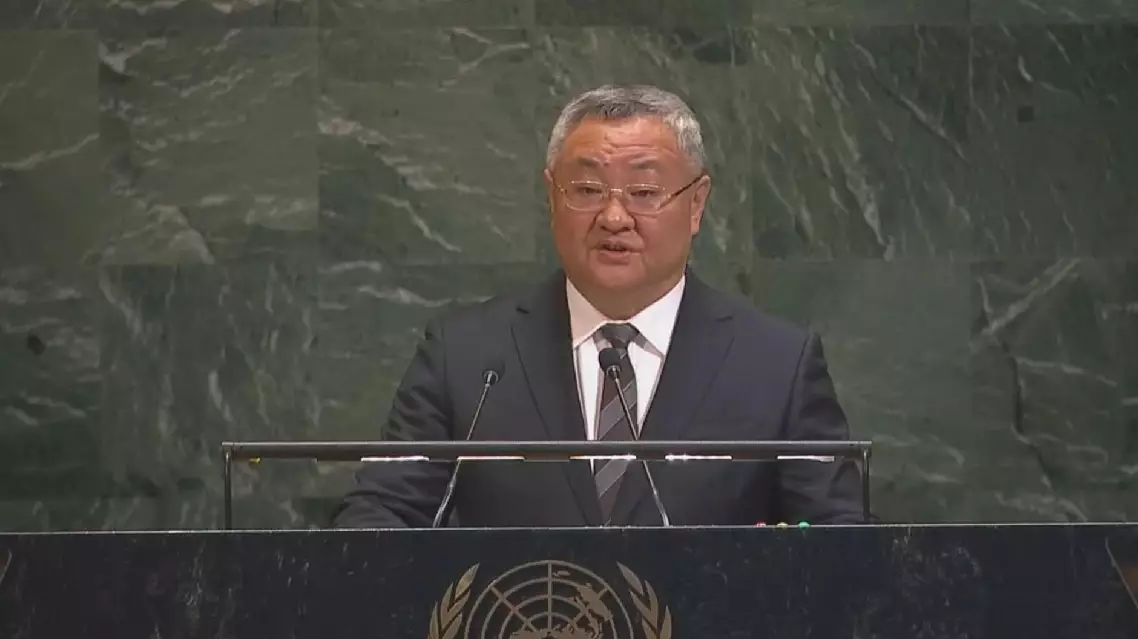
China condemns Japan's colonial past in Taiwan, urging vigilance against militarism