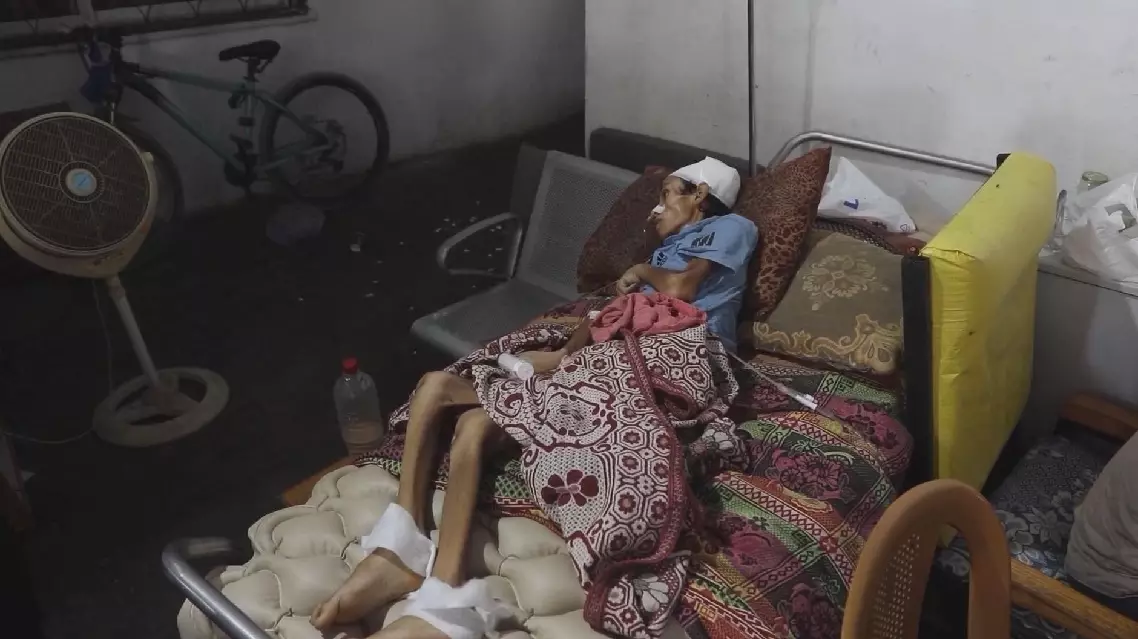
The Gaza Media Office issued a statement on Sunday, strongly condemning Israel's systematic starvation policy and acts of genocide in the Gaza Strip. It called for the immediate opening of border crossings to alleviate the humanitarian crisis and urged the media to stop spreading false information.
The statement noted that the reality of aid delivery into Gaza over the past two days has been disappointing: only 73 trucks have entered the Gaza Strip, while the total amount of airdropped aid was equivalent to just two trucks. Moreover, the airdropped supplies fell into Israel-designated "red zones," where civilians are forbidden and thus have no actual humanitarian effect.
The statement held Israel and its main partners—such as the United States and other Western countries—fully responsible for the worsening famine in Gaza and the escalating humanitarian disaster. It stressed that the fundamental solution to the humanitarian crisis in Gaza is the immediate and unconditional opening of border crossings, breaking Israel's unjust blockade, and urgently delivering supplies such as food and infant formula to the Gaza Strip.
The statement also urged the media to stop spreading rumors and false information, emphasizing that the famine not only persists but is expanding in scope, worsening in severity, and becoming increasingly threatening.
Hamas said on Sunday that the entry of humanitarian aid is a fundamental human right for Palestinians and called for the full and permanent reopening of all land crossings into Gaza.
"The arrival of food, medicine, and humanitarian relief to Gaza is a natural right to confront the humanitarian catastrophe created by the occupation," Hamas said.
The remarks came as dozens of aid trucks began entering the Gaza Strip through the Kerem Shalom border crossing on Sunday morning, and airdrops of aid resumed on Saturday evening.
Hamas, in the statement, criticized the limited airdrops as "symbolic and misleading," arguing that they fail to address the root causes of the crisis.
"The airdrop operations are intended to improve the image of the occupation before the international community and to evade growing global pressure to end its starvation policy," Hamas added. "This is not a solution. It is a policy of managing hunger under bombardment and siege, rather than ending it."
The movement further asserted that resolving the humanitarian crisis requires halting the ongoing military campaign, lifting the blockade, and ensuring the regular and unhindered delivery of aid via land routes in coordination with mechanisms approved by the United Nations.
On Sunday local time, Israeli Prime Minister Benjamin Netanyahu visited the Ramon Air Force Base. In his speech, he said that Israel has so far allowed a minimal humanitarian aids to enter Gaza, which he described as a consistent policy that Israel has always upheld and will continue to implement. Netanyahu also accused the United Nations of spreading "false propaganda" against Israel and denied allegations that aid deliveries were being obstructed.
The Gaza health authorities issued a statement on Sunday, reporting six new deaths due to famine and malnutrition over the past 24 hours. This brings the total number of related deaths in Gaza to 133, of which 87 were children.
Meanwhile, the number of civilians killed or injured while trying to receive humanitarian aid continues to rise. In the past day alone, 11 people died while collecting aid, and more than 36 others were injured, according to the health authorities.
Since May 27 of this year, when the so-called Gaza Humanitarian Foundation—backed by the United States and Israel—took over the distribution of aid supplies in the Gaza Strip, a total of 1,132 Gazans have been killed and 7,521 injured while attempting to collect aid.
The Israeli military on Sunday announced a daily 10-hour humanitarian pause in its operations in parts of the Gaza Strip, along with the opening of secure routes for aid delivery, amid growing international pressure over the deepening hunger crisis there.
The Israel Defense Forces (IDF) said in a statement that it would halt military activity in areas including Al-Mawasi, Deir al-Balah and Gaza City, from 10:00 am to 8:00 pm local time (0700-1700 GMT) every day until further notice.
UN Under-Secretary-General for Humanitarian Affairs and Emergency Relief Coordinator Tom Fletcher on Sunday said that the crisis in Gaza Strip is rapidly worsening, with hundreds of thousands of people facing threats of famine, disease and death. He urged all relevant parties to take urgent and sustained actions to ensure unimpeded access to humanitarian aid.
Preliminary reports on the same day showed that more than 100 trucks had successfully delivered aid supplies to designated reception points.
Israeli Minister of Energy and Infrastructure Eli Cohen said on Sunday that the Israeli government's decision to allow the resumption of the humanitarian aid into the Gaza Strip is not a hasty move, but a well-thought-out strategic decision, in part to avoid European sanctions.
Cohen also revealed that before the decision, the Israeli Ministry of Foreign Affairs had previously held several rounds of consultations with European countries to prevent international sanctions against Israel due to the situation in Gaza.
He also claimed that the Hamas hoped to use the situation in Gaza to make the international community come up with a decision unfavorable to Israel, but Israel did not fall into the trap.
Gaza condemns Israeli 'starvation policy,' demands border opening