Skip to Content Facebook Feature Image

Displaced Gazans say aid not nearly enough as children going hungry

China

China

China

Displaced Gazans say aid not nearly enough as children going hungry

2025-07-29 16:33 Last Updated At:19:47

Displaced Palestinians in the Gaza Strip have expressed desperation as Israel's blockade on aid continues to prevent families from obtaining enough food to fill their stomachs.

Hospitals in Gaza reported that 14 more people have died of hunger and malnutrition over the past 24 hours, bringing the total number of hunger- and malnutrition-related deaths to 147, including 88 children, health officials in Gaza said on Monday.

Israel has further tightened its blockade on Gaza since the conflict between Hamas and Israel erupted on October 7, 2023, causing severe shortages of food, drugs, fuels and other basic necessities.

It remains common to see crowds of people at markets, but few of them are able to buy anything because of the insufficient supply and high prices.

"There is no one here in Gaza with a full stomach. I almost (would) sell everything I have, my car -- I would sell even my house, just to feed my children," said Sameh Al-Sakani, a displaced person.

"I have small children, and I can't even feed them bread. I can't provide them with a decent life like other human beings. I am injured, and my children are still young. I can't even send them to the U.S. aid distribution points in the Zikim area, for fear they might be killed," said displaced person Bilal Abu Al-Khair.

"Since this morning, I've only had a cup of bitter tea without sugar. Ever since we returned from southern Gaza after Ramadan, we've been surviving only on bitter tea," said Sami Al-Dabbour, another displaced person.

Vendors at the market have clearly witnessed people's suffering in the besieged enclave.

"In the past, we would sell large quantities. The least someone would buy was vegetables by the pound, even small families bought by the kilo or pound. But today, everyone buys just one piece at a time," said Ahmad Ashour, a vegetable vendor.

A total of one million women and girls in Gaza are facing mass starvation, violence and abuse, UN Women said in a statement on the escalating humanitarian catastrophe in Gaza on Monday.

Malnutrition is soaring and essential services have long collapsed, forcing women and girls to adopt increasingly dangerous survival strategies, the statement said.

"We are displaced from northern Gaza. There is no flour or food. Every four to five days, we manage to get just one kilo of flour -- only after severe hardship, either from generous people or by borrowing money to buy it," said Umm Muhammad Abu Sharia, a displaced woman.

Amid the blockade and higher prices, Gazans have been forced to seek out cheaper alternatives, even if they provide little nutritional value.

"Because of the high price of sugar, we've started relying on this sweetener (Stevia) as a substitute. Today, the price of one kilo of sugar ranges from 650 to 700 shekels (about 195 to 210 U.S. dollars). Nowadays, we've come to depend on alternatives for everything," said Saeed Al-Hout, a vendor.
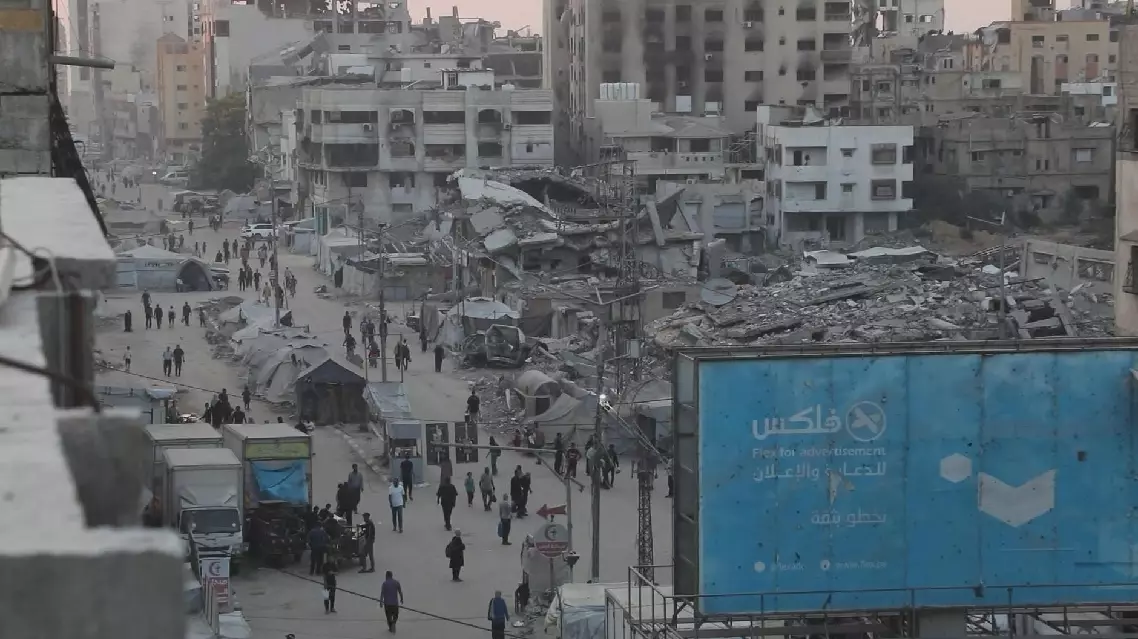
Displaced Gazans say aid not nearly enough as children going hungry

Displaced Gazans say aid not nearly enough as children going hungry

A former television host from Taiwan, Zhai Xuan, has made a pivotal decision to leave mainstream broadcasting in order to create content that provides a better understanding of the Chinese mainland and cross-strait relations.

Zhai, a seasoned television host with over a decade of experience in Taiwan's media landscape, recently addressed an audience at an event in Beijing, where she revealed her complete transition into independent online media.

In her remarks, she articulated her aspiration to bridge what she perceives as a significant information gap between audiences on both sides of the Strait, highlighting her commitment to fostering a deeper understanding and connection through her new endeavors.

"I was really surprised by all the fake news. There were stories saying people on the mainland can't afford tea eggs or that they live in mud houses and in Taiwan, this was the main information many people received," said Zhai.

Zhai said she initially began producing online videos to challenge such perceptions while continuing her work as a television host.

In April 2025, she travelled to the mainland with her father to fulfill her late grandfather's wish to return to his hometown. The trip, which reunited family members separated since 1949, was recorded in a video series titled "Journey to Find Our Roots", drawing attention from viewers in both Taiwan and the mainland.

"Many people in Taiwan told me that after watching, they wanted to apply for a mainland travel permit immediately and go looking for their relatives. Some had long forgotten these things, but after seeing my story, they began thinking about their hometowns and family members they had never met and decided to search for their roots," Zhai shared her story at the event.

By mid-2025, Zhai said she began to feel increasing pressure amid rising political tensions and a tightening atmosphere around cross-Strait exchanges in Taiwan.

After more than 12 years in the industry, Zhai resigned from her position, believing it was the right thing to do.

"At that moment, I felt this was a major issue,not just for me, but for Chinese people on both sides of the Strait. If I backed down then, I wouldn’t be standing on the right side," said Zhai.

Since leaving television, Zhai has broadened her online programming to encompass a range of daily-life topics, including practical guidance on applying for a mainland travel permit and using commonly employed mobile applications, in addition to content that delves into historical memory and cultural connections across the Strait.

As the debate over cross-Strait relations continues in Taiwan, Zhai said she remains committed to her current path.

Former Taiwan TV host bridges cross-Strait divide via online media

Former Taiwan TV host bridges cross-Strait divide via online media

Recommended Articles