Skip to Content Facebook Feature Image

Losses for health care stocks help push Wall Street lower

News

Losses for health care stocks help push Wall Street lower
News

News

Losses for health care stocks help push Wall Street lower

2025-08-01 04:53 Last Updated At:05:00

Stocks capped a choppy day of trading on Wall Street with more losses Thursday after an early big tech rally faded and a health care sector pullback led the market lower.

The S&P 500 fell 0.4%, its third straight decline. The benchmark index, which is just below the record high it set on Monday, notched a 2.2% gain for the month of July and is up 7.8% so far this year.

More Images
Traders work on the floor at the New York Stock Exchange in New York, Wednesday, July 30, 2025. (AP Photo/Seth Wenig)
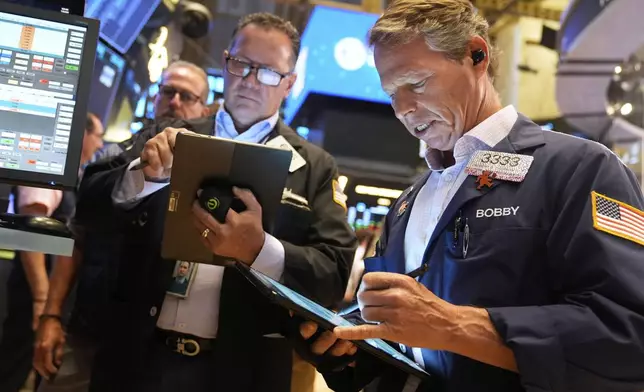
Traders work on the floor at the New York Stock Exchange in New York, Wednesday, July 30, 2025. (AP Photo/Seth Wenig)

Robert Charmak, right, works on the floor at the New York Stock Exchange in New York, Wednesday, July 30, 2025. (AP Photo/Seth Wenig)

Robert Charmak, right, works on the floor at the New York Stock Exchange in New York, Wednesday, July 30, 2025. (AP Photo/Seth Wenig)

Currency traders work near a screen showing the Korea Composite Stock Price Index (KOSPI), left, and the foreign exchange rate between U.S. dollar and South Korean won at the foreign exchange dealing room of the Hana Bank headquarters in Seoul, South Korea, Thursday, July 31, 2025. (AP Photo/Ahn Young-joon)

Currency traders work near a screen showing the Korea Composite Stock Price Index (KOSPI), left, and the foreign exchange rate between U.S. dollar and South Korean won at the foreign exchange dealing room of the Hana Bank headquarters in Seoul, South Korea, Thursday, July 31, 2025. (AP Photo/Ahn Young-joon)

Currency traders work near a screen showing the Korea Composite Stock Price Index (KOSPI), top center left, and the foreign exchange rate between U.S. dollar and South Korean won, top center, at the foreign exchange dealing room of the Hana Bank headquarters in Seoul, South Korea, Thursday, July 31, 2025. (AP Photo/Ahn Young-joon)

Currency traders work near a screen showing the Korea Composite Stock Price Index (KOSPI), top center left, and the foreign exchange rate between U.S. dollar and South Korean won, top center, at the foreign exchange dealing room of the Hana Bank headquarters in Seoul, South Korea, Thursday, July 31, 2025. (AP Photo/Ahn Young-joon)

Currency traders watch monitors near a screen showing the Korea Composite Stock Price Index (KOSPI), top left, and the foreign exchange rate between U.S. dollar and South Korean won, top center, at the foreign exchange dealing room of the Hana Bank headquarters in Seoul, South Korea, Thursday, July 31, 2025. (AP Photo/Ahn Young-joon)

Currency traders watch monitors near a screen showing the Korea Composite Stock Price Index (KOSPI), top left, and the foreign exchange rate between U.S. dollar and South Korean won, top center, at the foreign exchange dealing room of the Hana Bank headquarters in Seoul, South Korea, Thursday, July 31, 2025. (AP Photo/Ahn Young-joon)

A currency trader works near a screen showing the Korea Composite Stock Price Index (KOSPI) at the foreign exchange dealing room of the Hana Bank headquarters in Seoul, South Korea, Thursday, July 31, 2025. (AP Photo/Ahn Young-joon)

A currency trader works near a screen showing the Korea Composite Stock Price Index (KOSPI) at the foreign exchange dealing room of the Hana Bank headquarters in Seoul, South Korea, Thursday, July 31, 2025. (AP Photo/Ahn Young-joon)

The Dow Jones Industrial Average lost 0.7%, and the Nasdaq composite closed less than 0.1% lower.

Roughly 70% of stocks in the S&P 500 lost ground, with health care companies accounting for the biggest drag on the market.

Health care stocks sank after the White House released letters asking big pharmaceutical companies to cut prices and make other changes in the next 60 days. Eli Lilly & Co. fell 2.6%, UnitedHealth Group slid 6.2% and Bristol-Myers Squibb dropped 5.8%.

Gains by some big technology stocks with hefty values helped temper the impact of the broader market's decline.

Meta Platforms surged 11.3% after the parent company of Facebook and Instagram crushed Wall Street’s sales and profit targets even as the company continues to pour billions of dollars into artificial intelligence.

Microsoft climbed 3.9% after posting better results than analysts expected. The software pioneer also gave investors an encouraging update on its Azure cloud computing platform, which is a centerpiece of the company's artificial intelligence efforts.

Big Tech companies have regularly been the driving force behind much of the market's gains over enthusiasm for the future of artificial intelligence.

Elsewhere in the market, design software company Figma soared in its stock market debut. The stock vaulted 250% above its initial public offering price of $33 a share.

All told, the S&P 500 fell 23.51 points to 6,339.39. The Dow dropped 330.30 points to 44,130.98, and the Nasdaq gave up 7.23 points to finish at 21,122.45.

Earnings remain a key focus outside of the technology sector in what has been a heavy week so far for corporate financial results. CVS Health fell 0.3% after it topped Wall Street expectations for the second quarter and raised its full-year forecast again.

In economic news, the Commerce Department said prices rose 2.6% in June compared with a year ago, as measured by the personal consumption expenditures index. That's the Federal Reserve's preferred measure for inflation. The latest reading was slightly higher than economists expected and also marks an increase from an annual pace of 2.4% in May.

Results from another measure of inflation earlier this month, the consumer price index, also showed inflation rising in June.

Also on Thursday, a report showed that the number of Americans filing for unemployment benefits inched up last week.

The latest updates on inflation and the jobs market are landing amid lingering concerns about the impact of tariffs. Inflation's temperature is being closely monitored by businesses and the Fed to better gauge the impact of President Donald Trump’s on-again-off-again approach to import taxes. Companies including Ford and Hershey’s have more recently warned that tariffs are weighing on their latest and projected financial results.

Trump has said he will levy tariffs against goods from dozens of countries if they don’t reach agreements with the U.S. by Friday. The latest developments in the seemingly unpredictable tariff landscape include a potential pause in tariff escalations with China and a deal with South Korea.

However, Trump said Thursday that he would enter a 90-day negotiating period with Mexico over trade as 25% tariff rates stay in place.

The reasons behind trade policy decisions remain unpredictable. On Wednesday, Trump signed an executive order to impose his threatened 50% tariffs on Brazil. He has directly linked the import tax to the trial of his ally, the country’s former president Jair Bolsonaro. He has also said that trade negotiations with Canada would be more difficult in the wake of that nation's economically unrelated decision to recognize a Palestinian state.

Uncertainty over tariffs and inflation have prompted the Fed to leave its benchmark interest rate alone through the central bank's past five meetings, including the one that ended Wednesday. The Fed has been trying to cool the rate of inflation back to its target of 2%. It has come close, but inflation remains stubbornly stuck just above that target.

A cut in rates would give the job market and overall economy a boost, but it could also risk fueling inflation. Fed Chair Jerome Powell has been pressured by Trump to cut the benchmark rate, though that decision isn't his to make alone, but belongs to the 12 members of the Federal Open Market Committee.

“Inflation is only a bit above the Fed’s target, but looks likely to rise in the second half of the year due to tariffs," said Bill Adams, chief economist for Comerica Bank. “With the job market in pretty good shape, they see room to hold interest rates steady and lean against inflation’s increase near-term.”

Wall Street has been tempering their expectations for rate cuts at the Fed's next meeting in September. Traders now see a 39% chance of a rate cut, according to data from CME Group. That's down from 58.4% a week ago and a 75.4% chance a month ago.

Treasury yields held steady in the bond market. The yield on the 10-year Treasury was unchanged at 4.37%. The yield on the two-year Treasury remained at 3.94% from late Wednesday.

Markets were mostly mixed in Asia and Europe.
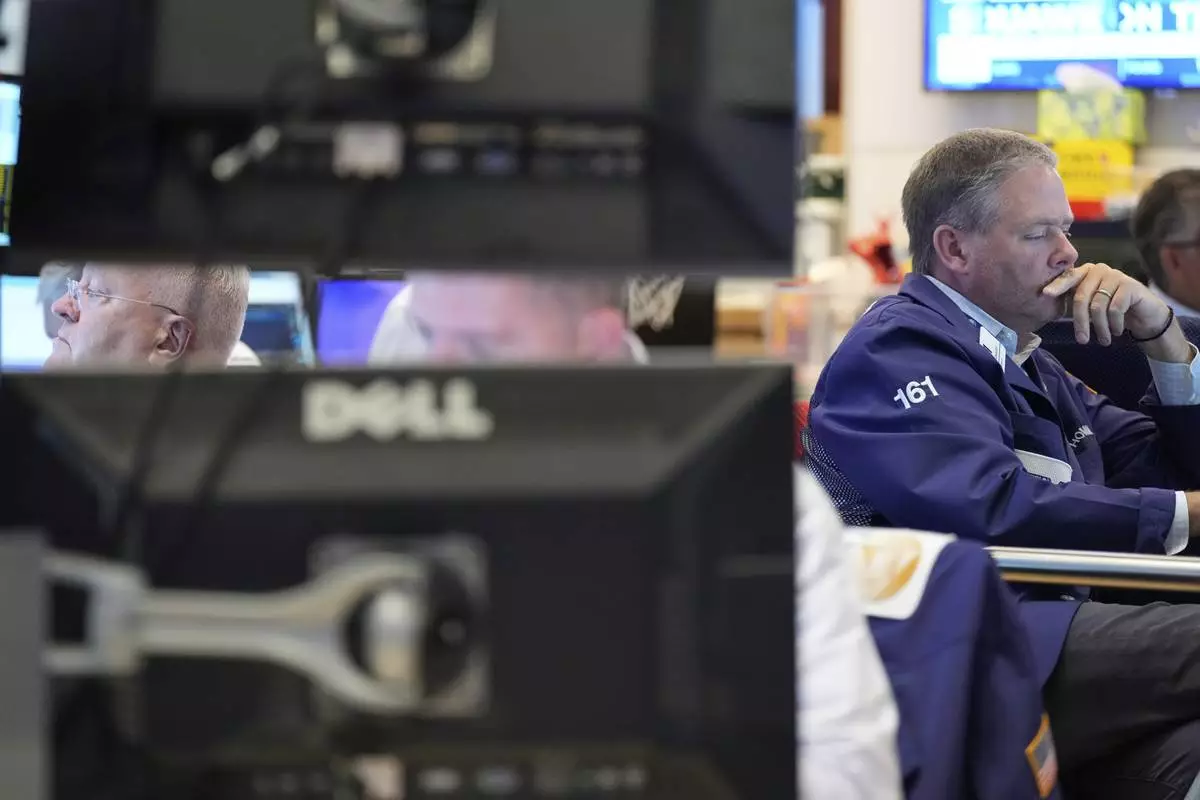
Traders work on the floor at the New York Stock Exchange in New York, Wednesday, July 30, 2025. (AP Photo/Seth Wenig)
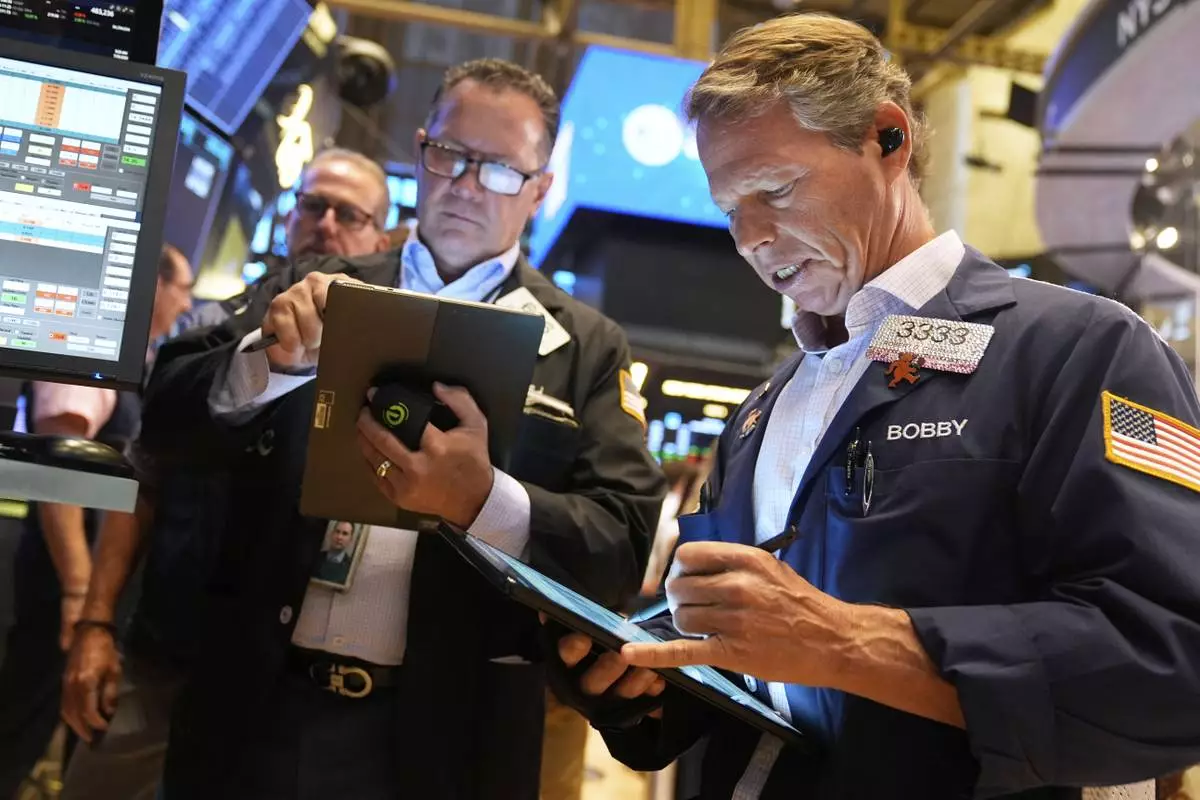
Traders work on the floor at the New York Stock Exchange in New York, Wednesday, July 30, 2025. (AP Photo/Seth Wenig)

Robert Charmak, right, works on the floor at the New York Stock Exchange in New York, Wednesday, July 30, 2025. (AP Photo/Seth Wenig)

Robert Charmak, right, works on the floor at the New York Stock Exchange in New York, Wednesday, July 30, 2025. (AP Photo/Seth Wenig)

Currency traders work near a screen showing the Korea Composite Stock Price Index (KOSPI), left, and the foreign exchange rate between U.S. dollar and South Korean won at the foreign exchange dealing room of the Hana Bank headquarters in Seoul, South Korea, Thursday, July 31, 2025. (AP Photo/Ahn Young-joon)

Currency traders work near a screen showing the Korea Composite Stock Price Index (KOSPI), left, and the foreign exchange rate between U.S. dollar and South Korean won at the foreign exchange dealing room of the Hana Bank headquarters in Seoul, South Korea, Thursday, July 31, 2025. (AP Photo/Ahn Young-joon)

Currency traders work near a screen showing the Korea Composite Stock Price Index (KOSPI), top center left, and the foreign exchange rate between U.S. dollar and South Korean won, top center, at the foreign exchange dealing room of the Hana Bank headquarters in Seoul, South Korea, Thursday, July 31, 2025. (AP Photo/Ahn Young-joon)

Currency traders work near a screen showing the Korea Composite Stock Price Index (KOSPI), top center left, and the foreign exchange rate between U.S. dollar and South Korean won, top center, at the foreign exchange dealing room of the Hana Bank headquarters in Seoul, South Korea, Thursday, July 31, 2025. (AP Photo/Ahn Young-joon)
Currency traders watch monitors near a screen showing the Korea Composite Stock Price Index (KOSPI), top left, and the foreign exchange rate between U.S. dollar and South Korean won, top center, at the foreign exchange dealing room of the Hana Bank headquarters in Seoul, South Korea, Thursday, July 31, 2025. (AP Photo/Ahn Young-joon)
Currency traders watch monitors near a screen showing the Korea Composite Stock Price Index (KOSPI), top left, and the foreign exchange rate between U.S. dollar and South Korean won, top center, at the foreign exchange dealing room of the Hana Bank headquarters in Seoul, South Korea, Thursday, July 31, 2025. (AP Photo/Ahn Young-joon)
A currency trader works near a screen showing the Korea Composite Stock Price Index (KOSPI) at the foreign exchange dealing room of the Hana Bank headquarters in Seoul, South Korea, Thursday, July 31, 2025. (AP Photo/Ahn Young-joon)
A currency trader works near a screen showing the Korea Composite Stock Price Index (KOSPI) at the foreign exchange dealing room of the Hana Bank headquarters in Seoul, South Korea, Thursday, July 31, 2025. (AP Photo/Ahn Young-joon)

MADISON, Wis. (AP) — Democrats across the country are proposing state law changes to rein in federal immigration officers and protect the public following the shooting death of a protester in Minneapolis and the wounding of two people in Portland, Oregon.

Many of the measures have been proposed in some form for years in Democratic-led states, but their momentum is growing as legislatures return to work amid President Donald Trump’s national immigration crackdown following the killing of Renee Good by an Immigration and Customs Enforcement agent in Minneapolis. Republicans are pushing back, blaming protesters for impeding enforcement of immigration laws.

Democratic Gov. Kathy Hochul wants New York to allow people to sue federal officers alleging violations of their constitutional rights. Another measure aims to keep immigration agents lacking judicial warrants out of schools, hospitals and houses of worship.

Oregon Democrats plan to introduce a bill to allow residents to sue federal agents for violating their Fourth Amendment rights against unlawful search and seizure.

New Jersey’s Democrat-led Legislature passed three bills on Monday that immigrant rights groups have long pushed for, including a measure prohibiting state law enforcement officers from cooperating with federal immigration enforcement. Democratic Gov. Phil Murphy has until his last day in office Tuesday to sign or veto them.

California lawmakers are proposing to ban local and state law enforcement from taking second jobs with the Department of Homeland Security and make it a violation of state law when ICE officers make “indiscriminate” arrests around court appearances. Other measures are pending.

“Where you have government actions with no accountability, that is not true democracy,” Democratic state Sen. Scott Wiener of San Francisco said at a news conference.

Democrats in Georgia introduced four Senate bills designed to limit immigration enforcement — a package unlikely to become law because Georgia’s conservative upper chamber is led by Lt. Gov. Burt Jones, a close Trump ally. Democrats said it's still important to take a stand.

“Donald Trump has unleashed brutal aggression on our families and our communities across our country,” said state Sen. Sheikh Rahman, an immigrant from Bangladesh whose district in suburban Atlanta’s Gwinnett County is home to many immigrants.

Democrats in New Hampshire have proposed numerous measures seeking to limit federal immigration enforcement, but the state's Republican majorities passed a new law taking effect this month that bans “sanctuary cities.”

In Tennessee, instead of considering a Democratic measure that would limit civil immigration enforcement at schools and churches, Republican House Speaker Cameron Sexton said he was working with the White House on a separate package of immigration-related bills. He hasn't said what they would do.

The Trump administration has opposed any effort to blunt ICE, including suing local governments whose “sanctuary” policies limit police interactions with federal officers.

States have broad power to regulate within their borders unless the U.S. Constitution bars it, but many of these laws raise novel issues that courts will have to sort out, said Harrison Stark, senior counsel with the State Democracy Research Initiative at the University of Wisconsin Law School.

“There’s not a super clear, concrete legal answer to a lot of these questions,” he said. “It’s almost guaranteed there will be federal litigation over a lot of these policies.”

That's already happening.

California in September was the first to ban most law enforcement officers, including federal immigration agents, from covering their faces on duty. The Justice Department said its agents won't comply and sued California, arguing that the laws threaten the safety of officers who are facing “unprecedented” harassment, doxing and violence.

The Justice Department also sued Illinois last month, challenging a law that bars federal civil arrests near courthouses, protects medical records and regulates how universities and day care centers manage information about immigration status. The Justice Department claims the law is unconstitutional and also threatens federal officers’ safety.

Minnesota and Illinois, joined by their largest cities, sued the Trump administration this week. Minneapolis and Minnesota accuse the Republican administration of violating free speech rights by punishing a progressive state that favors Democrats and welcomes immigrants. Illinois and Chicago claim “Operation Midway Blitz” made residents afraid to leave their homes.

Homeland Security spokesperson Tricia McLaughlin accused Minnesota officials of ignoring public safety and called the Illinois lawsuit “baseless.”

Associated Press writers John O’Connor in Springfield, Illinois; Sophie Austin in Sacramento, California; Mike Catalini in Trenton, New Jersey; Jonathan Mattise in Nashville, Tennessee; Anthony Izaguirre in Albany, New York; Claire Rush in Portland, Oregon; and Jeff Amy in Atlanta contributed.

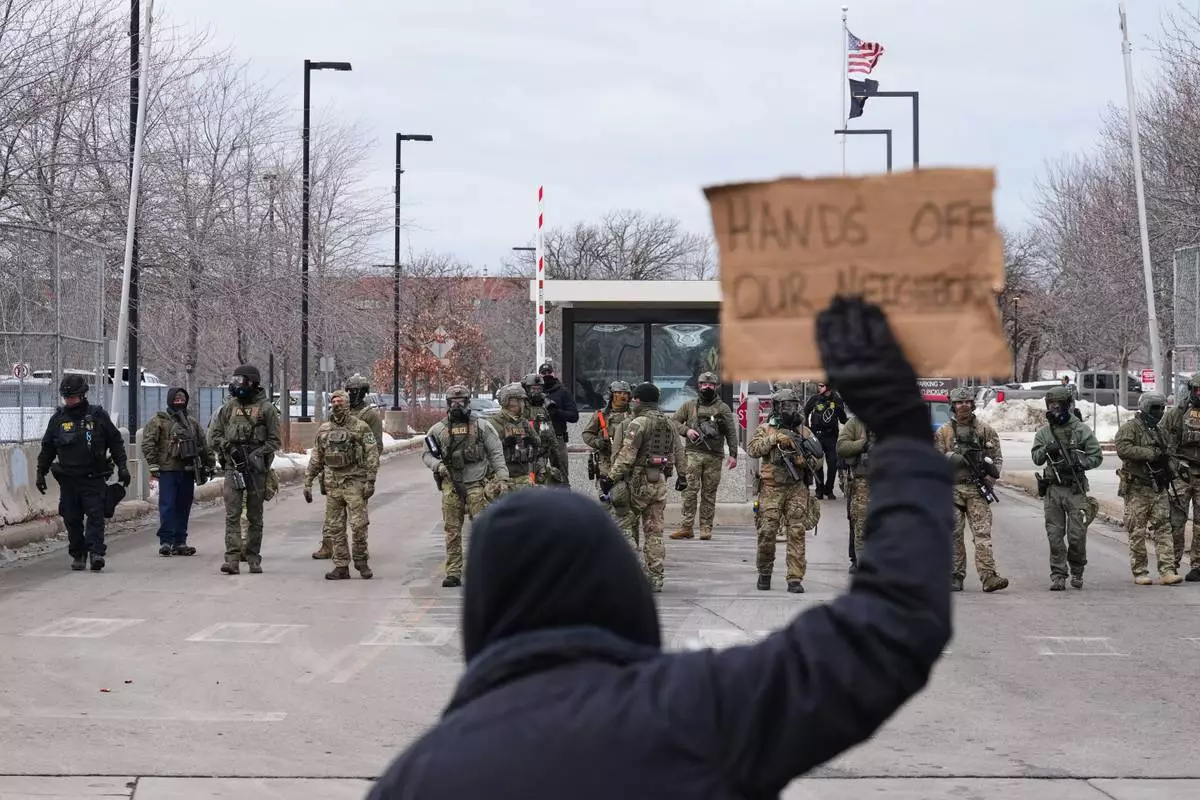
Protesters confront federal immigration officers outside the Bishop Henry Whipple Federal Building, Tuesday, Jan. 13, 2026, in Minneapolis. (AP Photo/Adam Gray)

Protesters confront federal immigration officers outside the Bishop Henry Whipple Federal Building, Tuesday, Jan. 13, 2026, in Minneapolis. (AP Photo/Adam Gray)

Recommended Articles