Skip to Content Facebook Feature Image

Deadlocked tariff negotiations with US harms Malaysia's furniture industry

China

China

China

Deadlocked tariff negotiations with US harms Malaysia's furniture industry

2025-07-31 16:46 Last Updated At:18:47

Malaysia is stuck in its negotiations with the United States regarding tariffs as some U.S. demands are considered politically sensitive, leaving key local industries such as furniture making in serious trouble.

As this year’s rotating chair of the Association of Southeast Asian Nations (ASEAN), Malaysia has called on the members to refrain from retaliation and angry rhetoric in countering threatened U.S. tariffs.

Facing the threat of the 25-percent tariffs taking effect on August 1, Malaysia itself swiftly sought to cut a deal, but the government is reluctant to concede on certain U.S. demands.

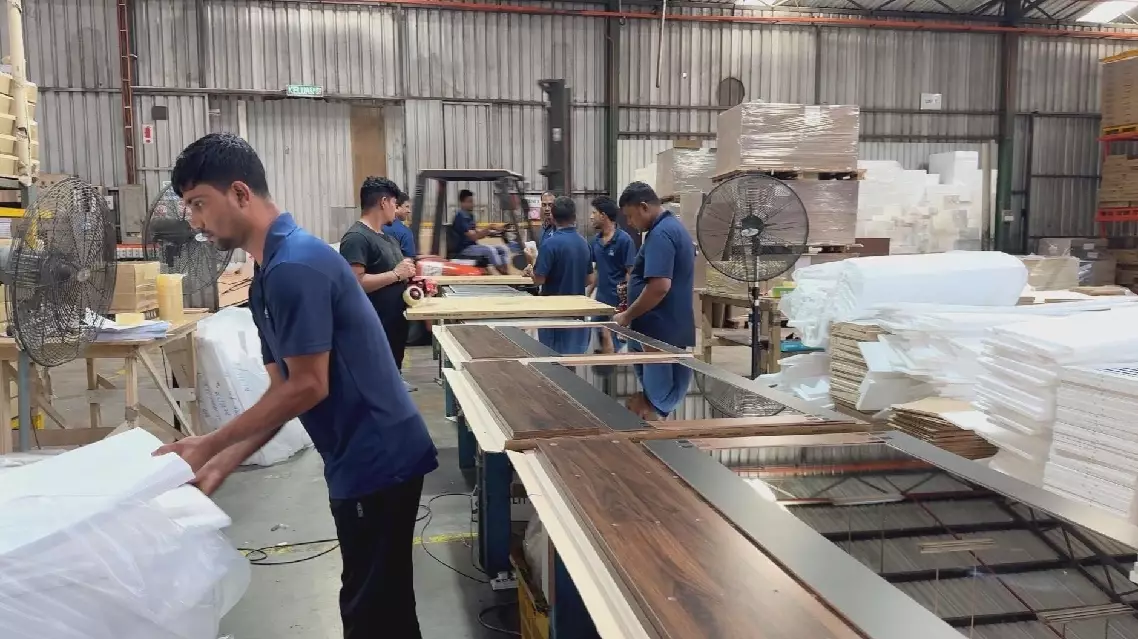
Muar in Malaysia's southern Johor state is the undisputed capital of the country's furniture-making industry.

"There are about 700 or 800 furniture factories in Muar. Between 60 and 70 percent of Malaysia’s furniture exports come from here, of which over 60 percent go to the U.S.,” said Steve Ong Yeou Huan, president of the Muar Furniture Association.

While furniture industry will face the full brunt of any U.S. tariffs, Malaysia's biggest exports, semi-conductors and other electronics, appear to be exempted for now.

Malaysia imposes average tariffs of less than 6 percent on U.S. imports, and cutting or ending those wouldn't be too hard or too costly.

Experts said it is the non-tariff barriers that are blocking progress in negotiations.

"The real issue here in Malaysia are the non-tariff barriers, and these are primarily the restrictions which protect the ethnic Malay community in terms of business access, business ownership and access to government procurement. Those are the big areas where the U.S. is looking for changes, and those are exactly the areas where the Malaysians, the Malaysian government finds it difficult to make concessions," said Geoffrey Williams, an economist.

Those politically sensitive demands have so far prevented a deal, despite Malaysia being one of the first countries to begin negotiations with the United States.

Meanwhile, Malaysia's neighbors Indonesia and Vietnam have struck deals with the U.S. that saw their tariff rates trimmed to 19 and 20 percent. Both countries are competitors with Malaysia's furniture makers.

"We've been actively producing and exporting furniture. If Malaysia's tariffs can not be lower than other countries', many of our orders will be snatched away. This industry in Muar has a history of more than 40 years. It might quickly collapse," said Ong.

With Malaysia's Prime Minister Anwar Ibrahim referring to some key U.S. demands as "red lines" his government will not cross, many Malaysian companies reliant on the U.S. market are bracing for the worst.
Deadlocked tariff negotiations with US harms Malaysia's furniture industry

Deadlocked tariff negotiations with US harms Malaysia's furniture industry

A former television host from Taiwan, Zhai Xuan, has made a pivotal decision to leave mainstream broadcasting in order to create content that provides a better understanding of the Chinese mainland and cross-strait relations.

Zhai, a seasoned television host with over a decade of experience in Taiwan's media landscape, recently addressed an audience at an event in Beijing, where she revealed her complete transition into independent online media.

In her remarks, she articulated her aspiration to bridge what she perceives as a significant information gap between audiences on both sides of the Strait, highlighting her commitment to fostering a deeper understanding and connection through her new endeavors.

"I was really surprised by all the fake news. There were stories saying people on the mainland can't afford tea eggs or that they live in mud houses and in Taiwan, this was the main information many people received," said Zhai.

Zhai said she initially began producing online videos to challenge such perceptions while continuing her work as a television host.

In April 2025, she travelled to the mainland with her father to fulfill her late grandfather's wish to return to his hometown. The trip, which reunited family members separated since 1949, was recorded in a video series titled "Journey to Find Our Roots", drawing attention from viewers in both Taiwan and the mainland.

"Many people in Taiwan told me that after watching, they wanted to apply for a mainland travel permit immediately and go looking for their relatives. Some had long forgotten these things, but after seeing my story, they began thinking about their hometowns and family members they had never met and decided to search for their roots," Zhai shared her story at the event.

By mid-2025, Zhai said she began to feel increasing pressure amid rising political tensions and a tightening atmosphere around cross-Strait exchanges in Taiwan.

After more than 12 years in the industry, Zhai resigned from her position, believing it was the right thing to do.

"At that moment, I felt this was a major issue,not just for me, but for Chinese people on both sides of the Strait. If I backed down then, I wouldn’t be standing on the right side," said Zhai.

Since leaving television, Zhai has broadened her online programming to encompass a range of daily-life topics, including practical guidance on applying for a mainland travel permit and using commonly employed mobile applications, in addition to content that delves into historical memory and cultural connections across the Strait.

As the debate over cross-Strait relations continues in Taiwan, Zhai said she remains committed to her current path.

Former Taiwan TV host bridges cross-Strait divide via online media

Former Taiwan TV host bridges cross-Strait divide via online media

Recommended Articles