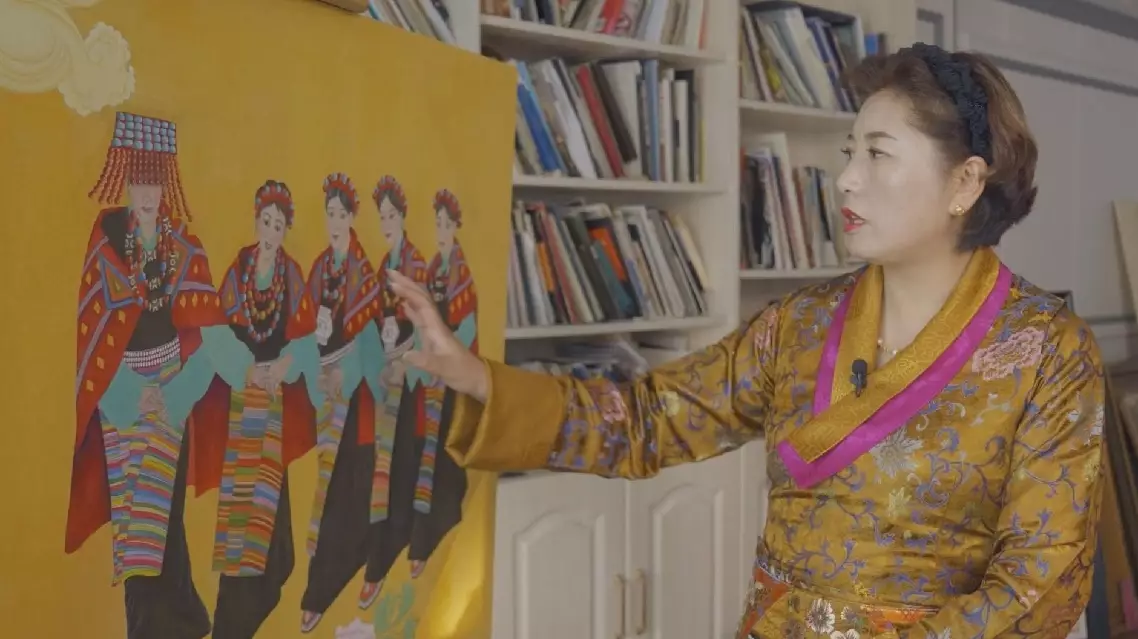
On the vast plateau of Xizang, artist Sonam Pema dips her brush into vivid pigments, bringing to life a centuries old tradition with contemporary flair.
Her cloth-based heavy color paintings, a Tibetan art form featuring rich textures on fabric, have become a powerful medium for cultural storytelling. The protagonists of her paintings are often women from the plateau.
"Like the Galsang flowers of the snowy plateau, Tibetan women possess a tenacious vitality and embody the purest, kindest hearts. Through my artwork, I aim to express their love for life and help more people understand the women of the plateau," Sonam Pema said as she was working on her latest piece.
Art originates from life. The painter has frequently traveled to rural communities, sitting with local women to understand their daily lives.
"When I go to the countryside for inspiration, I try to understand their preferences, habits, and life experiences. I see their attitudes toward life through their experiences. My works must first touch me before I can strive to touch other people," she said.
Her artistic journey began under the guidance of her father Tsering Dorje, one of Tibet's first generation oil painters and a nationally celebrated artist.
"She strives to integrate Tibetan culture with foreign cultures. As a native female Tibetan artist, she has achieved considerable success. I believe she can forge a new path in combining modern and traditional paintings," said her father.
And that's exactly what she has been doing, experimenting with different styles and techniques to discover the perfect modern and traditional paintings.
"In this piece, I used traditional Chinese painting techniques for the face, hands, and body. However, since Chinese painting techniques couldn't fully capture the heaviness of the clothing in the Ngari region, I have employed oil painting techniques for the Tibetan robes to emphasize their three-dimensional texture," she said.
More than technical mastery, it is the emotional truth in her work that resonates. When depicting Tibetan women dancing, Sonam Pema captures not just their movements but the radiant pride in their expressions.
"When I saw these women dressed in traditional attire performing folk dances, and their faces were radiant with joy, I could feel their deep love for their land and their lives. It touched me deeply, and I wanted to capture that moment with my brush. I hope to touch more people and help them better understand Xizang through my paintings," she said.
Now mentoring her son in these artistic traditions, Sonam Pema looks to the future, watching the next generation reinterpret their heritage. Through exhibitions and teaching, she ensures that this ancient art form continues evolving,and its vibrant colors carry Tibetan stories to new audiences across time and space.
Tibetan Artist reimagines traditional cloth painting with modern vision