China's commitment to global development cooperation, climate action, and green development plays a pivotal role in achieving higher-level sustainability goals, particularly the urgent need to stay below the critical 1.5 degrees Celsius global warming limit, according to UN Under-Secretary-General Jorge Moreira da Silva.
The 1.5.degrees Celsius limit marks a tipping point in the Earth's climate system. Exceeding this threshold would exponentially increase the risk of cascading disasters, such as desertification, ice sheet collapse, and extreme weather events, according to reports.
Against this backdrop, China has pledged to peak carbon dioxide emissions by 2030 and achieve carbon neutrality by 2060. By championing cooperation, sharing, and win-win outcomes, China not only accelerates its own transition but also offers stability and optimism to the global community, a crucial force in the fight against climate change.
In an exclusive interview with China Central Television (CCTV) aired on Friday, Da Silva, who is also the director of the UN Office for Project Services (UNOPS), highlighted the gravity of the global climate crisis. He praised China's proactive efforts as vital to addressing the escalating challenges, while warning of the risks of failing to meet the 2030 Agenda. "I think that there is an important contribution that we all must provide in support of the 2030 Agenda. Let's not forget the 2030 Agenda is not an environmental agenda, it is a sustained development agenda, which is about economic, environmental, and social dimensions. We must address this in a moment where we are off track," he said.
He emphasized that, so far, only 17 percent of the 17 Sustainable Development Goals (SDGs) established in 2015 are on track, while about 30 percent of these goals have regressed. "At the same time, the other key pillar of the 2030 Agenda was the climate agreement, the Paris Agreement, and we all agreed, all nations agreed to commit to reduce emissions at home and to partner with other nations to help them reduce emissions in ways that will put us in a pathway to limiting the increase of temperature to 1.5 degrees Celsius. But today, if you take all the commitments from member states, we are in a path, not to 1.5, but 2.6 to 2.9 degrees Celsius," said Da Silva. The UN official called for urgent global solidarity ahead of COP30, stressing the critical need to address climate targets and collective action.
"And finally, we are off track on solidarity. Because what the numbers tell us is that developing countries are missing every year four trillion U.S. dollars to implement the SDGs. So we agreed on the SDGs, but developing countries are missing four trillion U.S. dollars every year. We'll get in Belem of Para by the end of the year COP30 on climate. It's the moment where the world must respond: Are we fixing our national targets, and our solidarity to ensure that we will reach 1.5 degrees Celsius? Or are we pursuing in a complacent manner towards 2.9 degrees Celsius? This is the moment of truth. We have to answer to these questions," he said.
Highlighting China's dual approach to domestic and international sustainable progress, da Silva commended its efforts in renewable energy and electric mobility as proof that green development can drive economic growth and global collaboration.
"So I hope that with China's commitment on development cooperation and on climate and on the green agenda, we can all pursue towards the highest ambition. I want to recall that China has made very significant efforts on renewable energy, on electrical mobility. This shows that it is possible to go green and to generate jobs, and economy. China is doing this domestically, but is also doing this in partnership with developing countries," he said.
COP30 is scheduled to take place this November in Brazil's Belem, a city in the heart of the Amazon rain forest. Officials explained that this location was chosen not only to draw attention to vulnerable ecosystems under threat from climate change, but also to highlight the crucial role that nature-based solutions, such as forest restoration, play in climate mitigation.
The 2030 Agenda for Sustainable Development is a global initiative adopted by United Nations Member States in 2015. It focuses on eradicating poverty, protecting the planet, and ensuring prosperity for all through 17 SDGs.
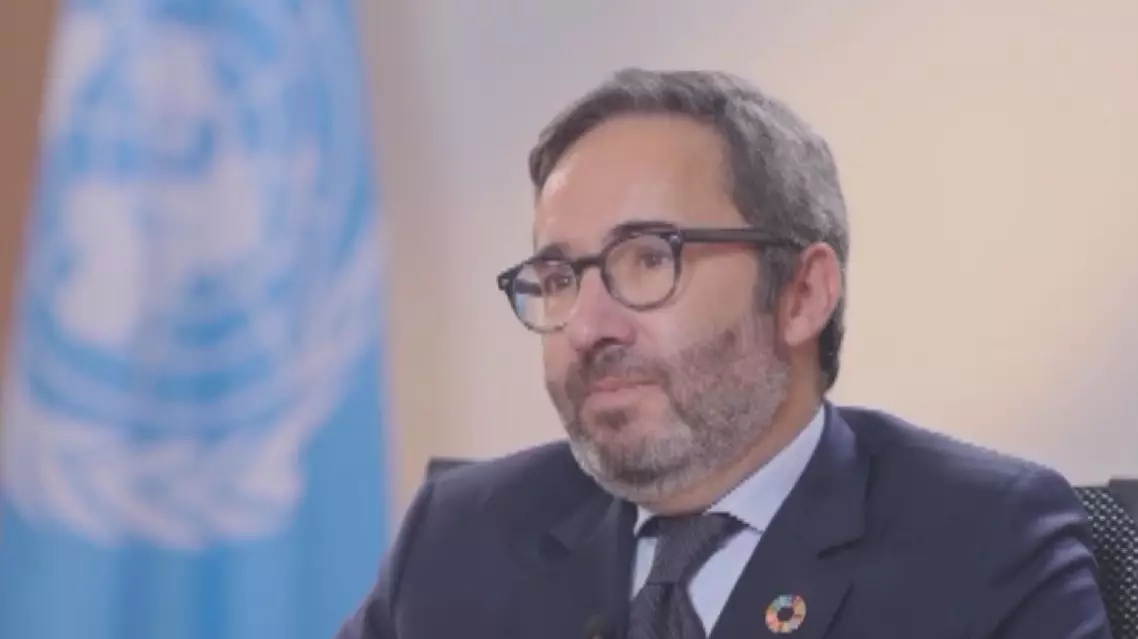
UN official praises China’s leadership on climate, green development ahead of COP30