GENEVA (AP) — After weeks of working with U.S. officials to try to avoid hefty tariffs on Swiss goods, negotiators from Switzerland got assurances that a deal was all but done. Swiss businesses vowed to pour tens of billions in investment in the United States in the coming years.
Still, President Donald Trump said no to any special deal. Now a scramble is underway ahead of Thursday, the deadline for when the whopping 39% tariff on Swiss products announced last week goes into effect.
Switzerland’s President Karin Keller-Sutter and other top officials traveled to Washington on Tuesday to try to convince Trump that the measure — among the highest from the Trump administration — was too much and could cut profits for famed Swiss industries like chocolates and watchmaking.
The new rate is over 2 1/2 times higher than the one on European Union goods exported to the U.S. and nearly four times higher than on British exports to the U.S. — raising questions about Switzerland’s ability to compete with the 27-member bloc that it neighbors.
Under the U.S. announcements from last Friday, the export duties imposed on Swiss companies will now only be surpassed by those on firms from Laos, Myanmar and Syria, which are facing 40-41% rates.
Switzerland's case is a lesson in do’s and don’ts of doing business with Trump. The thinking goes, if a rich country with economic might that excels in technology, pharmaceuticals and finance can’t convince the U.S. president to scale back the high tariffs, who can?
Trump himself seems to be focused on a single, high number: Switzerland’s trade surplus in goods with the U.S.
In an interview with CNBC on Tuesday, Trump alluded to a recent call he had with Keller-Sutter, saying “the woman was nice, but she didn’t want to listen” and that he had told her: “We have a $41 billion deficit with you, Madame.”
It was not immediately clear where that $41 billion figure came from. According to the U.S. Census Bureau, the U.S. ran a $38.3 billion trade imbalance on goods last year with Switzerland. That figure excludes exports of services.
Keller-Sutter, who also serves as Switzerland’s finance minister, has faced criticism in Swiss media over the last-ditch call with Trump before a U.S. deadline on tariffs expired Aug. 1, which some say appeared to make things worse.
The 39% rate is even higher than the 31% on Swiss goods announced on Trump's “Liberation Day” in early April — before the Swiss started negotiating with U.S. officials. The new figure took many Swiss business leaders by surprise.
“It’s hard to negotiate when you’re dealing with someone as unpredictable as Donald Trump,” said Ivan Slatkine, head of the Federation of Romandie Enterprises, which groups companies in the French-speaking part of Switzerland.
“We had a (Swiss) government that gave the impression the deal was done, it only awaited a signature from the president,” Slatkine told The Associated Press over the phone. “We have the impression that we were punished, but we don’t know why.”
The United States is Switzerland’s second-biggest trading partner after the EU, which nearly surrounds the Alpine country of more than 9 million.
The Swiss government said Tuesday's trip was meant to “facilitate meetings with the U.S. authorities at short notice and hold talks with a view to improving the tariff situation for Switzerland.”
Swiss officials have argued that American goods face virtually zero tariffs in Switzerland, and the Swiss government says the wealthy Alpine country is the sixth-biggest foreign investor in the U.S. and the leading investor in research and development.
Switzerland’s powerful pharmaceutical industry — which promised tens of billions of investments in the U.S. in recent months amid the tariff worries — is exempt from the 39% rate.
But Slatkine said the steep tariff level could be aimed to send Switzerland's Big Pharma — epitomized by Roche and Novartis — a message that it too could come under pressure.
The trip comes a day after Switzerland’s executive branch, the Federal Council, held an extraordinary meeting and said it was “keen to pursue talks with the United States on the tariff situation,” according to a government statement.
After consulting with Swiss businesses, the council said it had developed “new approaches for its discussions” with U.S. officials and was looking ahead to continued negotiations.
"Switzerland enters this new phase ready to present a more attractive offer, taking U.S. concerns into account and seeking to ease the current tariff situation," the council said.
According to figures published by the Swiss Embassy in Washington, the U.S. has been Switzerland’s most important goods export market since 2021, while Switzerland is the fourth most important export market for U.S. services — not goods.
The bilateral trade volume in goods and services between Switzerland and the U.S. reached a total of $185.9 billion in 2023, the embassy says on its website.

FILE - Swiss federal president Karin Keller-Sutter attends the Informal Meeting of EU Ministers for Economic and Financial Affairs and Central Bank Governors in Warsaw, Poland, on April 11, 2025. (AP Photo/Czarek Sokolowski, File)
MADISON, Wis. (AP) — Democrats across the country are proposing state law changes to rein in federal immigration officers and protect the public following the shooting death of a protester in Minneapolis and the wounding of two people in Portland, Oregon.
Many of the measures have been proposed in some form for years in Democratic-led states, but their momentum is growing as legislatures return to work amid President Donald Trump’s national immigration crackdown following the killing of Renee Good by an Immigration and Customs Enforcement agent in Minneapolis. Republicans are pushing back, blaming protesters for impeding enforcement of immigration laws.
Democratic Gov. Kathy Hochul wants New York to allow people to sue federal officers alleging violations of their constitutional rights. Another measure aims to keep immigration agents lacking judicial warrants out of schools, hospitals and houses of worship.
Oregon Democrats plan to introduce a bill to allow residents to sue federal agents for violating their Fourth Amendment rights against unlawful search and seizure.
New Jersey’s Democrat-led Legislature passed three bills on Monday that immigrant rights groups have long pushed for, including a measure prohibiting state law enforcement officers from cooperating with federal immigration enforcement. Democratic Gov. Phil Murphy has until his last day in office Tuesday to sign or veto them.
California lawmakers are proposing to ban local and state law enforcement from taking second jobs with the Department of Homeland Security and make it a violation of state law when ICE officers make “indiscriminate” arrests around court appearances. Other measures are pending.
“Where you have government actions with no accountability, that is not true democracy,” Democratic state Sen. Scott Wiener of San Francisco said at a news conference.
Democrats in Georgia introduced four Senate bills designed to limit immigration enforcement — a package unlikely to become law because Georgia’s conservative upper chamber is led by Lt. Gov. Burt Jones, a close Trump ally. Democrats said it's still important to take a stand.
“Donald Trump has unleashed brutal aggression on our families and our communities across our country,” said state Sen. Sheikh Rahman, an immigrant from Bangladesh whose district in suburban Atlanta’s Gwinnett County is home to many immigrants.
Democrats in New Hampshire have proposed numerous measures seeking to limit federal immigration enforcement, but the state's Republican majorities passed a new law taking effect this month that bans “sanctuary cities.”
In Tennessee, instead of considering a Democratic measure that would limit civil immigration enforcement at schools and churches, Republican House Speaker Cameron Sexton said he was working with the White House on a separate package of immigration-related bills. He hasn't said what they would do.
The Trump administration has opposed any effort to blunt ICE, including suing local governments whose “sanctuary” policies limit police interactions with federal officers.
States have broad power to regulate within their borders unless the U.S. Constitution bars it, but many of these laws raise novel issues that courts will have to sort out, said Harrison Stark, senior counsel with the State Democracy Research Initiative at the University of Wisconsin Law School.
“There’s not a super clear, concrete legal answer to a lot of these questions,” he said. “It’s almost guaranteed there will be federal litigation over a lot of these policies.”
That's already happening.
California in September was the first to ban most law enforcement officers, including federal immigration agents, from covering their faces on duty. The Justice Department said its agents won't comply and sued California, arguing that the laws threaten the safety of officers who are facing “unprecedented” harassment, doxing and violence.
The Justice Department also sued Illinois last month, challenging a law that bars federal civil arrests near courthouses, protects medical records and regulates how universities and day care centers manage information about immigration status. The Justice Department claims the law is unconstitutional and also threatens federal officers’ safety.
Minnesota and Illinois, joined by their largest cities, sued the Trump administration this week. Minneapolis and Minnesota accuse the Republican administration of violating free speech rights by punishing a progressive state that favors Democrats and welcomes immigrants. Illinois and Chicago claim “Operation Midway Blitz” made residents afraid to leave their homes.
Homeland Security spokesperson Tricia McLaughlin accused Minnesota officials of ignoring public safety and called the Illinois lawsuit “baseless.”
Associated Press writers John O’Connor in Springfield, Illinois; Sophie Austin in Sacramento, California; Mike Catalini in Trenton, New Jersey; Jonathan Mattise in Nashville, Tennessee; Anthony Izaguirre in Albany, New York; Claire Rush in Portland, Oregon; and Jeff Amy in Atlanta contributed.
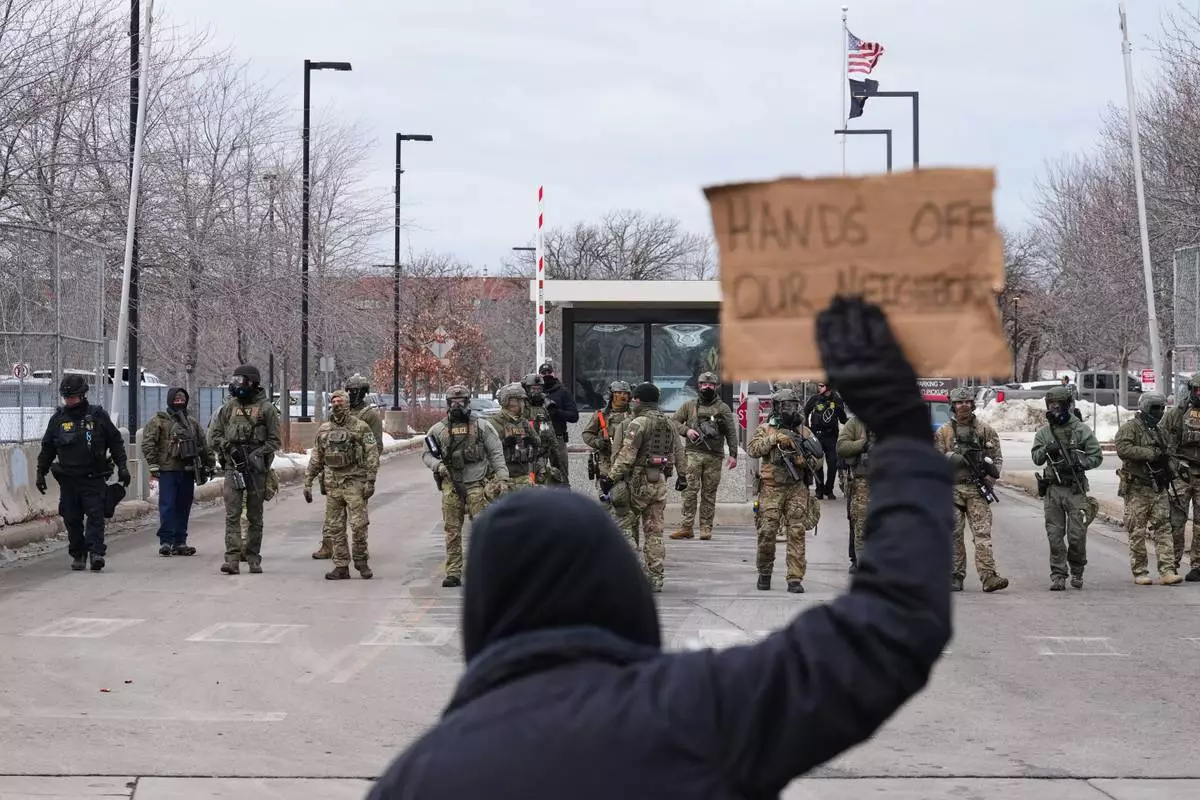
Protesters confront federal immigration officers outside the Bishop Henry Whipple Federal Building, Tuesday, Jan. 13, 2026, in Minneapolis. (AP Photo/Adam Gray)