MANILA, Philippines--(BUSINESS WIRE)--Aug 5, 2025--
Black & Veatch, a global leader in human critical infrastructure, has successfully delivered the Philippines’ first megawatt-scale floating solar photovoltaic (PV) facility, marking a milestone in renewable energy innovation and sustainable mining practices.
This press release features multimedia. View the full release here: https://www.businesswire.com/news/home/20250805571227/en/
Commissioned by Carmen Copper Corporation, the 3-hectare floating solar array on Malubog Reservoir features 8,540 solar panels generating up to 4.99 megawatts (MW) of clean energy — enough to meet 10% of the mine’s power needs, the first step to meeting the Philippines Department of Energy goal of 35% by 2030. The project is designed to scale up to 50 MW, with the potential to fully power Carmen Copper’s operations with renewable energy.
“This project exemplifies how engineering excellence and environmental stewardship can converge to deliver transformative infrastructure,” said Jerin Raj, Asia Pacific managing director for Black & Veatch. “Our engineering, procurement and construction professionals worked alongside the Carmen Copper team to complete this project on time and on budget in just 15 months, with more than 250,000 man-hours without lost time due to injury. We are incredibly proud of our team that delivered this first-of-a-kind facility in the Philippines.”
Built by a proven EPC leader
Black & Veatch served as the EPC contractor — a role that encompasses engineering, procurement and construction — managing every phase from design and sourcing to installation and commissioning. As a trusted EPC partner, Black & Veatch brings more than 100 years of experience managing large, complex infrastructure projects across energy, water, telecommunications and AI data center sectors.
“This initiative reflects Carmen Copper’s commitment to responsible mining and environmental stewardship, while aligning with the Department of Energy’s target to have renewable energy account for at least half of the country’s total power capacity by 2040,” said Atty. Axel G. Tumulak, Carmen Copper Head of Legal, Compliance, and Corporate Governance. Carmen Copper is a wholly owned subsidiary of Atlas Consolidated Mining and Development Corporation.
A model for sustainable mining
Floating solar — also known as floatovoltaics — offers a compelling solution for land-constrained regions. By utilizing water surfaces, it improves panel efficiency through natural cooling and reduces water evaporation. This project sets a benchmark for replicable, scalable renewable energy solutions in mining and other industrial sectors.
Using solar panels fixed at a constant tilt angle, the power from the sun will prove invaluable during peak energy hours, paring dependence on fossil fuels while underscoring Carmen Copper’s desire to meet environmental compliance standards and achieve its own goals to be more energy responsible.
Editor’s notes:
About Black & Veatch
Black & Veatch is a 100-percent employee-owned global engineering, procurement, consulting and construction company with a more than 100-year track record of innovation in sustainable infrastructure. Since 1915, we have helped our clients improve the lives of people around the world by addressing the resilience and reliability of our most important infrastructure and energy assets. Learn more about us at the Black & Veatch newsroom and follow us on LinkedIn, Facebook, Instagram and X.

Black & Veatch powers the Philippines’ first megawatt-scale floating solar facility, Carmen Copper
A federal appeals panel on Thursday reversed a lower court decision that released former Columbia University graduate student Mahmoud Khalil from an immigration jail, bringing the government one step closer to detaining and ultimately deporting the Palestinian activist.
The three-judge panel of the 3rd U.S. Circuit Court of Appeals didn’t decide the key issue in Khalil’s case: whether the Trump administration’s effort to throw Khalil out of the U.S. over his campus activism and criticism of Israel is unconstitutional.
But in its 2-1 decision, the panel ruled a federal judge in New Jersey didn’t have jurisdiction to decide the matter at this time. Federal law requires the case to fully move through the immigration courts first, before Khalil can challenge the decision, they wrote.
“That scheme ensures that petitioners get just one bite at the apple — not zero or two,” the panel wrote. “But it also means that some petitioners, like Khalil, will have to wait to seek relief for allegedly unlawful government conduct.”
The law bars Khalil “from attacking his detention and removal in a habeas petition,” the panel added.
It was not clear whether the government would seek to detain Khalil, a legal permanent resident, again while his legal challenges continue.
Thursday’s decision marked a major win for the Trump administration’s sweeping campaign to detain and deport noncitizens who joined protests against Israel.
In a statement distributed by the American Civil Liberties Union, Khalil said the appeals ruling was “deeply disappointing, but it does not break our resolve.”
He added: “The door may have been opened for potential re-detainment down the line, but it has not closed our commitment to Palestine and to justice and accountability. I will continue to fight, through every legal avenue and with every ounce of determination, until my rights, and the rights of others like me, are fully protected.”
Baher Azmy, one of Khalil's lawyers, said the ruling was “contrary to rulings of other federal courts.” He noted the panel’s finding concerned a “hypertechnical jurisdictional matter,” rather than the legality of the Trump administration’s policy.
“Our legal options are by no means concluded, and we will fight with every available avenue,” he added, saying Khalil would remain free pending the full resolution of all appeals, which could take months or longer.
The ACLU said the Trump administration cannot lawfully re-detain Khalil until the order takes formal effect, which won't happen while he can still immediately appeal.
Khalil's lawyers can request the active judges on the 3rd Circuit hear an appeal, or they can go to the U.S. Supreme Court.
An outspoken leader of the pro-Palestinian movement at Columbia, Khalil was arrested on March 8, 2025. He then spent three months detained in a Louisiana immigration jail, missing the birth of his firstborn.
Federal officials have accused Khalil of leading activities “aligned to Hamas,” though they have not presented evidence to support the claim and have not accused him of criminal conduct. They have also accused Khalil, 30, of failing to disclose information on his green card application.
The government has justified the arrest under a seldom-used statute that allows for the expulsion of noncitizens whose beliefs are deemed to pose a threat to U.S. foreign policy interests.
In June, a federal judge in New Jersey ruled that justification would likely be declared unconstitutional and ordered Khalil released.
President Donald Trump's administration appealed that ruling, arguing the deportation decision should fall to an immigration judge, rather than a federal court.
Khalil has dismissed the allegations as “baseless and ridiculous,” framing his arrest and detention as a “direct consequence of exercising my right to free speech as I advocated for a free Palestine and an end to the genocide in Gaza.”
Judge Arianna Freeman dissented Thursday, writing that her colleagues were holding Khalil to the wrong legal standard. Khalil, she wrote, is raising “now-or-never claims” that can be handled at the district court level. He does not have a final order of removal, which would permit a challenge in an appellate court, she wrote.
Both judges who ruled against Khalil, Thomas Hardiman and Stephanos Bibas, were Republican appointees. President George W. Bush appointed Hardiman to the 3rd Circuit, while Trump appointed Bibas. President Joe Biden, a Democrat, appointed Freeman.
The majority opinion noted Freeman worried the ruling would leave Khalil with no remedy for unconstitutional immigration detention, even if he later can appeal.
“But our legal system routinely forces petitioners — even those with meritorious claims — to wait to raise their arguments, the judges wrote. “To be sure, the immigration judge’s order of removal is not yet final; the Board has not affirmed her ruling and has held the parties’ briefing deadlines in abeyance pending this opinion. But if the Board ultimately affirms, Khalil can get meaningful review.”
The decision comes as an appeals board in the immigration court system weighs a previous order that found Khalil could be deported. His attorneys have argued that the federal order should take precedence.
That judge has suggested Khalil could be deported to Algeria, where he maintains citizenship through a distant relative, or Syria, where he was born in a refugee camp to a Palestinian family.
His attorneys have said he faces mortal danger if forced to return to either country.
Associated Press Writer Larry Neumeister contributed to this story.
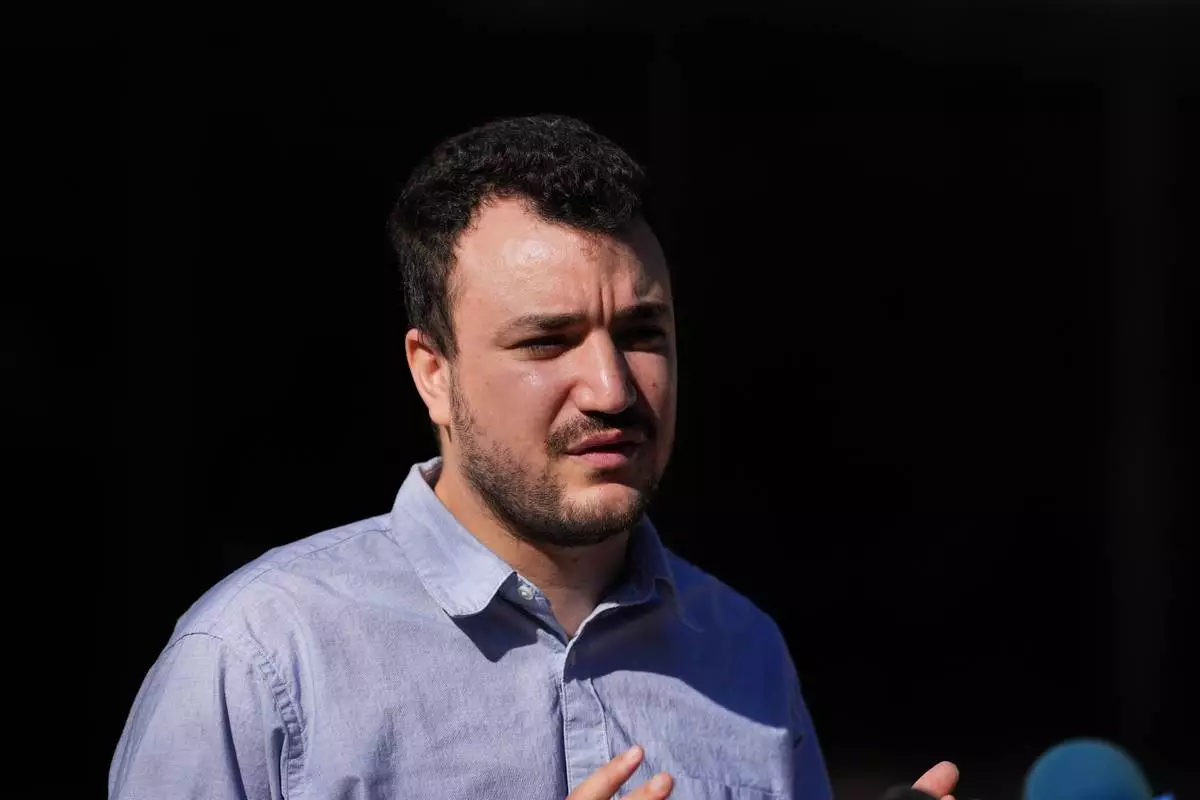
FILE - Palestinian activist Mahmoud Khalil holds a news conference outside Federal Court on Tuesday, Oct. 21, 2025 in Philadelphia (AP Photo/Matt Rourke, File)