DEARBORN, Mich. (AP) — Brick by brick, beam by beam and shingle by shingle, a house where the Rev. Martin Luther King Jr. and others planned marches in support of Black voting rights in the Deep South has been trucked from Alabama to a museum near Detroit.
The intricate operation to move and preserve the Jackson Home and other artifacts from the Civil Rights era preceded President Donald Trump's efforts to eradicate what he calls “divisive” and “race-centered ideologies,” and minimize the cultural and historical impact of race, racism and Black Americans.
Click to Gallery
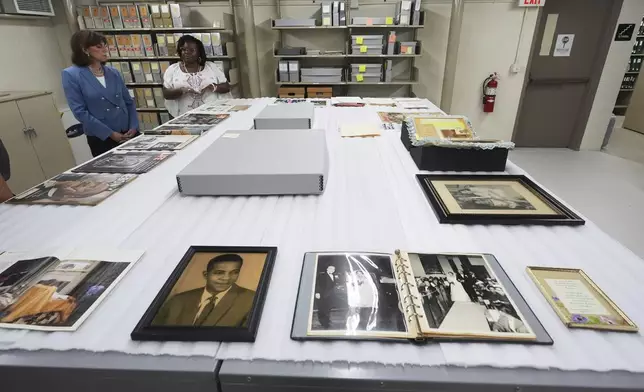
The Henry Ford President and CEO Patricia Mooradian, left, and Amber N. Mitchell, Curator of Black History view items from The Jackson Home at The Henry Ford in Dearborn, Mich., Monday, July 14, 2025. (AP Photo/Paul Sancya)

The Jackson Home, where Martin Luther King Jr. and others planned marches to call for Black voting rights in the early 60s in Selma, Ala., is shown being reconstructed at The Henry Ford in Dearborn, Mich., Monday, July 14, 2025. (AP Photo/Paul Sancya)
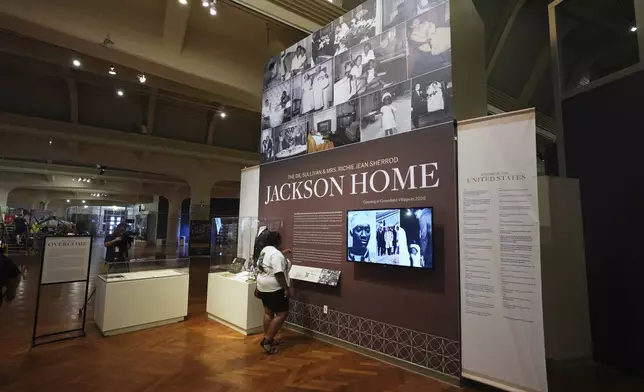
Visitors view a display for The Jackson Home at The Henry Ford in Dearborn, Mich., Monday, July 14, 2025. (AP Photo/Paul Sancya)
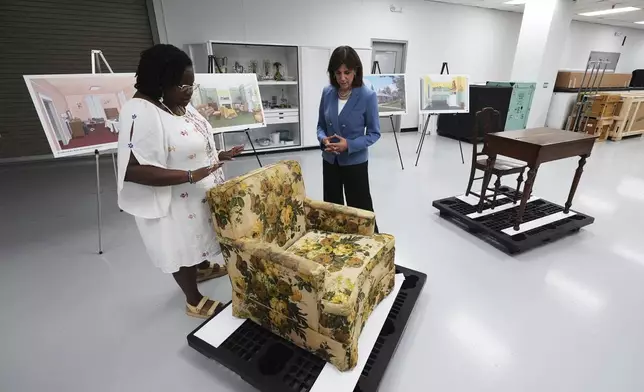
Amber N. Mitchell, Curator of Black History, left, and Patricia Mooradian, President and CEO of The Henry Ford, right, view items from The Jackson Home, where Martin Luther King Jr. and others planned marches to call for Black voting rights in the early 60s in Selma, Ala., at The Henry Ford in Dearborn, Mich., Monday, July 14, 2025. (AP Photo/Paul Sancya)

The Jackson Home, where Martin Luther King Jr. and others planned marches to call for Black voting rights in the early 60s in Selma, Ala., is shown being reconstructed at The Henry Ford in Dearborn, Mich., Monday, July 14, 2025. (AP Photo/Paul Sancya)
Trump's purges have sought to remove all reference to diversity, equity and inclusion from the federal government and workforce, and many private companies have followed suit. The establishments that house some of the most important reminders of African American history — including the Smithsonian Institution in Washington, D.C. — have come under particular pressure.
The chief executive of the Henry Ford, the new location of the Jackson Home, insists the museum has no political agenda.
“The Henry Ford’s work is focusing on good, factual public history,” Patricia Mooradian told The Associated Press.
King was often at the home of Dr. Sullivan and Richie Jean Jackson in Selma, Alabama, during the pivotal years of the Civil Rights Movement in the early '60s. It was within the walls of the 3,000-square-foot (280-square-meter) bungalow that King and others strategized a series of peaceful marches from Selma to the state capital, Montgomery, that helped usher in the Voting Rights Act of 1965.
Jawana Jackson told AP in 2023 that she decided to ask the Henry Ford — a history museum complex in Dearborn, Michigan — to relocate and preserve her parents' house and its contents because she believes “ the house belonged to the world.”
The building was taken apart and carried the more than 1,000 miles (1,600 kilometers) to be reconstructed in Greenfield Village at the Henry Ford, and archivists are digitizing and cataloging some 6,000 items contained within. They illustrate the movement's efforts to seek equal rights despite the often violent response of angry mobs and the police.
“The fact that the Jackson family saved things for this long, even though they may have been out of date or old, they knew the significance of all the things that were in that home, and they saved them and preserved them,” Mooradian said.
The second Trump administration has made it clear that viewing history through what it considers a “woke” or antiwhite lens will not be tolerated. The president has made specific moves to remove any reference to divisions over race, gender or sexuality in national institutions.
Last week, the Smithsonian Institution removed from an exhibit a reference to Trump’s two impeachments in 2019 and in 2021. The Democratic majority in the House voted each time for impeachment. The Republican-led Senate each time acquitted Trump.
A Smithsonian spokesman said the exhibit eventually “will include all impeachments.”
The U.S. has withdrawn from the United Nation’s cultural agency because, according to the White House, UNESCO “supports woke, divisive cultural and social causes that are totally out-of-step with the commonsense policies that Americans voted for in November.” Trump also fired the Kennedy Center board and slashed funding for the National Endowment for the Arts and National Endowment for the Humanities.
And the president issued an executive order titled “Restoring Truth and Sanity to American History," that condemns the Smithsonian Institution — a vast complex of museums, galleries and a zoo — for what he calls its “widespread effort to rewrite history.”
The Smithsonian includes the National Museum of African American History and Culture.
“Once widely respected as a symbol of American excellence and a global icon of cultural achievement, the Smithsonian Institution has, in recent years, come under the influence of a divisive, race-centered ideology,” Trump wrote. “This shift has promoted narratives that portray American and Western values as inherently harmful and oppressive.”
Mooradian said she is saddened by the order.
“I think museums are such an important part of our culture and our heritage, not just in this country but around the globe," she said. "And it’s important that we tell the truth, that people look to us for the truth, not for opinion, not for judgements but for the truth.”
Just weeks after Trump's March executive order, the Rev. Amos Brown, pastor emeritus of San Francisco's Third Baptist Church who was an activist in the Civil Rights Movement, said he was notified that two family bibles and a book on Black history that he lent to the African American history museum in 2016 would be removed from the collection.
Brown blamed the president for the snub, calling it an attempt to “wipe out our identity." He said last month that the books have not been returned to him.
The Smithsonian said in a June statement that it “routinely returns artifacts per applicable loan agreements and rotates objects on display in accordance with the Smithsonian’s high standards of care and preservation and as part of our regular museum turnover.”
The Smithsonian and the African American museum have not responded to AP interview requests.
The National Museum of African American History and Culture and the National Museum of American History are holders of some of the most iconic artifacts from the Civil Rights era, including the lunch counter and stool from a Greensboro, North Carolina, diner where a group of Black college students conducted a sit-in to protest segregation.
Other items are on display in museums across the U.S.
The Mississippi Civil Rights Museum in Jackson has on loan a door from a grocery store where witnesses said 14-year-old Emmett Till of Chicago whistled at a white woman in 1955. Till had been visiting relatives in Mississippi. Soon after, he was abducted and his body was later pulled from a river.
“We can be guardians of these very few and fragile remains,” said Kathryn Etre, director of conservation at the Mississippi Department of Archives and History. “We’re not going to hide the pain and all of the terror and all the awful things that happened. We try to be unbiased and tell every side of the story.”

The Henry Ford President and CEO Patricia Mooradian, left, and Amber N. Mitchell, Curator of Black History view items from The Jackson Home at The Henry Ford in Dearborn, Mich., Monday, July 14, 2025. (AP Photo/Paul Sancya)

The Jackson Home, where Martin Luther King Jr. and others planned marches to call for Black voting rights in the early 60s in Selma, Ala., is shown being reconstructed at The Henry Ford in Dearborn, Mich., Monday, July 14, 2025. (AP Photo/Paul Sancya)

Visitors view a display for The Jackson Home at The Henry Ford in Dearborn, Mich., Monday, July 14, 2025. (AP Photo/Paul Sancya)

Amber N. Mitchell, Curator of Black History, left, and Patricia Mooradian, President and CEO of The Henry Ford, right, view items from The Jackson Home, where Martin Luther King Jr. and others planned marches to call for Black voting rights in the early 60s in Selma, Ala., at The Henry Ford in Dearborn, Mich., Monday, July 14, 2025. (AP Photo/Paul Sancya)

The Jackson Home, where Martin Luther King Jr. and others planned marches to call for Black voting rights in the early 60s in Selma, Ala., is shown being reconstructed at The Henry Ford in Dearborn, Mich., Monday, July 14, 2025. (AP Photo/Paul Sancya)