Skip to Content Facebook Feature Image

Italy OKs $15.5 billion project to build world's longest suspension bridge from mainland to Sicily

News

Italy OKs $15.5 billion project to build world's longest suspension bridge from mainland to Sicily
News

News

Italy OKs $15.5 billion project to build world's longest suspension bridge from mainland to Sicily

2025-08-07 09:12 Last Updated At:09:20

MILAN (AP) — Italy cleared the way Wednesday to build the world’s largest suspension bridge linking the Italian mainland with Sicily in a massive 13.5 billion euro ($15.5 billion) infrastructure project that has been long delayed by debates over its scale, earthquake threats, environmental impact and the specter of mafia interference.

The Strait of Messina Bridge will be “the biggest infrastructure project in the West,” Transport Minister Matteo Salvini told a news conference in Rome, after an interministerial committee with oversight of strategic public investments approved the project.

More Images
Italian Vice Premier and Minister of Transport Matteo Salvini holds a press conference about the decision to approve work on the Strait of Messina suspension bridge linking the Italian mainland with Sicily, in Rome, Wednesday, Aug. 6, 2025. (AP Photo/Andrew Medichini)

Italian Vice Premier and Minister of Transport Matteo Salvini holds a press conference about the decision to approve work on the Strait of Messina suspension bridge linking the Italian mainland with Sicily, in Rome, Wednesday, Aug. 6, 2025. (AP Photo/Andrew Medichini)

From left: Italian undersecretary Alessandro Morelli, Italian Vice Premier and Minister of Transport Matteo Salvini and businessman Pietro Ciucci pose for photographers at the end of a press conference in Rome, Wednesday, Aug. 6, 2025. (AP Photo/Andrew Medichini)

From left: Italian undersecretary Alessandro Morelli, Italian Vice Premier and Minister of Transport Matteo Salvini and businessman Pietro Ciucci pose for photographers at the end of a press conference in Rome, Wednesday, Aug. 6, 2025. (AP Photo/Andrew Medichini)

Italian Vice Premier and Minister of Transport Matteo Salvini holds a press conference about the decision to approve work on the Strait of Messina suspension bridge linking the Italian mainland with Sicily, in Rome, Wednesday, Aug. 6, 2025. (AP Photo/Andrew Medichini)
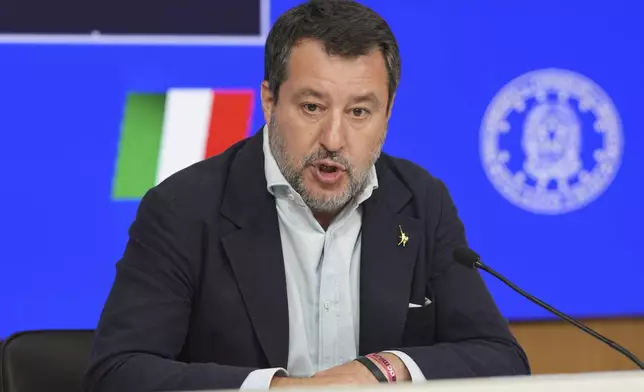
Italian Vice Premier and Minister of Transport Matteo Salvini holds a press conference about the decision to approve work on the Strait of Messina suspension bridge linking the Italian mainland with Sicily, in Rome, Wednesday, Aug. 6, 2025. (AP Photo/Andrew Medichini)

Italian Vice Premier and Minister of Transport Matteo Salvini holds a press conference about the decision to approve work on the Strait of Messina suspension bridge linking the Italian mainland with Sicily, in Rome, Wednesday, Aug. 6, 2025. (AP Photo/Andrew Medichini)

Italian Vice Premier and Minister of Transport Matteo Salvini holds a press conference about the decision to approve work on the Strait of Messina suspension bridge linking the Italian mainland with Sicily, in Rome, Wednesday, Aug. 6, 2025. (AP Photo/Andrew Medichini)

Premier Giorgia Meloni said that the bridge "will be an engineering symbol of global significance.''

Salvini cited studies showing the project will create 120,000 jobs a year and accelerate growth in economically lagging southern Italy, as billions more in investments are made in roads and other infrastructure projects accompanying the bridge.

Preliminary work could begin between late September and early October, once Italy’s court of audit signs off, with construction expected to start next year. Despite bureaucratic delays, the bridge is expected to be completed between 2032-2033, Salvini said.

The Strait of Messina Bridge has been approved and canceled multiple times since the Italian government first solicited proposals in 1969. Premier Giorgia Meloni’s administration revived the project in 2023, and this marks the furthest stage the ambitious project— first envisioned by the Romans — has ever reached.

“From a technical standpoint, it’s an absolutely fascinating engineering project,’’ Salvini said.

The Strait of Messina Bridge would measure nearly 3.7 kilometers (2.2 miles), with the suspended span reaching 3.3 kilometers (more than 2 miles), surpassing Turkey's Canakkale Bridge, currently the longest, by 1,277 meters (4,189 feet).

With three car lanes in each direction flanked by a double-track railway, the bridge would have the capacity to carry 6,000 cars an hour and 200 trains a day — reducing the time to cross the strait by ferry from up to 100 minutes to 10 minutes by car. Trains will save 2/12 hours in transit time, Salvini said.

The project could provide a boost to Italy’s commitment to raise defense spending to 5% of GDP targeted by NATO, as the government has indicated it would classify the bridge as defense-related, helping it to meet a 1.5% security component. Italy argues that the bridge would form a strategic corridor for rapid troop movements and equipment deployment to NATO’s southern flanks, qualifying it as a “security-enhancing infrastructure.”

Salvini confirmed the intention to classify the project as dual use, but said that was up to Italy’s defense and economic ministers.

A group of more than 600 professors and researchers signed a letter earlier this summer opposing the military classification, noting that such a move would require additional assessments to see if it could withstand military use. Opponents also say the designation would potentially make the bridge a target.

Environmental groups have lodged complaints with the EU, citing concerns that the project will impact migratory birds, noting that environmental studies had not demonstrated that the project is a public imperative and that any environmental damage would be offset.

The original government decree reactivating the bridge project included language giving the Interior Ministry control over anti-mafia measures. But Italy’s president insisted that the project remain subject to anti-mafia legislation that applies to all large-scale infrastructure projects in Italy out of concerns that the ad-hoc arrangement would weaken controls.

Salvini pledged that keeping organized crime out of the project was top priority, saying it would adhere to the same protocols used for the Expo 2015 World’s Fair and the upcoming Milan-Cortina 2026 Winter Olympic Games. “We need to pay attention so that the entire supply chain is impermeable to bad actors,’’ he said.

The project has been awarded to a consortium led by Webuild, an Italian infrastructure group that initially won the bid to build the bridge in 2006 before it was later canceled. The Canakkale Bridge, which opened in 2022, was built using an engineering design similar to the one devised for the Messina bridge, including a wing profile and a deck shape that resembles a fighter jet fuselage with openings to allow wind to pass through the structure, according to Webuild.

Addressing concerns about building the bridge over the Messina fault, which triggered a deadly quake in 1908, Webuild has emphasized that suspension bridges are structurally less vulnerable to seismic forces. It noted that such bridges have been built in seismically active areas, including Japan. Turkey and California.

Webuild CEO Pietro Salini said in a statement that the Strait of Messina Bridge “will be transformative for the whole country.”
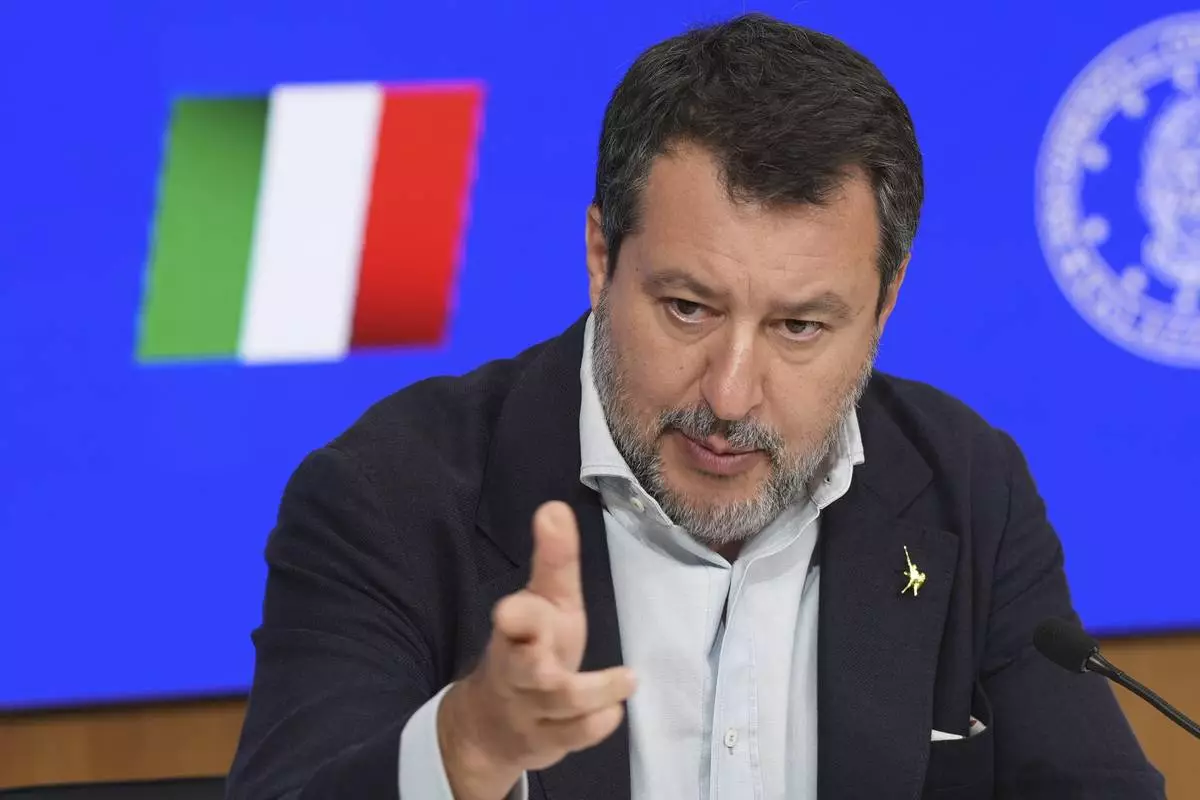
Italian Vice Premier and Minister of Transport Matteo Salvini holds a press conference about the decision to approve work on the Strait of Messina suspension bridge linking the Italian mainland with Sicily, in Rome, Wednesday, Aug. 6, 2025. (AP Photo/Andrew Medichini)
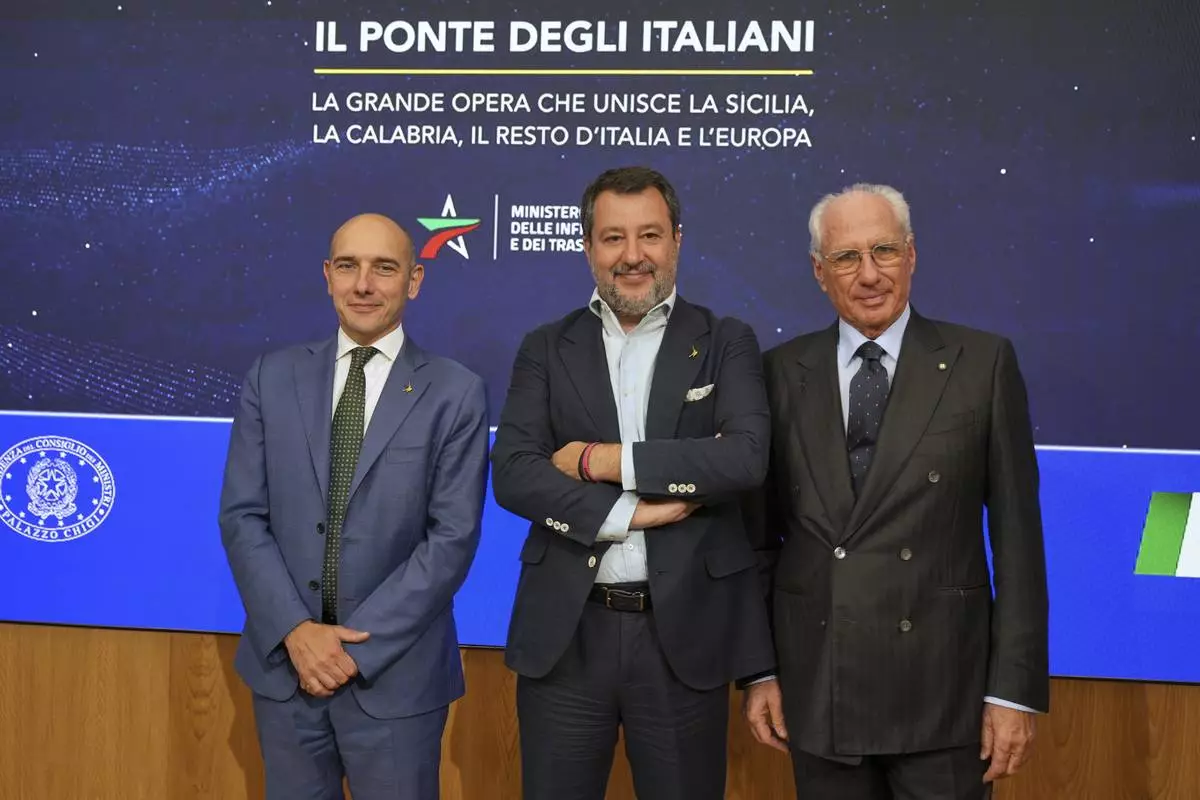
Italian Vice Premier and Minister of Transport Matteo Salvini holds a press conference about the decision to approve work on the Strait of Messina suspension bridge linking the Italian mainland with Sicily, in Rome, Wednesday, Aug. 6, 2025. (AP Photo/Andrew Medichini)

From left: Italian undersecretary Alessandro Morelli, Italian Vice Premier and Minister of Transport Matteo Salvini and businessman Pietro Ciucci pose for photographers at the end of a press conference in Rome, Wednesday, Aug. 6, 2025. (AP Photo/Andrew Medichini)
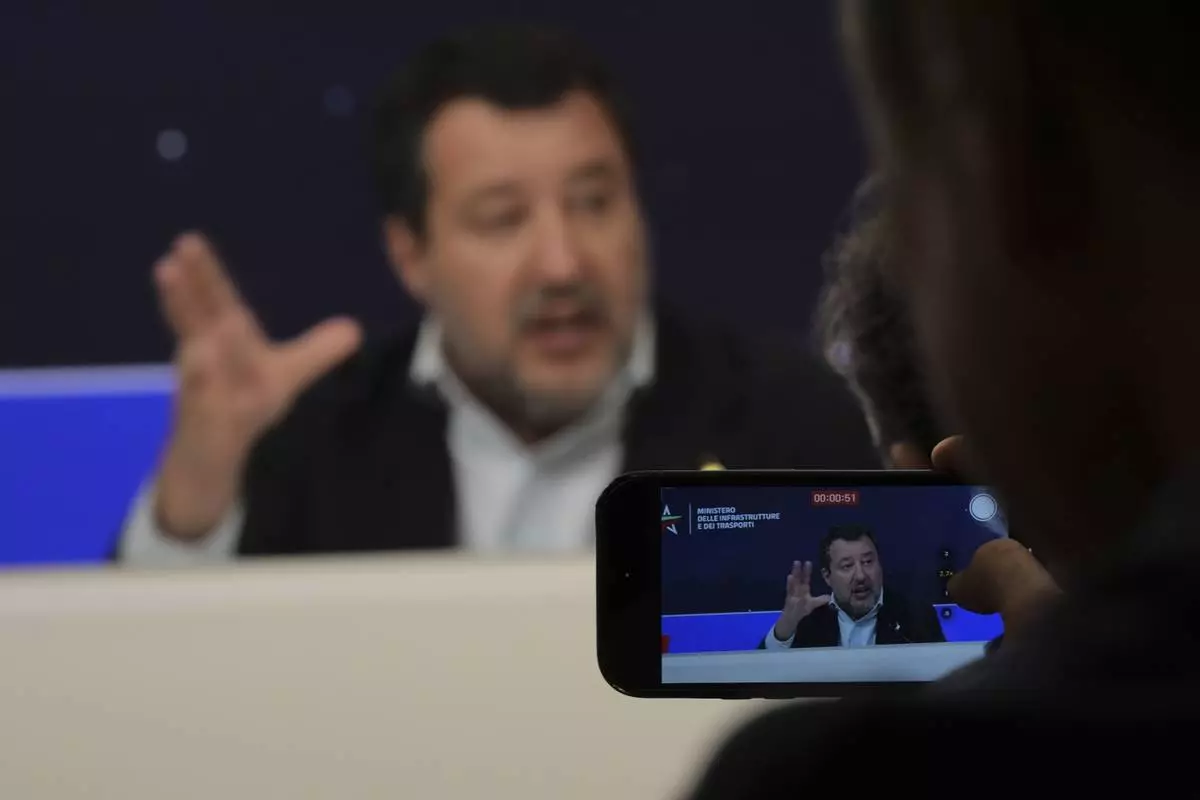
From left: Italian undersecretary Alessandro Morelli, Italian Vice Premier and Minister of Transport Matteo Salvini and businessman Pietro Ciucci pose for photographers at the end of a press conference in Rome, Wednesday, Aug. 6, 2025. (AP Photo/Andrew Medichini)

Italian Vice Premier and Minister of Transport Matteo Salvini holds a press conference about the decision to approve work on the Strait of Messina suspension bridge linking the Italian mainland with Sicily, in Rome, Wednesday, Aug. 6, 2025. (AP Photo/Andrew Medichini)
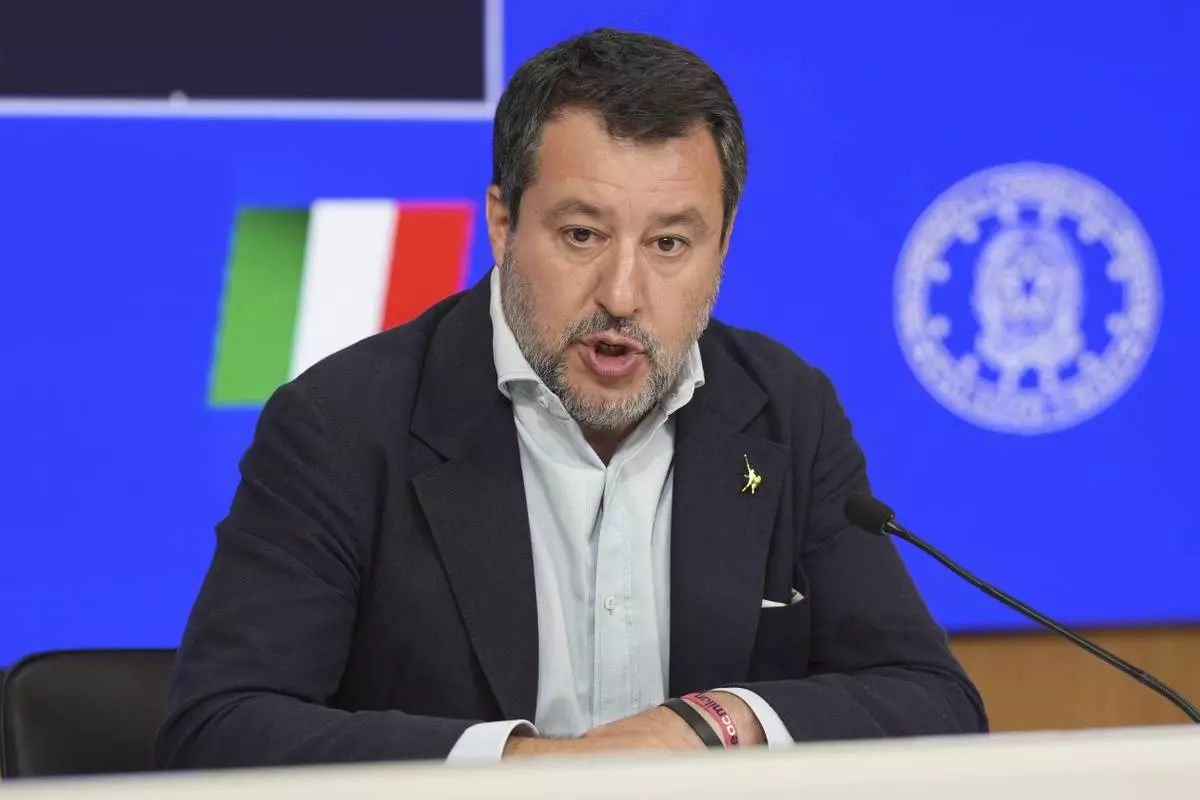
Italian Vice Premier and Minister of Transport Matteo Salvini holds a press conference about the decision to approve work on the Strait of Messina suspension bridge linking the Italian mainland with Sicily, in Rome, Wednesday, Aug. 6, 2025. (AP Photo/Andrew Medichini)
Italian Vice Premier and Minister of Transport Matteo Salvini holds a press conference about the decision to approve work on the Strait of Messina suspension bridge linking the Italian mainland with Sicily, in Rome, Wednesday, Aug. 6, 2025. (AP Photo/Andrew Medichini)
Italian Vice Premier and Minister of Transport Matteo Salvini holds a press conference about the decision to approve work on the Strait of Messina suspension bridge linking the Italian mainland with Sicily, in Rome, Wednesday, Aug. 6, 2025. (AP Photo/Andrew Medichini)
WASHINGTON (AP) — Two senators from opposite parties are joining forces in a renewed push to ban members of Congress from trading stocks, an effort that has broad public support but has repeatedly stalled on Capitol Hill.

Democratic Sen. Kirsten Gillibrand of New York and Republican Sen. Ashley Moody of Florida on Thursday plan to introduce legislation, first shared with The Associated Press, that would bar lawmakers and their immediate family members from trading or owning individual stocks.

It's the latest in a flurry of proposals in the House and the Senate to limit stock trading in Congress, lending bipartisan momentum to the issue. But the sheer number of proposals has clouded the path forward. Republican leaders in the House are pushing their own bill on stock ownership, an alternative that critics have dismissed as watered down.

“There’s an American consensus around this, not a partisan consensus, that members of Congress and, frankly, senior members of administrations and the White House, shouldn’t be making money off the backs of the American people,” Gillibrand said in an interview with the AP on Wednesday.

Trading of stock by members of Congress has been the subject of ethics scrutiny and criminal investigations in recent years, with lawmakers accused of using the information they gain as part of their jobs — often not known to the public — to buy and sell stocks at significant profit. Both parties have pledged to stop stock trading in Washington in campaign ads, creating unusual alliances in Congress.

In the House, for example, Republican Rep. Anna Paulina Luna of Florida is trying to bypass party leadership and force a vote on her own stock trading bill. Her push with a discharge petition has 79 of the 218 signatures required, the majority of them Democrats.

House Republican leaders are supporting an alternative bill that would prohibit members of Congress and their spouses from buying individual stocks but would not require lawmakers to divest from stocks they already own. It would mandate public notice seven days before a lawmaker sells a stock. The bill advanced in committee on Wednesday, but its prospects are unclear.

Gillibrand and Moody, meanwhile, are introducing a version of a House bill introduced last year by Reps. Chip Roy, a Republican from Texas, and Seth Magaziner, a Democrat from Rhode Island. That proposal, which has 125 cosponsors, would ban members of Congress from buying or selling individual stocks altogether.

Magaziner and other House Democrats, including Rep. Alexandria Ocasio-Cortez of New York, wrote in a joint statement Wednesday that they “are disappointed that the bill introduced by Republican leadership today fails to deliver the reform that is needed.”

The Senate bill from Gillibrand and Moody would give lawmakers 180 days to divest their individual stock holdings after the bill takes effect, while newly elected members would have 90 days from being sworn in to divest. Lawmakers would be prohibited from trading and owning certain other financial assets, including securities, commodities and futures.

“The American people must be able to trust that their elected officials are focused on results for the American people and not focused on profiting from their positions,” Moody wrote in response to a list of questions from the AP.

The legislation would exempt the president and vice president, a carveout likely to draw criticism from some Democrats. Similar objections were raised last year over a bill that barred members of Congress from issuing certain cryptocurrencies but did not apply to the president.

Gillibrand said the president “should be held to the same standard” but described the legislation as “a good place to start.”

“I don’t think we have to allow the perfect to be the enemy of the good,” Gillibrand said. “There’s a lot more I would love to put in this bill, but this is a consensus from a bipartisan basis and a consensus between two bodies of Congress.”

Moody, responding to written questions, wrote that Congress has the “constitutional power of the purse” so it's important that its members don't have “any other interests in mind, financial or otherwise.”

“Addressing Members of Congress is the number one priority our constituents are concerned with,” she wrote.

It remains to be seen if the bill will reach a vote in the Senate. A similar bill introduced by Gillibrand and GOP Sen. Josh Hawley of Missouri in 2023 never advanced out of committee.

Still, the issue has salience on the campaign trail. Moody is seeking election to her first full term in Florida this year after being appointed to her seat when Marco Rubio became secretary of state. Gillibrand chairs the Senate Democrats’ campaign arm.

“The time has come," Gillibrand said. “We have consensus, and there’s a drumbeat of people who want to get this done.”

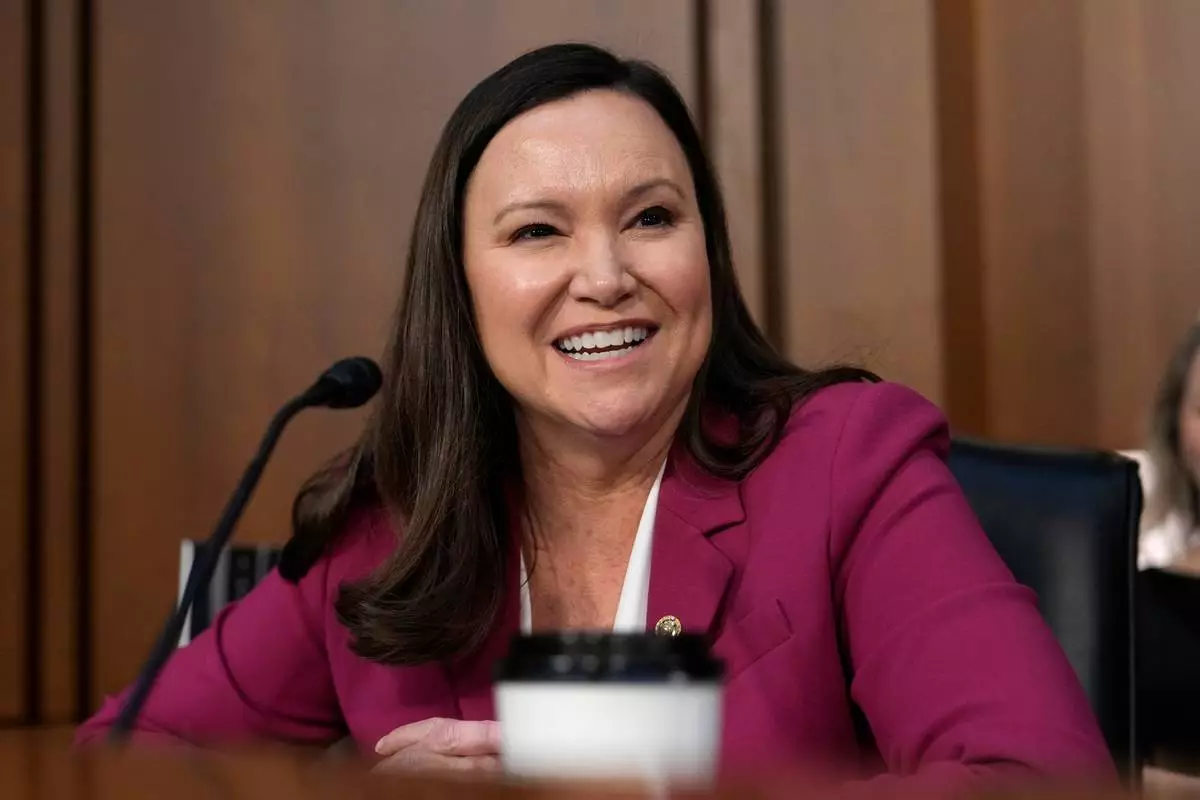
FILE -Sen. Ashley Moody, R-Fla., speaks during the confirmation hearing before the Senate Judiciary Committee for Kash Patel, President Donald Trump's choice to be director of the FBI, at the Capitol in Washington, Jan. 30, 2025. (AP Photo/Ben Curtis, File)

FILE -Sen. Ashley Moody, R-Fla., speaks during the confirmation hearing before the Senate Judiciary Committee for Kash Patel, President Donald Trump's choice to be director of the FBI, at the Capitol in Washington, Jan. 30, 2025. (AP Photo/Ben Curtis, File)

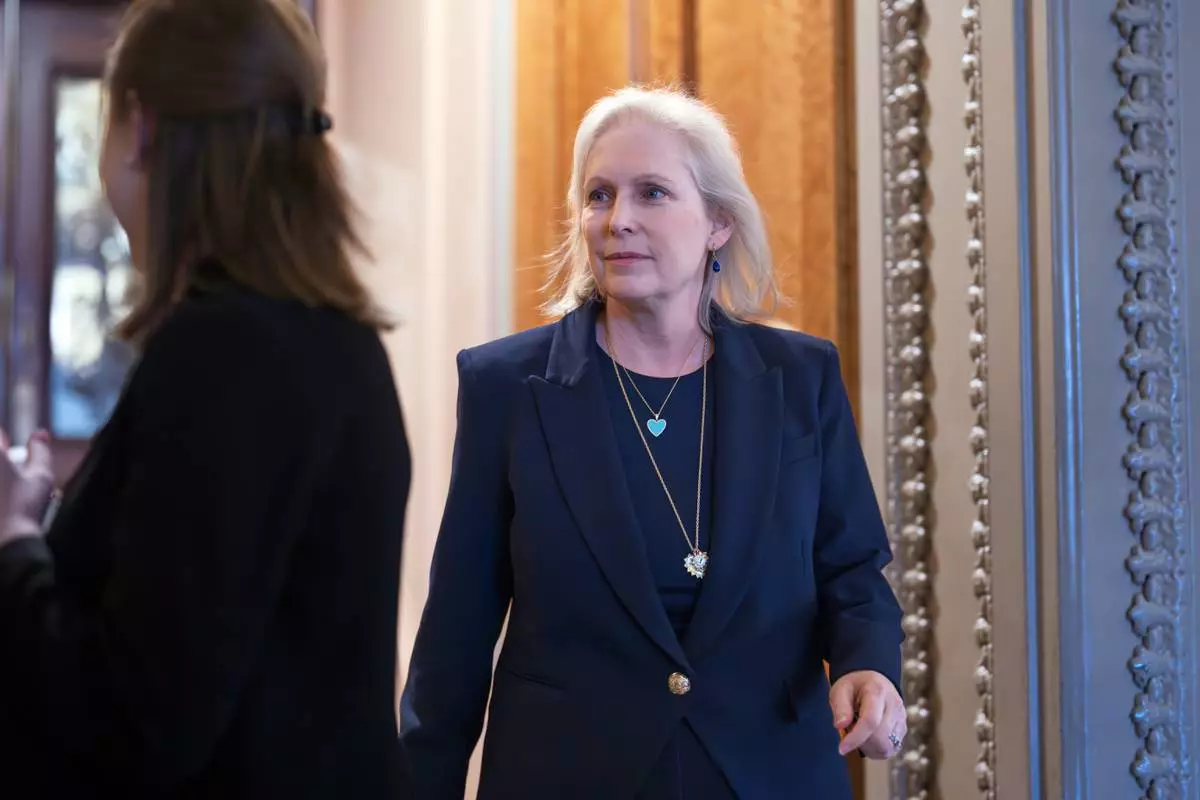
FILE - Sen. Kirsten Gillibrand, D-N.Y., leaves the Senate chamber after voting on a government funding bill at the Capitol in Washington, March 14, 2025. (AP Photo/J. Scott Applewhite, File)

FILE - Sen. Kirsten Gillibrand, D-N.Y., leaves the Senate chamber after voting on a government funding bill at the Capitol in Washington, March 14, 2025. (AP Photo/J. Scott Applewhite, File)

Recommended Articles