
Eddie Palmieri, the avant-garde musician who was one of the most innovative artists of rumba and Latin jazz, has died. He was 88.
Fania Records announced Palmieri's death Wednesday evening. Palmieri’s daughter Gabriela told The New York Times that her father died earlier that day at his home in New Jersey after “an extended illness.”
The pianist, composer and bandleader was the first Latino to win a Grammy Award and would win seven more over a career that spanned nearly 40 albums.
Palmieri was born in New York’s Spanish Harlem on December 15, 1936, at a time when music was seen as a way out of the ghetto. He began studying the piano at an early age, like his famous brother Charlie Palmieri, but at age 13, he began playing timbales in his uncle’s orchestra, overcome with a desire for the drums.
He eventually abandoned the instrument and went back to the playing piano. “I’m a frustrated percussionist, so I take it out on the piano,” the musician once said in his website biography.
His first Grammy win came in 1975 for the album “The Sun of Latin Music,” and he kept releasing music into his 80s, performing through the coronavirus pandemic via livestreams.
In a 2011 interview with The Associated Press, when asked if he had anything important left to do, he responded with his usual humility and good humor: “Learning to play the piano well. ... Being a piano player is one thing. Being a pianist is another.”
Palmieri dabbled in tropical music as a pianist during the 1950s with the Eddie Forrester Orchestra. He later joined Johnny Seguí’s band and Tito Rodríguez’s before forming his own band in 1961, La Perfecta, alongside trombonist Barry Rogers and singer Ismael Quintana.
La Perfecta was the first to feature a trombone section instead of trumpets, something rarely seen in Latin music. With its unique sound, the band quickly joined the ranks of Machito, Tito Rodríguez, and other Latin orchestras of the time.
Palmieri produced several albums on the Alegre and Tico Records labels, including the 1971 classic “Vámonos pa’l monte,” with his brother Charlie as guest organist. Charlie Palmieri died in 1988.
Eddie's unconventional approach would surprise critics and fans again that year with the release of “Harlem River Drive,” in which he fused Black and Latin styles to produce a sound that encompassed elements of salsa, funk, soul and jazz.
Later, in 1974, he recorded “The Sun of Latin Music” with a young Lalo Rodríguez. The album became the first Latin production to win a Grammy.
The following year he recorded the album “Eddie Palmieri & Friends in Concert, Live at the University of Puerto Rico,” considered by many fans to be a salsa gem.
In the 1980s, he won two more Grammy Awards, for the albums “Palo pa’ rumba” (1984) and “Solito” (1985). A few years later, he introduced the vocalist La India to the salsa world with the production “Llegó La India vía Eddie Palmieri.”
Palmieri released the album “Masterpiece” in 2000, which teamed him with the legendary Tito Puente, who died that year. It was a hit with critics and won two Grammy Awards. The album was also chosen as the most outstanding production of the year by the National Foundation for Popular Culture of Puerto Rico.
During his long career, he participated in concerts and recordings with the Fania All-Stars and Tico All-Stars, standing out as a composer, arranger, producer, and orchestra director.
In 1988, the Smithsonian Institute recorded two of Palmieri’s concerts for the catalog of the National Museum of American History in Washington.
Yale University in 2002 awarded him the Chubb Fellowship Award, an award usually reserved for international heads of state, in recognition of his work in building communities through music.
In 2005, he made his debut on National Public Radio as the host of the program “Caliente,” which was carried by more than 160 radio stations nationwide.
He worked with renowned musicians such as timbalero Nicky Marrero, bassist Israel “Cachao” López, trumpeter Alfredo “Chocolate” Armenteros, trombonist Lewis Khan, and Puerto Rican bassist Bobby Valentín.
In 2010, Palmieri said he felt a bit lonely musically due to the deaths of many of the rumberos with whom he enjoyed playing with.
As a musical ambassador, he brought salsa and Latin jazz to places as far afield as North Africa, Australia, Asia and Europe, among others.
Former Associated Press Writer Sigal Ratner-Arias is the primary author of this obituary.
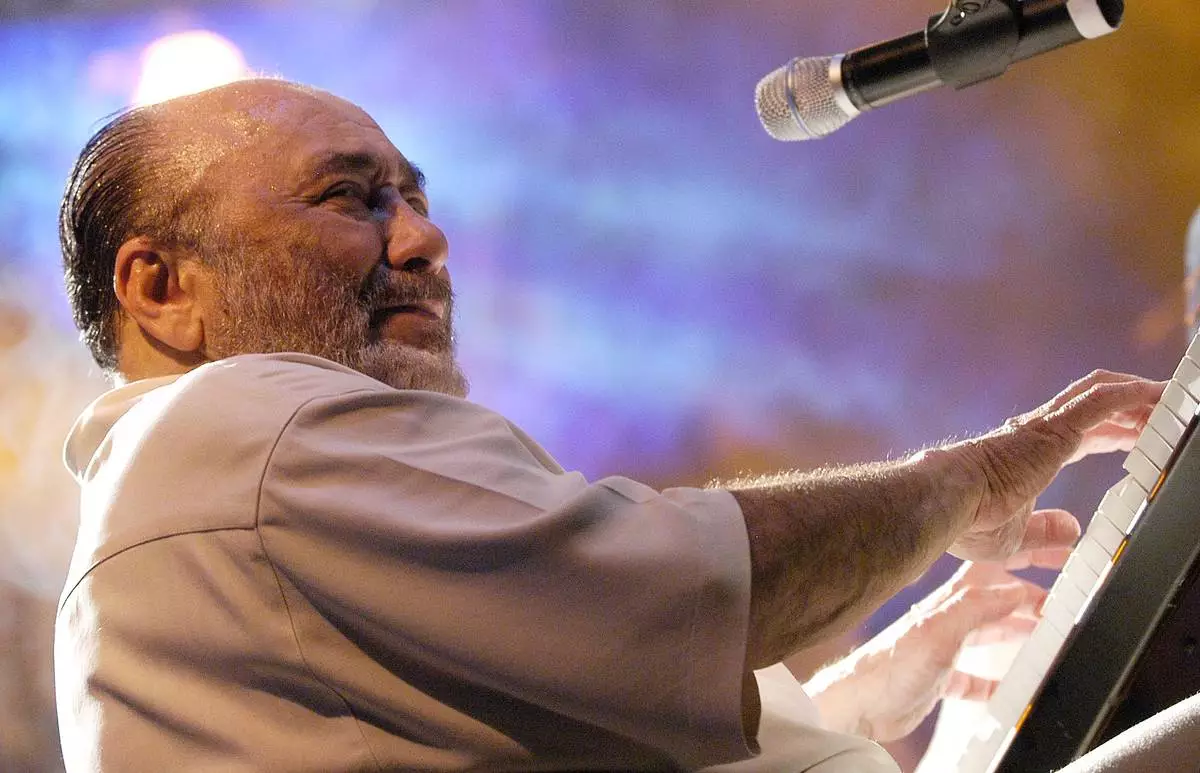
FILE - Grammy Award winner Eddie Palmieri performs during his concert "Listen Here" at Tito Puente Amphitheatre in San Juan, Puerto Rico, April 7, 2005. (AP Photo/Herminio Rodriguez, File)

FILE - Tito Puente Jr., center, speaks after Eddie Palmieri, left, and the late Tito Puente win the Grammy for best salsa album for "Masterpiece/Obra Maestra," at the 43rd annual Grammy Awards, Feb. 21, 2001, at the Staples Center in Los Angeles. (AP Photo/Kevork Djansezian, File)

FILE - Pianist Eddie Palmieri poses for a portrait in New York, Aug. 15, 2011. (AP Photo/Seth Wenig, File)