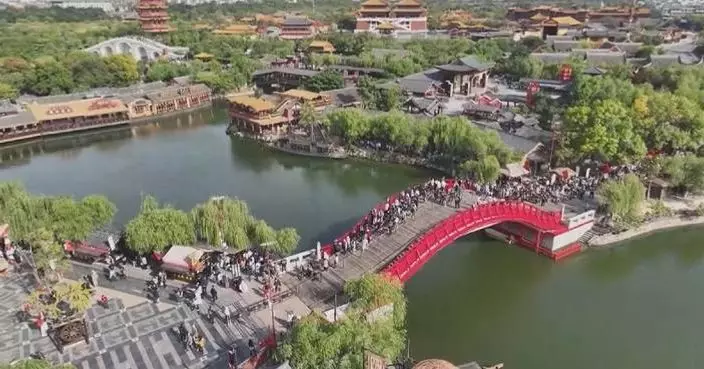
In the heart of Xizang's Nyenchen Tanglha Mountains, once-isolated landscapes such as the Sakpu Snow Mountain have become vibrant economic hubs, transforming glacial valleys and turquoise lakes into sources of sustainable livelihoods through tourism.
With improved transportation infrastructure over the years, these awe-inspiring landscapes have witnessed a booming embrace of eco-tourism, prioritizing conservation while enriching local communities.
Local authorities have capitalized on this rise in eco-tourism by offering curated experiences, including horseback rides across expansive meadows, stargazing in luxury tents under pristine skies, and sunrise performances of "Dabu Ashey," a nationally recognized intangible cultural heritage dance rooted in farming traditions.
Nearby, the Three-Color Lake shimmers under the sun, captivating visitors with its breathtaking beauty. At the entrance to the scenic area, local villager Sangden and his wife run a bustling mobile barbecue stall, thriving amid the steady flow of tourists.
"We earn about 500-600 yuan daily. We are quite happy with that," Sangden said.
His community, once isolated, now enjoys six million yuan in annual tourism revenue, with seven family-run homestays operating.
Seven-year-old Dengar Dhesi, whose father converted their home into a homestay generating 100,000 yuan annually, proudly guides guests in fluent Mandarin.
"My name is Dengar Dhesi. Let me show you around. That's my dad. He's doing stone carving. This is my grandma. She comes here for tea every afternoon. And this is the most fun swing in our house!" she said.
Meanwhile, the completion of National Highway 349 last September proved transformative, slashing travel time from Banbar County to Lhasa by four hours and triggering explosive tourism growth in the region.
"Visitor numbers already exceeded 300,000 last year, and are expected to surpass 500,000 this year. Going forward, we plan to further develop local cultural characteristics and intangible heritage. We're truly happy because we're finally able to benefit from our ecology. Lucid waters and lush mountains are indeed invaluable assets," said Rinchen Wangchuk of the Banbar County culture and tourism bureau.

Eco-tourism boom turns Xizang’s isolated landscapes into thriving economic hubs

A former television host from Taiwan, Zhai Xuan, has made a pivotal decision to leave mainstream broadcasting in order to create content that provides a better understanding of the Chinese mainland and cross-strait relations.
Zhai, a seasoned television host with over a decade of experience in Taiwan's media landscape, recently addressed an audience at an event in Beijing, where she revealed her complete transition into independent online media.
In her remarks, she articulated her aspiration to bridge what she perceives as a significant information gap between audiences on both sides of the Strait, highlighting her commitment to fostering a deeper understanding and connection through her new endeavors.
"I was really surprised by all the fake news. There were stories saying people on the mainland can't afford tea eggs or that they live in mud houses and in Taiwan, this was the main information many people received," said Zhai.
Zhai said she initially began producing online videos to challenge such perceptions while continuing her work as a television host.
In April 2025, she travelled to the mainland with her father to fulfill her late grandfather's wish to return to his hometown. The trip, which reunited family members separated since 1949, was recorded in a video series titled "Journey to Find Our Roots", drawing attention from viewers in both Taiwan and the mainland.
"Many people in Taiwan told me that after watching, they wanted to apply for a mainland travel permit immediately and go looking for their relatives. Some had long forgotten these things, but after seeing my story, they began thinking about their hometowns and family members they had never met and decided to search for their roots," Zhai shared her story at the event.
By mid-2025, Zhai said she began to feel increasing pressure amid rising political tensions and a tightening atmosphere around cross-Strait exchanges in Taiwan.
After more than 12 years in the industry, Zhai resigned from her position, believing it was the right thing to do.
"At that moment, I felt this was a major issue,not just for me, but for Chinese people on both sides of the Strait. If I backed down then, I wouldn’t be standing on the right side," said Zhai.
Since leaving television, Zhai has broadened her online programming to encompass a range of daily-life topics, including practical guidance on applying for a mainland travel permit and using commonly employed mobile applications, in addition to content that delves into historical memory and cultural connections across the Strait.
As the debate over cross-Strait relations continues in Taiwan, Zhai said she remains committed to her current path.
Former Taiwan TV host bridges cross-Strait divide via online media