Skip to Content Facebook Feature Image

Gazans suffer from food shortage amid ongoing conflict

China

Gazans suffer from food shortage amid ongoing conflict
China

China

Gazans suffer from food shortage amid ongoing conflict

2025-08-09 17:07 Last Updated At:08-10 01:07

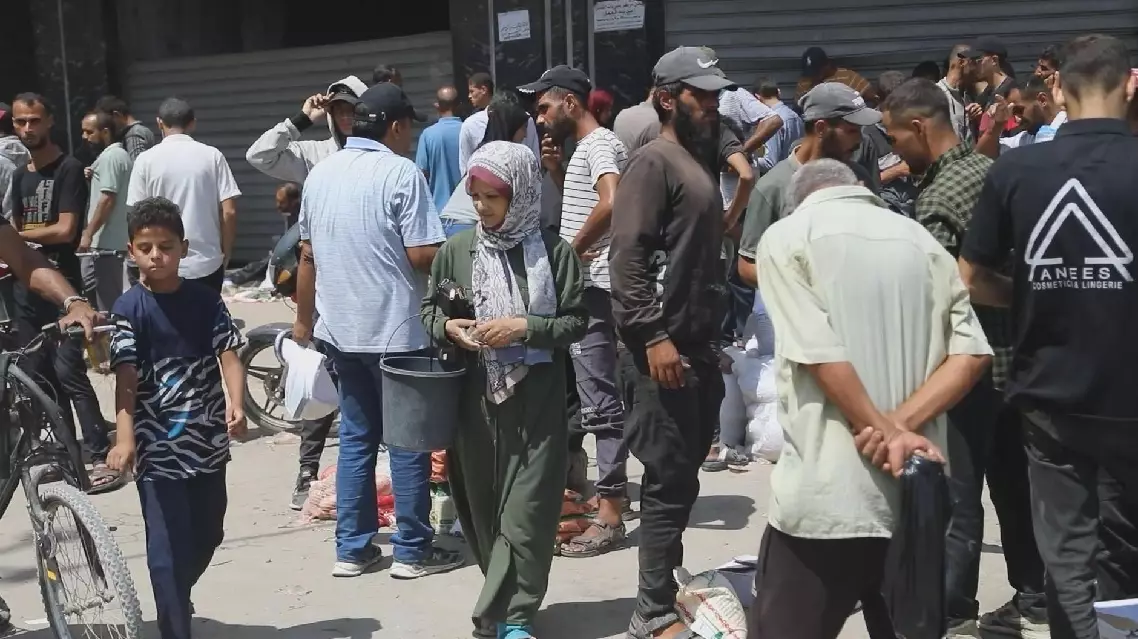
Food supplies are dangerously insufficient amid the lingering conflict in the Gaza Strip, with prices still unaffordable for starving families.

Amid catastrophic shortages, even small deliveries will bring both hope and tragedy.

For the first time in months, a limited number of commercial trucks entered Gaza through the Kerem Shalom border crossing -- the primary crossing between Israel and the Gaza Strip -- overnight Tuesday, delivering goods for local merchants. But the rare entry ended in tragedy, with at least 20 people killed and dozens more injured.

Officials said the Israeli army directed the trucks onto unsafe, bomb-damaged roads, causing one to overturn onto a crowd of people waiting for food near the Nuseirat refugee camp in the central Gaza city of Deir al-Balah.

"The so-called American aid centers have become nothing but death traps. They are also funneling some aid through unsafe corridors. Just last night, Al-Aqsa Hospital in central Gaza received over 20 victims, most of whom were civilians waiting for aid deliveries when the truck overturned on them," said Dr. Khalil Al-Daqran, spokesman for Al-Aqsa Hospital.

The goods that made it through are far from enough to meet the needs of Gaza's 2.3 million residents. Traders said prices remain prohibitively high, with basic staples still too expensive or unavailable for most people.

Mohammed Al-Jumla, a Palestinian trader, said that even though rice prices dropped slightly, it's still unaffordable for most.

"The goods that entered were not enough. It was 70 shekels (about 20.4 U.S. dollars) or 60 shekels (17.4 U.S. dollars) a kilo of rice. It's 50 shekels (14.5 U.S. dollars) now. It's not enough, and it's all expensive. Prices are high so far. A kilo of lentils used to cost 3 shekels (87 U.S. cents) in normal days, and now a kilo of lentils costs 30 shekels (8.7 U.S. dollars) . That's high price. Bringing in 40 trucks out of the 500 or 600 trucks that are needed won't make a difference. It's the same. Prices will stay as they are," he said.

For displaced Palestinians already exhausted by hunger, the small quantities of goods entering Gaza bring little comfort. Even when some items are available, most families can't afford them, as their income has been cut off for months, leaving them in a catastrophic economic situation.

"Many basic food items are still missing from the markets - eggs, poultry, meat, vegetables, and many types of fruit remain unavailable. Some items can be found, but in extremely limited quantities, and at prices that ordinary citizens simply can't afford. God willing, in the coming period larger quantities will arrive - much more than the supplies currently getting through," said Saeed Al-Zard, a displaced Palestinian.

Nearly two years into the Palestinian-Israeli conflict, Gaza is unraveling under the weight of starvation and siege.

Since Oct 7, 2023, at least 201 people have died due to starvation and lack of medical treatment in Gaza, including 98 children, according to figures released by the Gaza-based health authorities on Friday.
Gazans suffer from food shortage amid ongoing conflict


Gazans suffer from food shortage amid ongoing conflict
A former television host from Taiwan, Zhai Xuan, has made a pivotal decision to leave mainstream broadcasting in order to create content that provides a better understanding of the Chinese mainland and cross-strait relations.

Zhai, a seasoned television host with over a decade of experience in Taiwan's media landscape, recently addressed an audience at an event in Beijing, where she revealed her complete transition into independent online media.

In her remarks, she articulated her aspiration to bridge what she perceives as a significant information gap between audiences on both sides of the Strait, highlighting her commitment to fostering a deeper understanding and connection through her new endeavors.

"I was really surprised by all the fake news. There were stories saying people on the mainland can't afford tea eggs or that they live in mud houses and in Taiwan, this was the main information many people received," said Zhai.

Zhai said she initially began producing online videos to challenge such perceptions while continuing her work as a television host.

In April 2025, she travelled to the mainland with her father to fulfill her late grandfather's wish to return to his hometown. The trip, which reunited family members separated since 1949, was recorded in a video series titled "Journey to Find Our Roots", drawing attention from viewers in both Taiwan and the mainland.

"Many people in Taiwan told me that after watching, they wanted to apply for a mainland travel permit immediately and go looking for their relatives. Some had long forgotten these things, but after seeing my story, they began thinking about their hometowns and family members they had never met and decided to search for their roots," Zhai shared her story at the event.

By mid-2025, Zhai said she began to feel increasing pressure amid rising political tensions and a tightening atmosphere around cross-Strait exchanges in Taiwan.

After more than 12 years in the industry, Zhai resigned from her position, believing it was the right thing to do.

"At that moment, I felt this was a major issue,not just for me, but for Chinese people on both sides of the Strait. If I backed down then, I wouldn’t be standing on the right side," said Zhai.

Since leaving television, Zhai has broadened her online programming to encompass a range of daily-life topics, including practical guidance on applying for a mainland travel permit and using commonly employed mobile applications, in addition to content that delves into historical memory and cultural connections across the Strait.

As the debate over cross-Strait relations continues in Taiwan, Zhai said she remains committed to her current path.

Former Taiwan TV host bridges cross-Strait divide via online media

Former Taiwan TV host bridges cross-Strait divide via online media

Recommended Articles