Skip to Content Facebook Feature Image

China's foreign trade steadies with quality growth amid cross-border facilitation drive

China

China

China

China's foreign trade steadies with quality growth amid cross-border facilitation drive

2025-08-11 03:38 Last Updated At:09:07

Diverse cross-border trade facilitation measures implemented across China have helped maintain stable trade volumes while improving the quality of the country's foreign trade.

East China's Fujian Pilot Free Trade Zone (FTZ), building on the national single-window customs clearance system, has launched a smart service platform that incorporates Regional Comprehensive Economic Partnership (RCEP) tariff policies.

Through its AI-powered algorithm, the platform enables enterprises to obtain customized optimal tariff solutions with one-click analysis, while facilitating instant approval and issuance of certificates of origin.

Enterprises in Fujian Province have independently issued origin declarations for exports worth over 2.4 billion yuan (about 334 million U.S. dollars) this year -- ranking first nationwide -- providing strong support for businesses expanding into RCEP markets.

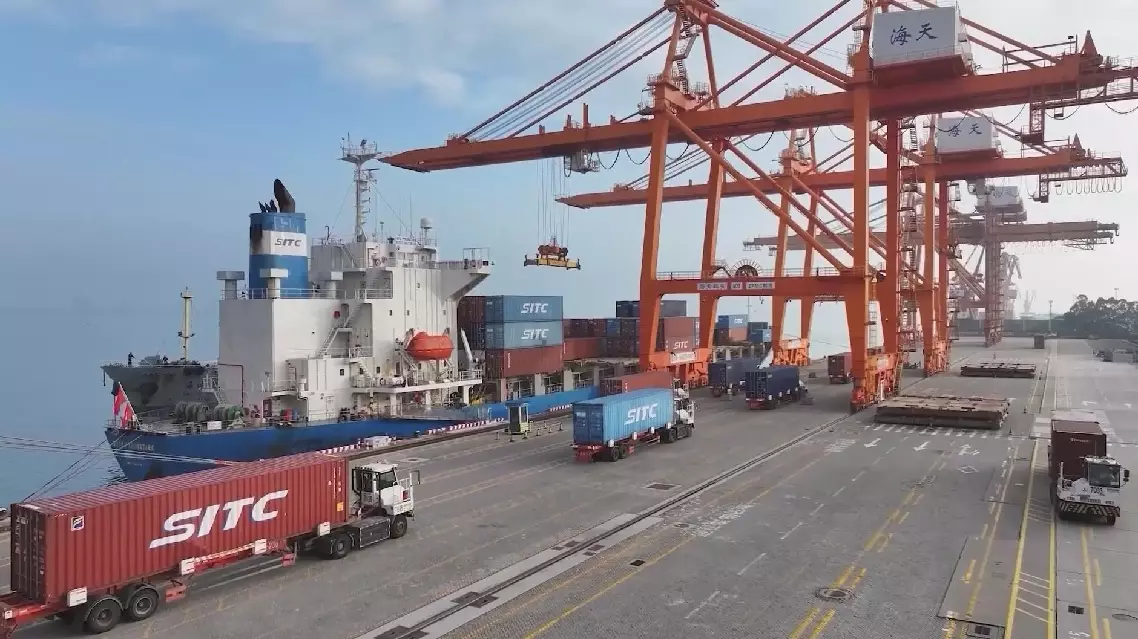
In Qingdao, east China's Shandong Province, customs authorities are actively promoting a new rail-sea intermodal regulatory model featuring "single bill of lading" and "single container" systems. Under this model, companies can complete customs clearance and inspection at inland ports before sending goods by rail to seaports for direct loading, eliminating container transfers and duplicate declarations, with a single bill of lading covering the entire process.

Since January, Qingdao Port has handled over 1.74 million TEUs of rail-sea intermodal cargo, up 13 percent year on year, maintaining its position as China's leading coastal port for this service.

The Dalian Area of China (Liaoning) Pilot Free Trade Zone in Dalian, northeast China's Liaoning Province, has introduced an inspection model for lithium battery export packaging that ensures the compliance of reusable packaging boxes, effectively solving the long-standing challenges of single-use plastic containers -- high costs and environmental waste.

This model has facilitated over 190,000 cycles of reusable packaging this year, saving enterprises more than 38 million yuan (about 5.3 million U.S. dollars) while promoting green logistics and energy efficiency.

Nationwide, the one-stop cross-border mail clearance platform, launched just over a month ago, has already cleared over 90,000 international mail items, cutting average clearance time by five hours per item and reducing agency fees.

"We consistently prioritize trade facilitation, streamlining declaration processes and upgrading smart port systems to enhance efficiency without compromising security. Next, we will expand reforms to energize foreign trade and better integrate Chinese goods into global supply chains," said Dang Xiaohong, deputy director-general of the National Office of Port Administration under the General Administration of Customs.
China's foreign trade steadies with quality growth amid cross-border facilitation drive


China's foreign trade steadies with quality growth amid cross-border facilitation drive

The global energy crunch and its impacts on Southeast Asia are driving efforts to link the power grids of ASEAN member states, with officials and analysts saying the push could strengthen energy security and accelerate the shift to renewables.

For decades, the idea of an interconnected ASEAN power grid has been on the regional agenda. The current crisis in the wake of wars in Iran and other Gulf states has added urgency, highlighting both the region's diverse energy resources and its vulnerabilities.

Some countries in the region have abundant natural gas or hydropower, others hold vast solar potential, while countries like Singapore rely almost entirely on imports. Even power-producing nations at times face shortages, making cross-border supply an attractive solution.

"It will help us to strengthen our energy security. And of course, a diversified and cheaper supply of energy will boost our regional economic integration and economy. So I think everyone benefits from this," said Chheang Vannarith, chairman of the Cambodian National Assembly Advisory Council.

Malaysia, as ASEAN chair last year, pressed for stronger commitments. Analysts say the current crisis is sharpening focus on the issue.

"It is definitely a wake-up call. It acts as a catalyst. It is also our hope that the Philippines, as the chair of ASEAN this year, and given the circumstances that we are in today with the global energy crisis and the global supply crisis, that this agenda is put at the forefront of the ASEAN discussion," said Amir Fareed Raheem, geo-economist at KRA Group, an ASEAN-focused public affairs and political risk consultancy.

Even as the idea gains momentum, major challenges remain ahead in terms of agreeing on regulations, technical standards and pricing. Further out still are the more ambitious proposals, such as undersea cables to transmit hydropower from northern Malaysia to Singapore and beyond.

Despite the lingering questions, tangible progress is being made. Since 2022, a flagship pilot project has enabled hydropower from Laos to flow through Thailand and Malaysia to Singapore. An agreement signed earlier this year will double its maximum capacity.

"Eleven countries, [with] different systems, different pricing mechanisms. It has to be tested in smaller groupings first before it is scaled up to the whole ASEAN operating system," said Raheem.

With countries striving to expand renewable energy and the crisis straining supplies, consensus is building to move the ASEAN power grid from long-standing aspiration to practical reality.

ASEAN power grid integration gathers pace amid energy crisis

ASEAN power grid integration gathers pace amid energy crisis

Recommended Articles