
NEW YORK (AP) — U.S. stocks edged back from their record heights on Monday in Wall Street’s final moves before an upcoming update on inflation.
The S&P 500 dipped 0.3% after flirting with its all-time high, which was set two weeks ago, earlier in the day. The Dow Jones Industrial Average dropped 200 points, or 0.5%, while the Nasdaq composite shaved 0.3% off its own record.
Click to Gallery
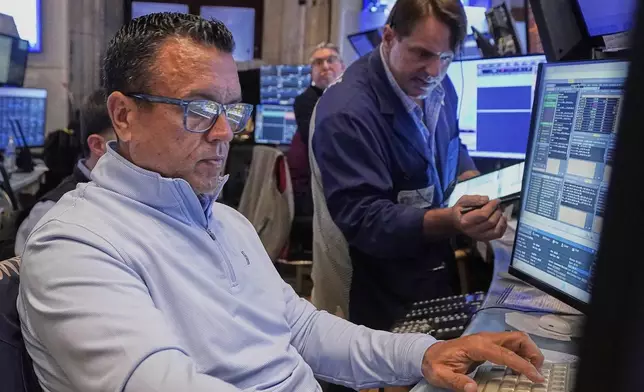
Traders Robert Finnerty Jr., left, and Michael Milano work on the floor of the New York Stock Exchange, Tuesday, July 29, 2025. (AP Photo/Richard Drew)

Visitors take photos near a screen showing the Korea Composite Stock Price Index (KOSPI), top left, and the foreign exchange rate between U.S. dollar and South Korean won, top center, at the foreign exchange dealing room of the Hana Bank headquarters in Seoul, South Korea, Monday, Aug. 11, 2025. (AP Photo/Ahn Young-joon)

Currency traders work near a screen showing the Korea Composite Stock Price Index (KOSPI), top left, and the foreign exchange rate between U.S. dollar and South Korean won, top center, at the foreign exchange dealing room of the Hana Bank headquarters in Seoul, South Korea, Monday, Aug. 11, 2025. (AP Photo/Ahn Young-joon)

Currency traders work near a screen showing the Korea Composite Stock Price Index (KOSPI), top left, and the foreign exchange rate between U.S. dollar and South Korean won, top center, at the foreign exchange dealing room of the Hana Bank headquarters in Seoul, South Korea, Monday, Aug. 11, 2025. (AP Photo/Ahn Young-joon)

Currency traders watch monitors near a screen showing the Korea Composite Stock Price Index (KOSPI) at the foreign exchange dealing room of the Hana Bank headquarters in Seoul, South Korea, Monday, Aug. 11, 2025. (AP Photo/Ahn Young-joon)
The highlight of this week for Wall Street will likely arrive on Tuesday, when the government will report how bad inflation was across the country in July. Economists expect it to show U.S. consumers had to pay prices for groceries, gasoline and other costs of living that were 2.8% higher from a year earlier, a slight acceleration from June’s 2.7% inflation.
Inflation has remained above 2%, even if it has improved substantially from its peak above 9% three years ago. And the worry is that President Donald Trump’s tariffs could push inflation higher.
That in turn is raising fears about a potential, worst-case scenario called “stagflation” where the economy stagnates but inflation remains high. The Federal Reserve has no good tool to fix both at once, and it would need to concentrate on either the job market or inflation first. But helping one of those areas by moving interest rates would likely hurt the other.
A top Fed official, Michelle Bowman, said on Saturday that she believes the job market is the bigger concern. She is still backing three cuts to interest rates by the Fed this year following this month’s stunning, weaker-than-expected report on the U.S. job market. Trump has also been angrily calling for cuts to interest rates to support the economy.
Other Fed officials, led by Chair Jerome Powell, have been more hesitant. Powell has said he wants to wait for more data about how Trump’s tariffs are affecting inflation before the Fed makes its next move, and Tuesday’s update on the consumer price index may offer a big clue about that.
Strategists at Stifel are warning that stagflation may already be on the way, with spending by U.S. consumers slowing. That in turn could create a reckoning for investors after they sent stock prices soaring to records from their low point in April.
“Rate cuts cannot save an overvalued S&P 500,” according to the strategists, led by Thomas Carroll and Barry Bannister.
One way companies can make their stock prices appear less expensive is to deliver bigger profits.
Micron Technology climbed 4.1% after raising its forecasts for profit and revenue in the current quarter, which will end later this month. The maker of memory for computers said it’s benefiting from higher prices for its products.
AMC Entertainment rose 3.4% to trim its loss for the year so far, which came into the day at 26.4%, after reporting better results for the spring than analysts expected. The theater chain said moviegoers paid more for tickets, while also spending more on food and drinks.
TKO Group Holdings climbed 10.2% after reaching a deal to distribute its UFC mixed martial arts matches on the Paramount+ streaming platform. But Paramount Skydance’s stock dropped 3.7%.
Also on the losing side of Wall Street was C3.ai after the AI application software company warned it may report an operating loss as large as $124.9 million for its first quarter. CEO Thomas Siebel called the first-quarter sales results “completely unacceptable,” and its stock tumbled 25.6%.
All told, the S&P 500 fell 16.00 points to 6,373.45. The Dow Jones Industrial Average dropped 200.52 to 43,975.09, and the Nasdaq composite slipped 64.62 to 21,385.40.
The price of gold, meanwhile, eased after Trump said he would not place tariffs on the metal. That followed Friday’s brouhaha in the gold market after the U.S. Customs and Border Patrol seemed to rule that some kinds of gold bars coming from Switzerland would face a tariff. That in turn caused a disconnect between the prices of gold trading in New York versus in London, but the market has since calmed.
Gold for December delivery settled at $3,404.70 per ounce in New York, down 2.5%.
In stock markets abroad, indexes were mixed amid mostly modest movements across Europe and Asia.
In the bond market, the yield on the 10-year Treasury held at 4.27%, where it was late Friday.
AP Business Writers Wyatte Grantham-Philips and Elaine Kurtenbach contributed.
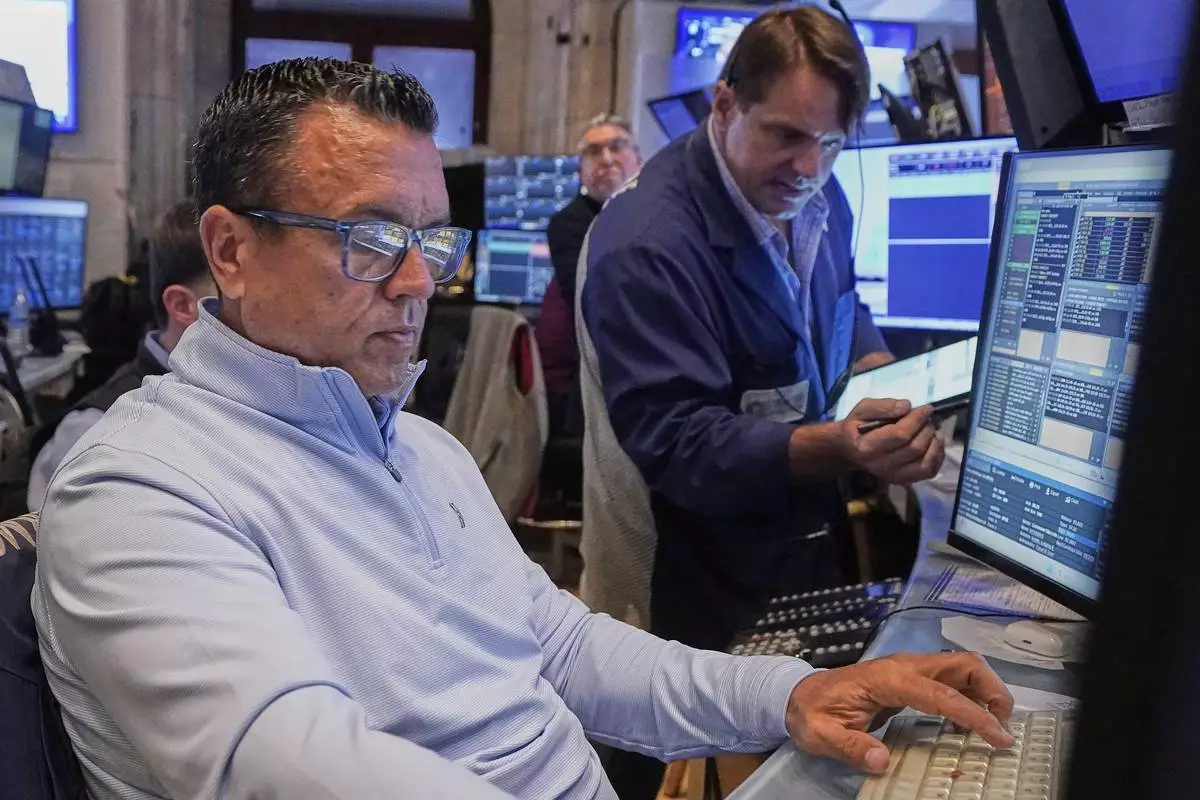
Traders Robert Finnerty Jr., left, and Michael Milano work on the floor of the New York Stock Exchange, Tuesday, July 29, 2025. (AP Photo/Richard Drew)

Visitors take photos near a screen showing the Korea Composite Stock Price Index (KOSPI), top left, and the foreign exchange rate between U.S. dollar and South Korean won, top center, at the foreign exchange dealing room of the Hana Bank headquarters in Seoul, South Korea, Monday, Aug. 11, 2025. (AP Photo/Ahn Young-joon)

Currency traders work near a screen showing the Korea Composite Stock Price Index (KOSPI), top left, and the foreign exchange rate between U.S. dollar and South Korean won, top center, at the foreign exchange dealing room of the Hana Bank headquarters in Seoul, South Korea, Monday, Aug. 11, 2025. (AP Photo/Ahn Young-joon)

Currency traders work near a screen showing the Korea Composite Stock Price Index (KOSPI), top left, and the foreign exchange rate between U.S. dollar and South Korean won, top center, at the foreign exchange dealing room of the Hana Bank headquarters in Seoul, South Korea, Monday, Aug. 11, 2025. (AP Photo/Ahn Young-joon)

Currency traders watch monitors near a screen showing the Korea Composite Stock Price Index (KOSPI) at the foreign exchange dealing room of the Hana Bank headquarters in Seoul, South Korea, Monday, Aug. 11, 2025. (AP Photo/Ahn Young-joon)