NEW YORK (AP) — AOL's dial-up internet is finally taking its last bow.
Yes, while perhaps a dinosaur by today's digital standards, dial-up is still around. But AOL says it's officially pulling the plug for its service on Sept. 30.
"AOL routinely evaluates its products and services and has decided to discontinue Dial-up Internet," AOL wrote in a brief update on its support site — noting that dial-up and associated software “optimized for older operating systems" will soon be unavailable on AOL plans.
AOL, formerly America Online, introduced many households to the world wide web for the first time when its dial-up service launched decades ago, rising to prominence particularly in the 90s and early 2000s.
The creaky door to the internet was characterized by a once-ubiquitous series of beeps and buzzes heard over the phone used to connect your computer online — along with frustrations of being kicked off the web if anyone else at home needed the landline for another call, and an endless bombardment of CDs mailed out by AOL to advertise free trials.
Eventually, broadband and wireless offerings emerged and rose to dominance, doing away with dial-up's quirks for most people accessing the internet today.
Still, a handful of consumers have continued to rely on internet services connected over telephone lines. In the U.S., according to Census Bureau data, an estimated 163,401 households were using dial-up alone to get online in 2023, representing just over 0.13% of all homes with internet subscriptions nationwide.
AOL was the largest dial-up internet provider for some time, but not the only one to emerge over the years. Some smaller internet providers continue to offer dial-up today. Regardless, the decline of dial-up has been a long time coming. And AOL shutting down its service arrives as other relics of the internet's earlier days continue to disappear.
Microsoft retired video calling service Skype just earlier this year, for example — as well as Internet Explorer back in 2022. And in 2017, AOL discontinued its Instant Messenger — a chat platform that was once lauded as the biggest trend in online communication since email when it was founded in 1997, but later struggled to ward off rivals.
AOL itself is far from the dominant internet player it was decades ago — when, beyond dial-up and IMs, the company also became known for its “You’ve got mail” catchphrase that greeted users who checked their inboxes, as famously displayed in the 1998 film starring Tom Hanks and Meg Ryan by the same name.
Before it was America Online, AOL was founded as Quantum Computer Services in 1985. It soon rebranded and hit the public market in 1991. Near the height of the dot-com boom, AOL's market value reached nearly $164 billion in 2000. But tumultuous years followed, and that valuation plummeted as the once-tech pioneer bounced between multiple owners. After a disastrous merger with Time Warner Inc., Verizon acquired AOL — which later sold AOL, along with Yahoo, to a private equity firm.
At the time Verzion announced that sale to in 2021, an anonymous source familiar with the transaction told CNBC that the number of AOL dial-up users was “in the low thousands," down from 2.1 million when Verzion first moved to acquire AOL in 2015 — and far below peak demand seen back in the 90s and early 2000s. But beyond dial-up, AOL continues to offer its free email services, as well as subscriptions that advertise identity protection and other tech support.

FILE - The AOL logo is shown on a wall of the company's New York office, on Monday, May 12, 2008. (AP Photo/Mark Lennihan, File)
SURIN, Thailand (AP) — Fighting continued to rage Saturday morning along the border of Thailand and Cambodia, even after U.S. President Donald Trump, acting as a mediator, declared that he had won agreement from both countries for a ceasefire.
Thai officials have said they did not agree to a ceasefire, and Cambodia has not commented on Trump’s claim. Its defense ministry instead said Thai jets carried out airstrikes Saturday morning. Cambodian media reported Trump’s claim without elaborating.
The latest large-scale fighting was set off by a skirmish on Dec. 7 that wounded two Thai soldiers and derailed a ceasefire promoted by Trump that ended five days of earlier combat in July over longstanding territorial disputes.
The July ceasefire was brokered by Malaysia and pushed through by pressure from Trump, who threatened to withhold trade privileges unless Thailand and Cambodia agreed. It was formalized in more detail in October at a regional meeting in Malaysia that Trump attended.
About two dozen people have officially been reported killed in this past week’s fighting, while hundreds of thousands have been displaced on both sides of the border.
The Thai military acknowledges 11 of its troops have been killed, while estimating there have been 165 fatalities among Cambodian soldiers. Cambodia has not announced military casualties, but has said at least 11 civilians have been killed and 76 wounded.
Trump on Friday, after speaking to Thai Prime Minister Anutin Charnvirakul and Cambodian Prime Minister Hun Manet, had announced an agreement to restart the ceasefire.
“They have agreed to CEASE all shooting effective this evening, and go back to the original Peace Accord made with me, and them, with the help of the Great Prime Minister of Malaysia, Anwar Ibrahim,” Trump said in his Truth Social post.
Trump’s claim came after midnight in Bangkok. Thai Prime Minister Anutin had after his call with Trump said he had explained Thailand’s reasons for fighting and said peace would depend on Cambodia ceasing its attacks first. The Thai foreign ministry later explicitly disputed Trump’s claim that a ceasefire had been reached. Anutin's busy day on Friday including dissolving Parliament so new elections could be held early next year.
Cambodian Prime Minister Hun Manet, in comments posted early Saturday morning, also made no mention of a ceasefire.
He said he held phone conversations on Friday night with Trump, and a night earlier with Malaysia’s Prime Minister Anwar Ibrahim, and thanked both “for their continuous efforts to achieve a long-lasting peace between Cambodia and Thailand.”
“Cambodia is ready to cooperate in any way that is needed,' Hun Manet wrote.
Thailand has been carrying out airstrikes on what it says are strictly military targets, while Cambodia has been firing thousands of medium-range BM-21 rockets that have caused havoc but relatively few casualties.
BM-21 rocket launchers can fire up to 40 rockets at a time with a range of 30-40 kilometers (19-25 miles). These rockets cannot be precisely targeted and have landed largely in areas from where most people have already been evacuated.
However, the Thai army announced Saturday that BM-21 rockets had hit a civilian area in Sisaket province, seriously injuring two civilians who had heard warning sirens and had been running toward a bunker for safety.
——
Peck reported from Bangkok. Sopheng Cheang in Serei Saophoan, Cambodia, and Matthew Lee in Washington contributed to this report.
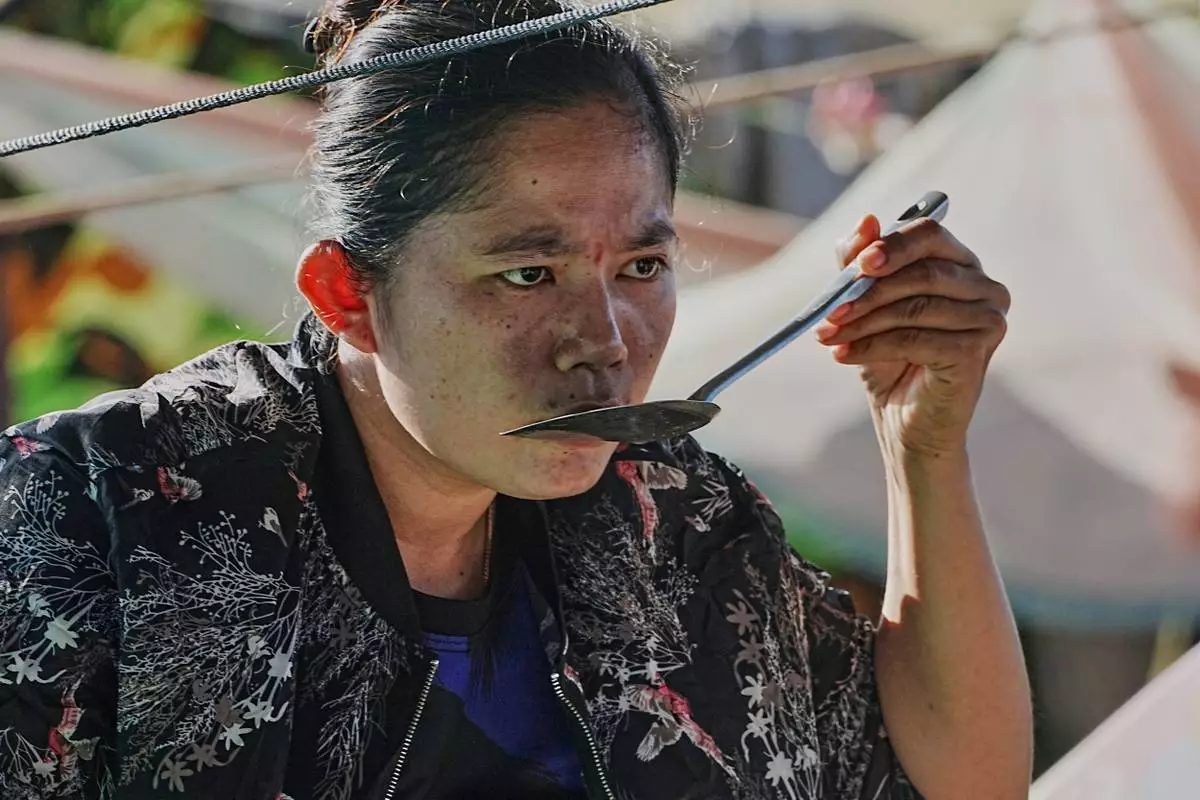
An evacuee tastes soup as she takes refuge in Banteay Menchey provincial town, Cambodia, Saturday, Dec. 13, 2025, after fleeing from home following fighting between Thailand and Cambodia. (AP Photo/Heng Sinith)
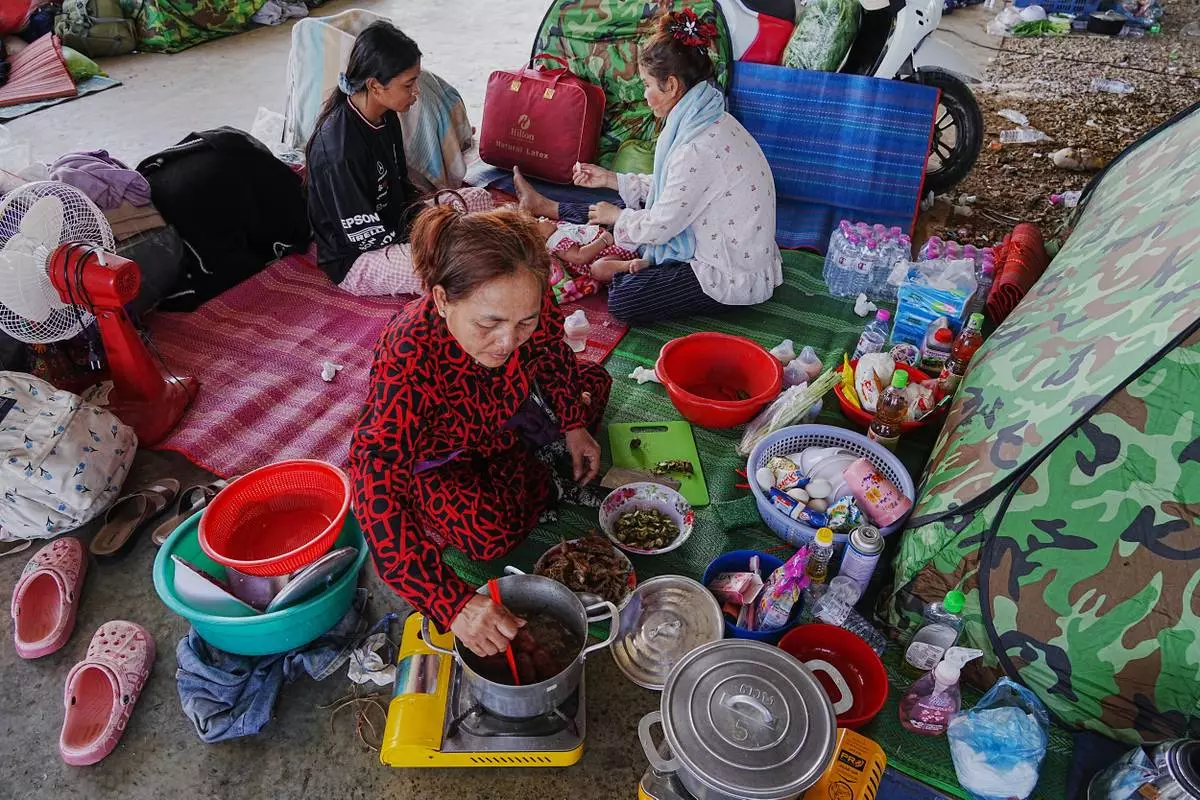
Evacuees cook food as they take refuge in Banteay Menchey provincial town, Cambodia, Saturday, Dec. 13, 2025, after fleeing homes following fighting between Thailand and Cambodia. (AP Photo/Heng Sinith)

Children raise their hands while receiving donation from charity as they take refuge in Banteay Menchey provincial town, Cambodia, Saturday, Dec. 13, 2025, after fleeing homes following fighting between Thailand and Cambodia. (AP Photo/Heng Sinith)
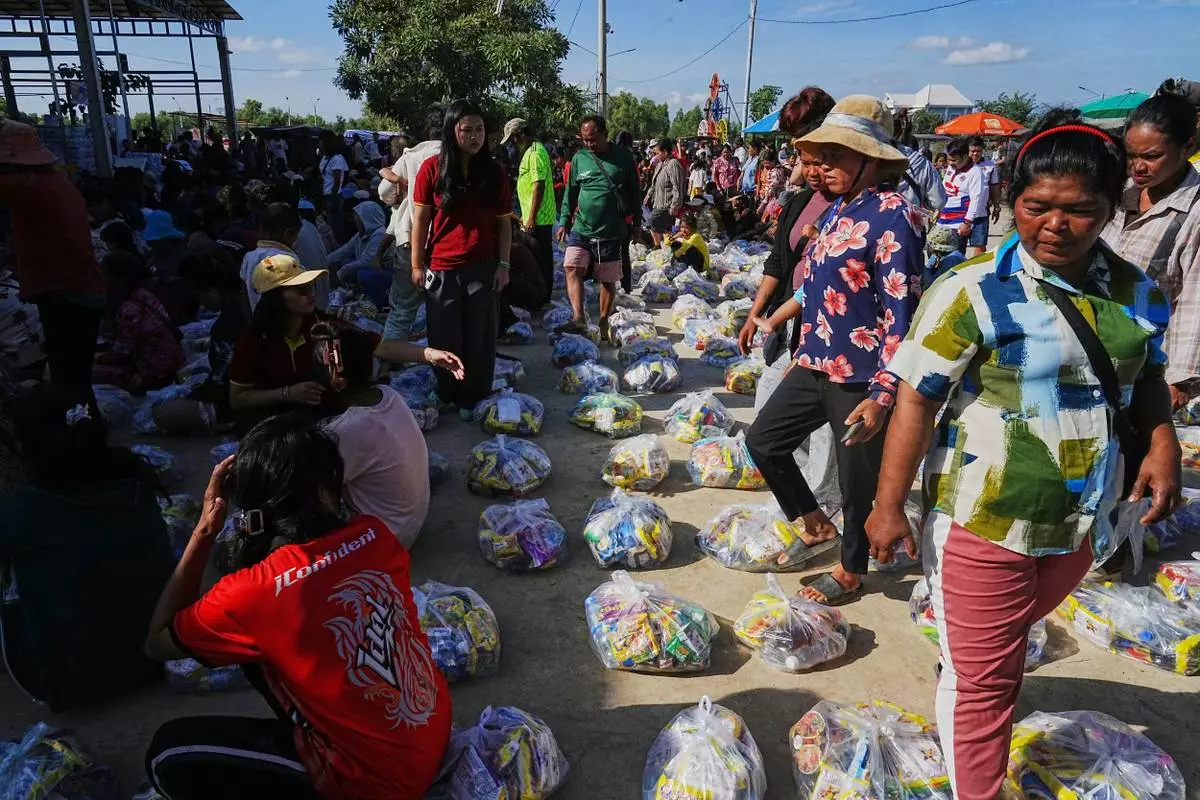
Evacuees wait to receive donation from local charity as they take refuge in Banteay Menchey provincial town, Cambodia, Saturday, Dec. 13, 2025, after fleeing homes following fighting between Thailand and Cambodia. (AP Photo/Heng Sinith)
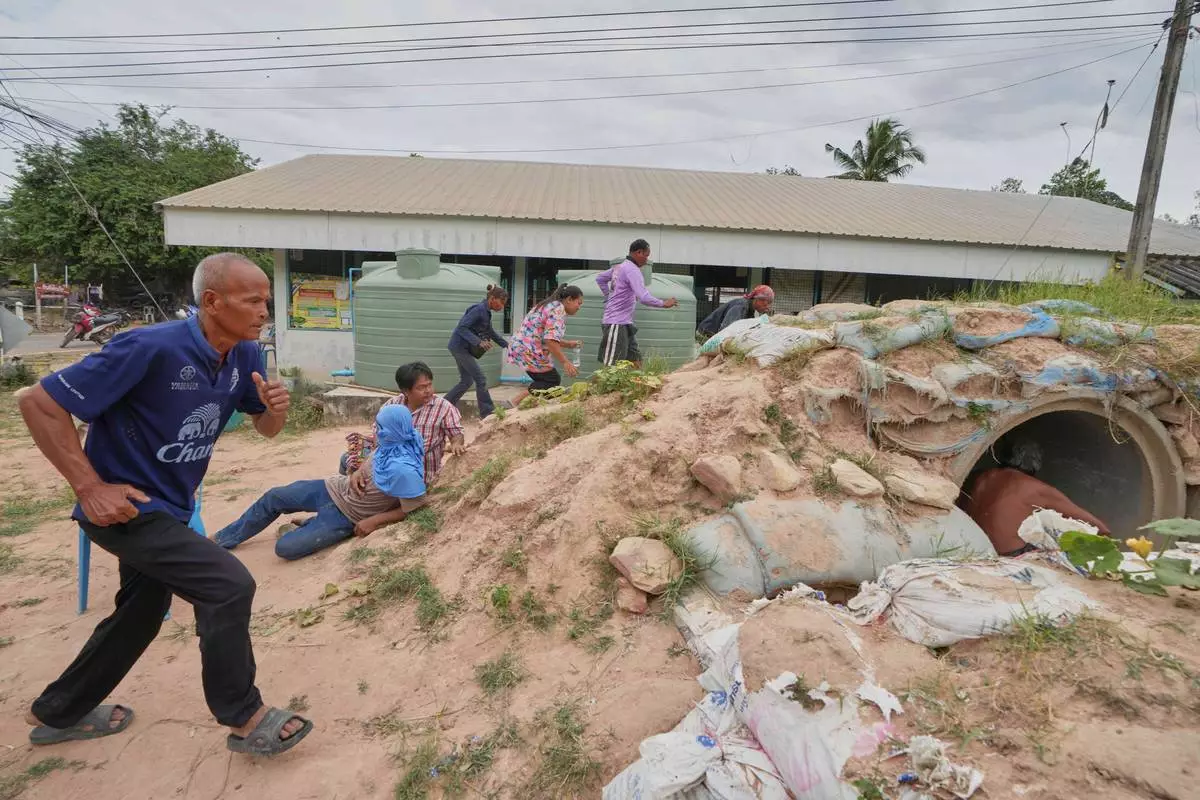
Village security volunteers and resident run into shelter while the blasts sounded too close in Buriram province, Thailand, Friday, Dec. 12, 2025, following renewed border conflict between Thailand and Cambodia. (AP Photo/Sakchai Lalit)