Students from remote areas are benefiting from the improved education on offer at boarding schools across southwest China's Xizang Autonomous Region, with these schools saving them the trouble of long-distance commutes while also opening up opportunities for them to embrace a brighter future.
Since Xizang covers a vast area while being scarcely populated, one of the biggest obstacles for children receiving a good quality education has often been the considerable distance between their homes and schools. To get around this, many educational institutions have been offering students from rural backgrounds the chance to live on-site.
Established in 2019, the Wanquan Secondary School in Shannan City is one of these facilities which brings students together from afar.
Ni Huili started teaching in Xizang back in 1998 and is well aware of some the local difficulties which have hindered young people's education in the past. She says the boarding school set-up offers a vital solution to some of these challenges.
"No matter where I work, in the county or in the city, I always feel that parents in Xizang give strong support to education and pay great attention to their children's schooling. I think the boarding school not only can relieve some burden from parents, such as picking up and dropping off their children, which honestly is quite exhausting; but also makes transportation safer and more convenient, giving them more time to study," said Ni.
There are over 1,800 students in the Wanquan Secondary School, with 95 percent of them coming from pastoral areas, and some even have to travel for an entire day just to get there. One of the most far-traveled students is Tshering Sangmo, who hails from a very remote area. She spent much of her childhood playing with her family's yaks on the grasslands and may well have been destined to spend her future life there too.
However, seeking to give their daughter the best chance in life, her parents were keen for her to receive a higher level education at the boarding school, even though it would mean moving far away from her home.
"My parents also don't want me to work in a restaurant. They hope I can study well, go to college and head out into the wider world," said Sangmo.
At the Wanquan Secondary School, carrying forward the values of traditional Tibetan culture is deemed as equally important as learning new knowledge and taking on extracurricular activities. Many clubs covering various fields have been launched in the school to cater to various interests.
The school's principal insists that the study of Tibetan language doesn't stop, no matter what grade students are in.
"The teaching of Tibetan language and literature is continuing as scheduled. We also offer classes on Tibetan dance, Tibetan language calligraphy, and other customs. We also plan to set up courses including in Tibetan chess which are related to traditional culture and intangible cultural heritage. This will allow students to understand more about their traditional culture, while inheriting it and carrying it forward," said Norbu Tsering, principal of the Wanquan Secondary School.
Since 2012, Xizang has been implementing a publicly-funded education system which spans a 15-year period, covering students from kindergarten all the way up to senior high school. As of 2024, the total number of students in schools in Xizang has reached 970,000, exceeding one quarter of the region's total population.
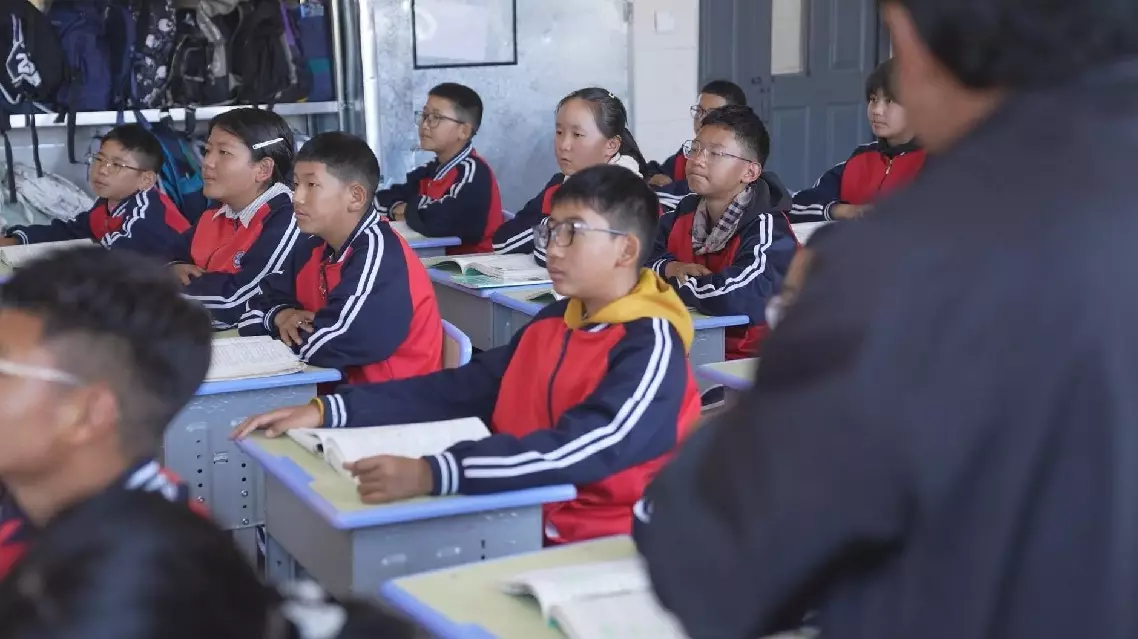
Boarding schools in Xizang offer vital education opportunities to remote students