WASHINGTON (AP) — U.S. lawmakers from both parties are urging the Trump administration to maintain a three-way security partnership designed to supply Australia with nuclear-powered submarines — a plea that comes as the Pentagon reviews the agreement and considers the questions it has raised about the American industrial infrastructure's shipbuilding capabilities.
Two weeks ago, the Defense Department announced it would review AUKUS, the 4-year-old pact signed by the Biden administration with Australia and the United Kingdom. The announcement means the Republican administration is looking closely at a partnership that many believe is critical to the U.S. strategy to push back China's influence in the Indo-Pacific. The review is expected to be completed in the fall.
“AUKUS is essential to strengthening deterrence in the Indo-Pacific and advancing the undersea capabilities that will be central to ensuring peace and stability," Republican Rep. John Moolenaar of Michigan and Democratic Rep. Raja Krishnamoorthi of Illinois wrote in a July 22 letter to Defense Secretary Pete Hegseth. Moolenaar chairs the House panel on China and Krishnamoorthi is its top Democrat.
The review comes as the Trump administration works to rebalance its global security concerns while struggling with a hollowed-out industrial base that has hamstrung U.S. capabilities to build enough warships. The review is being led by Elbridge Colby, the No. 3 Pentagon official, who has expressed skepticism about the partnership.
“If we can produce the attack submarines in sufficient number and sufficient speed, then great. But if we can’t, that becomes a very difficult problem," Colby said during his confirmation hearing in March. “This is getting back to restoring our defense industrial capacity so that we don’t have to face these awful choices but rather can be in a position where we can produce not only for ourselves, but for our allies."
As part of the $269 billion AUKUS partnership, the United States will sell three to five Virginia-class nuclear-powered submarines to Australia, with the first delivery scheduled as soon as 2032. The U.S. and the U.K. would help Australia design and build another three to five attack submarines to form an eight-boat force for Australia.
A March report by the Congressional Research Service warned that the lack of U.S. shipbuilding capacities, including workforce shortage and insufficient supply chains, is jeopardizing the much-celebrated partnership. If the U.S. should sell the vessels to Australia, the U.S. Navy would have a shortage of attack submarines for two decades, the report said.
The Navy has been ordering two boats per year in the last decade, but U.S. shipyards have been only producing 1.2 Virginia-class subs a year since 2022, the report said.
“The delivery pace is not where it needs to be" to make good on the first pillar of AUKUS, Admiral Daryl Caudle, nominee for the Chief of Naval Operations, told the Senate Armed Services Committee last month.
Australia has invested $1 billion in the U.S. submarine industrial base, with another $1 billion to be paid before the end of this year. It has agreed to contribute a total of $3 billion to uplift the U.S. submarine base, and it has sent both industry personnel to train at U.S. shipyards and naval personnel for submarine training in the United States.
"Australia was clear that we would make a proportionate contribution to the United States industrial base,” an Australian defense spokesperson said in July. “Australia’s contribution is about accelerating U.S. production rates and maintenance to enable the delivery of Australia’s future Virginia-class submarines.”
The three nations have also jointly tested communication capabilities with underwater autonomous systems, Australia's defense ministry said on July 23. Per the partnership, the countries will co-develop other advanced technologies, from undersea to hypersonic capabilities.
At the recent Aspen Security Forum, Kevin Rudd, the Australian ambassador to the United States, said his country is committed to increasing defense spending to support its first nuclear-powered sub program, which would also provide “massively expensive full maintenance repair facilities" for the U.S. Indo-Pacific fleet based in Western Australia.
Rudd expressed confidence that the two governments “will work our way through this stuff.”
Bruce Jones, senior fellow with the Strobe Talbott Center for Security, Strategy and Technology, told The Associated Press that the partnership, by positioning subs in Western Australia, is helping arm the undersea space that is “really crucial to American deterrence and defense options in the Western Pacific.”
“The right answer is not to be content with the current pace of submarine building. It’s to increase the pace," Jones said.
Jennifer Parker, who has served more than 20 years with the Royal Australian Navy and founded Barrier Strategic Advisory, said it should not be a zero-sum game. “You might sell one submarine to Australia, so you have one less submarine on paper. But in terms of the access, you have the theater of choice from operating from Australia, from being able to maintain your submarines from Australia," Parker said. “This is not a deal that just benefits Australia."
Defense policy is one of the few areas where Republican lawmakers have pushed back against the Trump administration, but their resolve is being tested with the Pentagon’s review of AUKUS. So far, they have joined their Democratic colleagues in voicing support for the partnership.
They said the U.S. submarine industry is rebounding with congressional appropriations totaling $10 billion since 2018 to ensure the U.S. will have enough ships to allow for sales to Australia.
Sen. Tim Kaine, D-Va., told the AP that support for AUKUS is strong and bipartisan, “certainly on the Armed Services Committee.”
"There is a little bit of mystification about the analysis done at the Pentagon,” Kaine said, adding that “maybe (what) the analysis will say is: We believe this is a good thing.”

FILE - The Portsmouth Naval Shipyard is seen, Sept. 8, 2021, in Kittery, Maine. (AP Photo/Robert F. Bukaty, File)
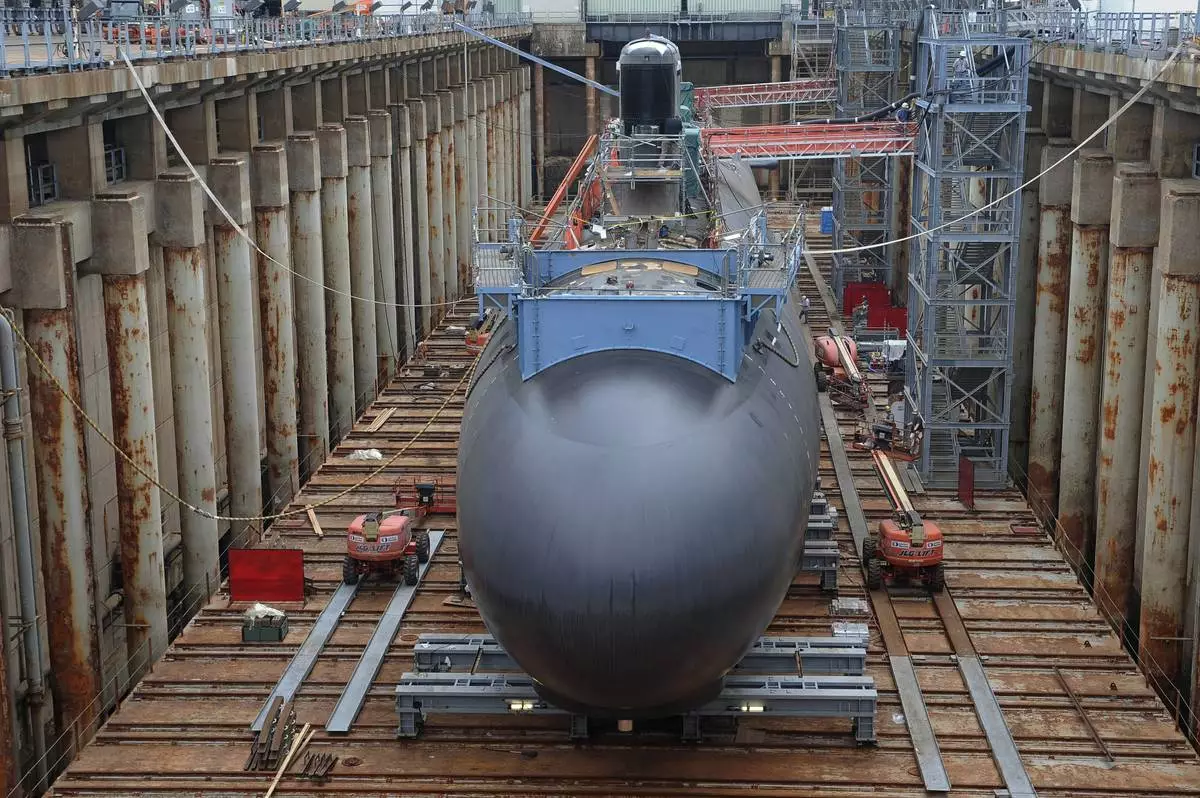
FILE- Shipyard workers at General Dynamics Electric Boat in Groton, Conn., prepare a submarine for float-off, July 30, 2015. (AP Photo/Jessica Hill, File)