Billionaire SpaceX, Tesla and X owner Elon Musk says he plans to sue Apple for not featuring X and its Grok artificial intelligence chatbot app in its top recommended apps in its App Store.
Musk posted the comments on X late Monday, saying, “Hey @Apple App Store, why do you refuse to put either X or Grok in your ‘Must Have’ section when X is the #1 news app in the world and Grok is #5 among all apps? Are you playing politics? What gives? Inquiring minds want to know.”
Grok is owned by Musk's artificial intelligence startup xAI.
Musk went on to say that “Apple is behaving in a manner that makes it impossible for any AI company besides OpenAI to reach #1 in the App Store, which is an unequivocal antitrust violation. xAI will take immediate legal action.”
He gave no further details.
In an emailed statement, Apple defended the fairness of its App Store.
“The App Store is designed to be fair and free of bias,” it said. "We feature thousands of apps through charts, algorithmic recommendations, and curated lists selected by experts using objective criteria. Our goal is to offer safe discovery for users and valuable opportunities for developers, collaborating with many to increase app visibility in rapidly evolving categories.”
The company has faced various allegations of antitrust violations in recent years.
A federal judge recently found that Apple violated a court injunction in an antitrust case filed by Fortnite maker Epic Games.
Regulators of the 27-nation European Union fined Apple 500 million euros in April for breaking competition rules by preventing app makers from pointing users to cheaper options outside its App Store.
Last year, the EU fined the U.S. tech giant nearly $2 billion for unfairly favoring its own music streaming service by forbidding rivals like Spotify from telling users how they could pay for cheaper subscriptions outside of iPhone apps.
As of early Tuesday, the top app in Apple's App Store was TikTok, followed by Tinder, Duolingo, YouTube and Bumble. Open AI's ChatGPT was ranked 7th.

FILE - The opening page of X is displayed on a computer and phone in Sydney on Oct. 16, 2023. (AP Photo/Rick Rycroft, File)
SALT LAKE CITY (AP) — Dylan Guenther had two goals and an assist, Jack McBain added a goal and two assists, and the Utah Mammoth beat the Toronto Maple Leafs 6-1 on Tuesday night.
Daniil But, JJ Peterka and Michael Carcone each had a goal and an assist, Ian Cole each had two assists, and Barrett Hayon added an assist for Utah, which extended its point streak to 4-0-1. Karel Vejmelka had 19 saves while getting his NHL-leading 21st win.
Calle Jarnkrok scored as Toronto snapped a four game win streak and a 10-game point streak. Dennis Hildeby finished with 34 saves.
Guenther scored his two goals just 1:18 apart early in the second period, the fastest back-to-back goals by a single player in Mammoth franchise history, and pushed Utah's lead to 3-0. The sharp-shooting forward leads Utah with 23 goals on the season.
Peterka made it a four-goal lead with 4 1/2 minutes remaining in the second before Jarnkrok spoiled Vejmelka’s shutout bid 3:30 into the third.
McBain and But scored 3:25 apart late in the third to cap the scoring.
Carcone scored the first goal 3:22 into the game on a one-timer off a cross-ice pass from Nate Schmidt. Carcone, who grew up just north of Toronto, has scored Utah's opening goal in the last three matchups.
Sean Durzi had a cut on his face after colliding with Auston Matthews in the second period but returned to skate in the third.
Late in the first period, But seemed to have scored but officials whistled a face-off while the puck was still free.
Toronto: At Vegas on Thursday night.
Utah: Hosts Dallas on Thursday night to continue a seven-game homestand.
AP NHL: https://www.apnews.com/nhl
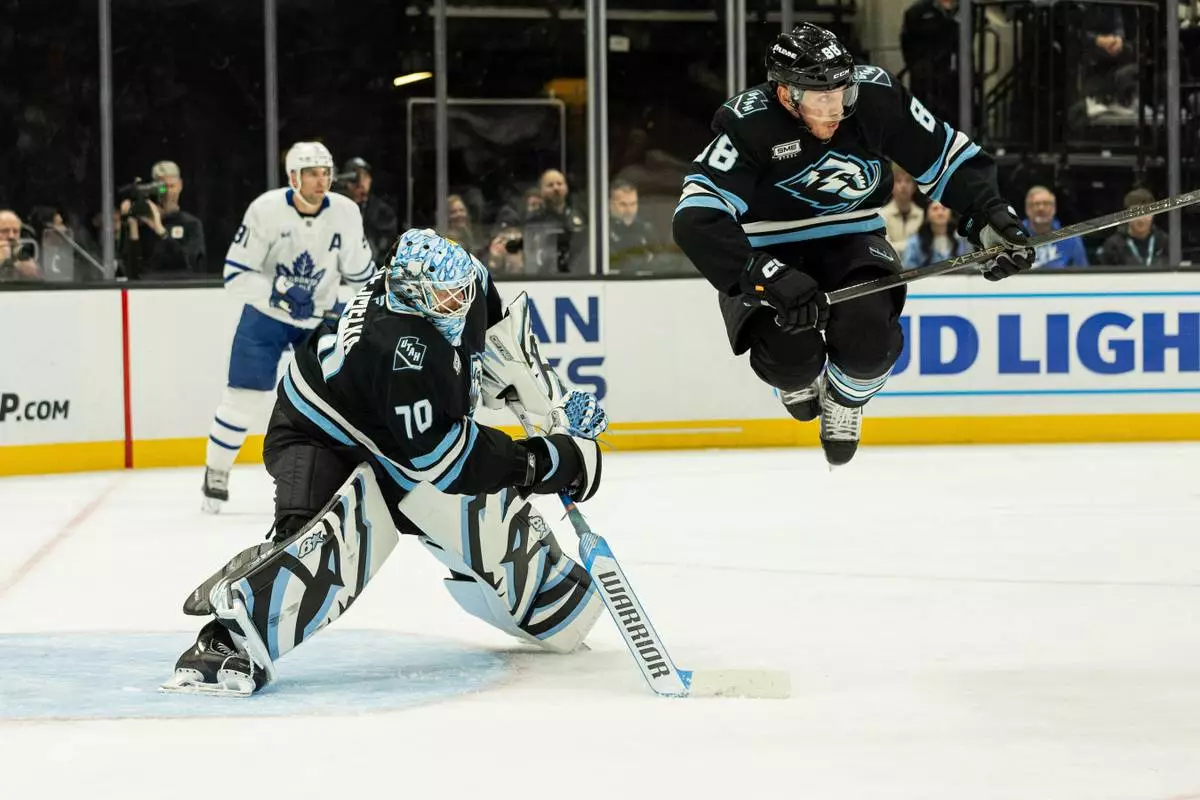
Utah Mammoth defenseman Nate Schmidt (88) jumps over Utah Mammoth goaltender Karel Vejmelka (70) hockey stick during the game against the Toronto Maple Leafs during the second period of an NHL hockey game Tuesday, Jan. 13, 2026, in Salt Lake City. (AP Photo/Melissa Majchrzak)
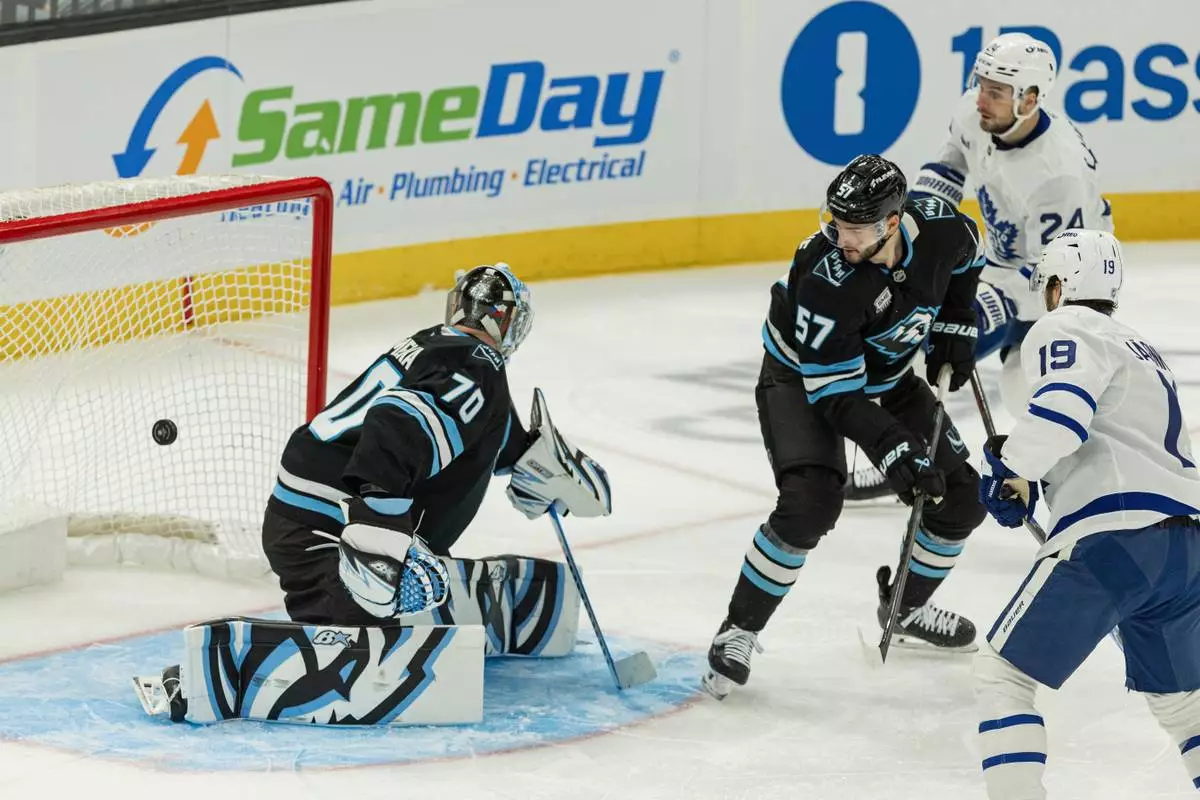
Toronto Maple Leafs center Calle Jarnkrok (19) scores against Utah Mammoth goaltender Karel Vejmelka (70) during the third period of an NHL hockey game Tuesday, Jan. 13, 2026, in Salt Lake City. (AP Photo/Melissa Majchrzak)
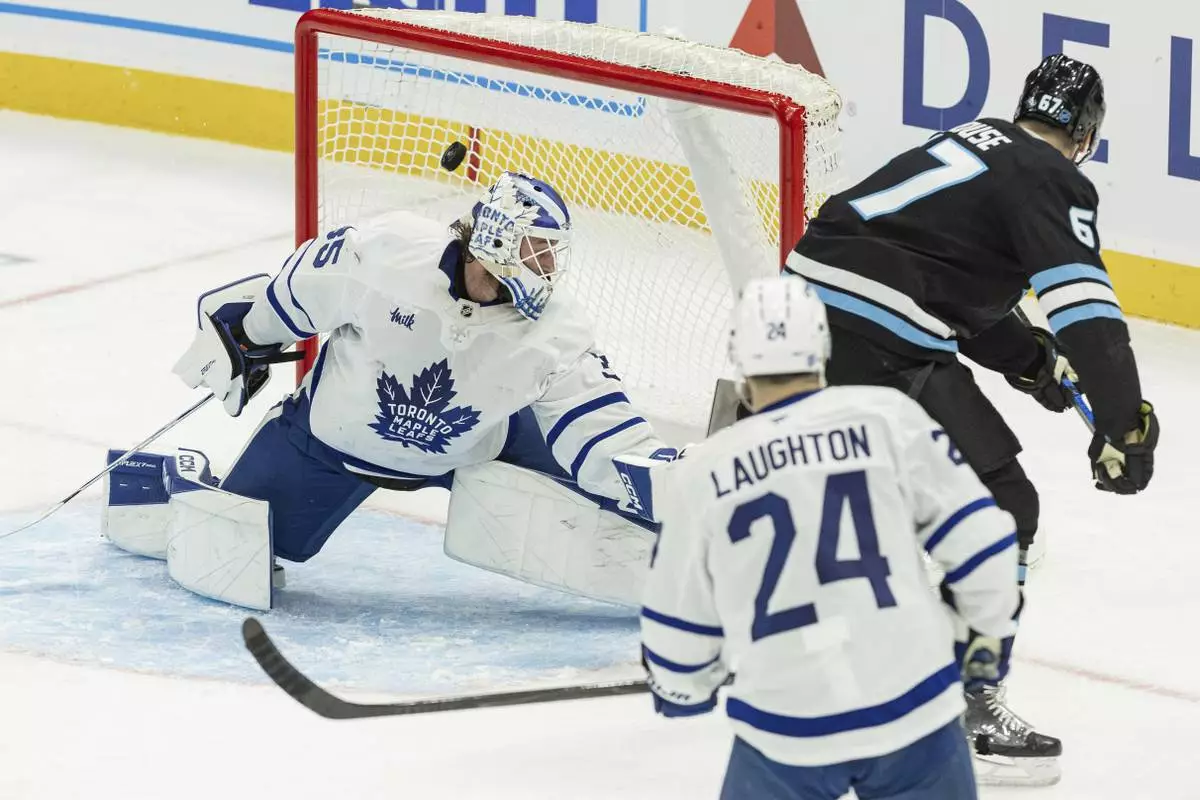
Utah Mammoth left wing Lawson Crouse (67) shoots the puck against Toronto Maple Leafs goalie Dennis Hildeby (35) during the third period of an NHL hockey game Tuesday, Jan. 13, 2026, in Salt Lake City. (AP Photo/Melissa Majchrzak)

Utah Mammoth center Nick Schmaltz (8) moves the puck on the ice against Toronto Maple Leafs center Steven Lorentz (18) during the third period of an NHL hockey game Tuesday, Jan. 13, 2026, in Salt Lake City. (AP Photo/Melissa Majchrzak)
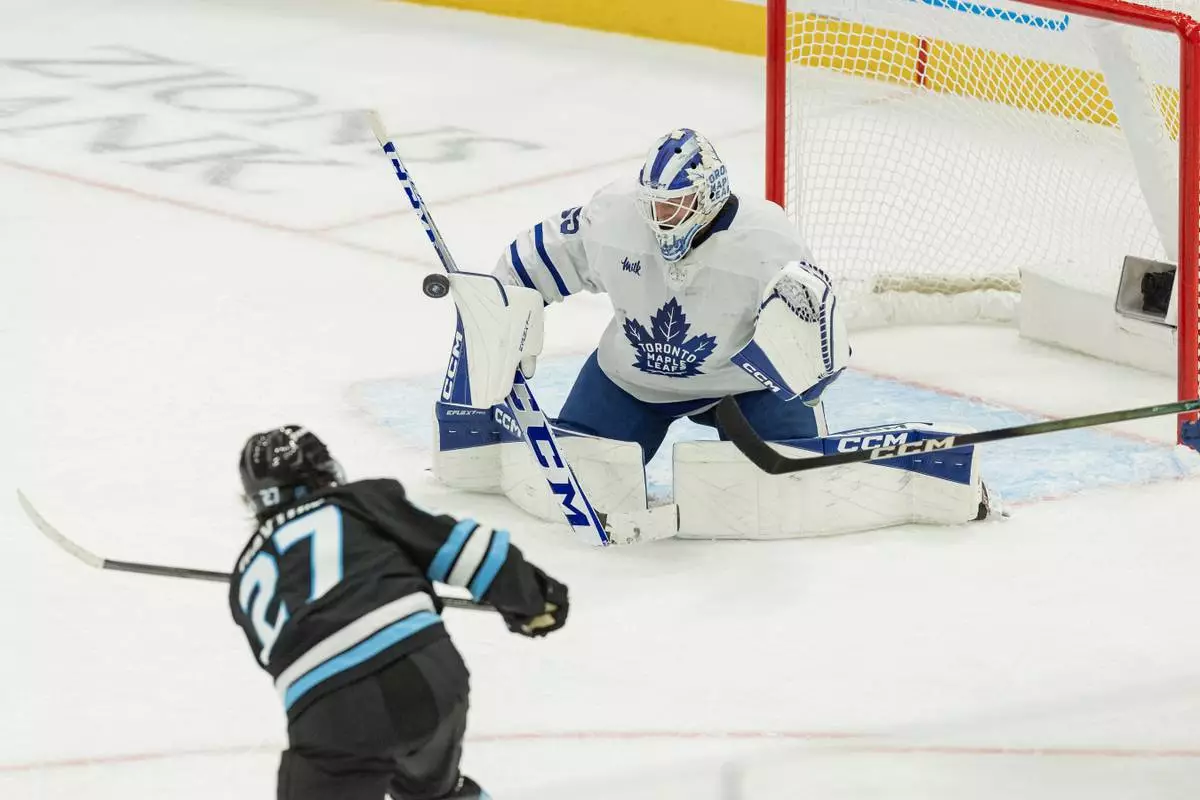
Utah Mammoth center Barrett Hayton (27) shoots the puck against Toronto Maple Leafs goalie Dennis Hildeby (35) during the third period of an NHL hockey game Tuesday, Jan. 13, 2026, in Salt Lake City. (AP Photo/Melissa Majchrzak)