China's rural revitalization strategy is helping transform countryside areas by unleashing a powerful agritourism, or "agriculture-plus-tourism" model, which allows locals to tap into their regional strengths, attract urban visitors and boost local economies.
This integrated approach has developed three primary models: the Rural Complex, blending farming, leisure, and community living; the Culture-Enabled model, breathing new life into heritage through immersive cultural experiences; and the Tech-Driven approach, harnessing smart agriculture and digital tourism tools.
Critical to success of the model is a focus on unique local branding, upgraded infrastructure, and training "New Farmers" in hospitality and e-commerce. Villages are also designing seasonal attractions to ensure year-round appeal.
Moganshan Township in Deqing County, east China's Zhejiang Province, is a prime example of how the model drives rural revitalization.
Once a remote mountain area, Moganshan is building a reputation as a world-class tourist destination, driven by a thriving homestay industry.
The township is famous for its 800 boutique guest houses with investors from 18 countries, including France, the UK and South Korea.
In just a decade, it has become one of China's top guest house destinations, generating over 2.5 billion yuan (around 347.8 million U.S. dollars).
As the industry grows, more young people are also coming back to build their futures there. In 2024 alone, Deqing welcomed nearly 300 youth innovation projects and over 3,500 young entrepreneurs, all chasing their dreams among these green hills.

Agritourism transforms China’s rural areas
Myanmar's new President U Min Aung Hlaing met Wang Yi, a member of the Political Bureau of the Communist Party of China Central Committee and Chinese foreign minister, in Nay Pyi Taw, Myanmar's capital, on Saturday.
Noting that Myanmar consistently regards its relationship with China as the most important bilateral tie, U Min Aung Hlaing emphasized that Myanmar stays committed to the one-China principle and highly appreciates and actively supports the China-proposed four global initiatives.
The new Myanmar government expects to strengthen high-level exchanges with China, advance the construction of the Myanmar-China Economic Corridor, and work together to maintain border peace and stability, while continuously deepening the comprehensive strategic cooperative partnership between the two countries, the president said.
Myanmar will never allow any activities that harm China's interests within its borders, and will continue to intensify its crackdown on online gambling and telecom fraud and take concrete measures to ensure the safety of Chinese personnel, institutions and projects in Myanmar, he added.
For his part, Wang stressed that China's policy toward Myanmar remains consistent. China firmly supports Myanmar in following a successful development path that suits its national conditions and is supported by its people; firmly supports Myanmar in safeguarding its national sovereignty, security and territorial integrity; and firmly supports Myanmar in achieving national peace, reconciliation and social harmony, he said.
Wang also noted that building a China-Myanmar community with a shared future perfectly aligns with the development and revitalization needs of both countries and serves the fundamental interests of both peoples, urging both sides to unswervingly follow this path.
China is willing to cooperate with Myanmar to resolutely and thoroughly eradicate online gambling and telecom fraud, he noted. China will also support Myanmar's participation in more dialogue and cooperation mechanisms and the enhancement of its interaction with ASEAN, Wang added.
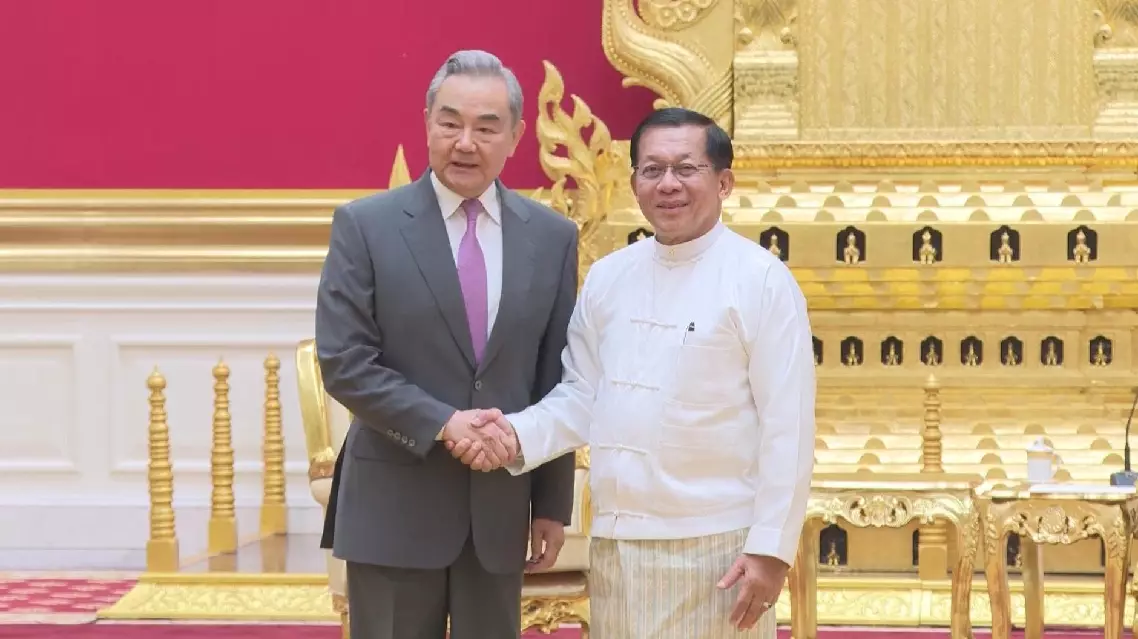
Myanmar president meets Chinese FM
Myanmar president meets Chinese FM