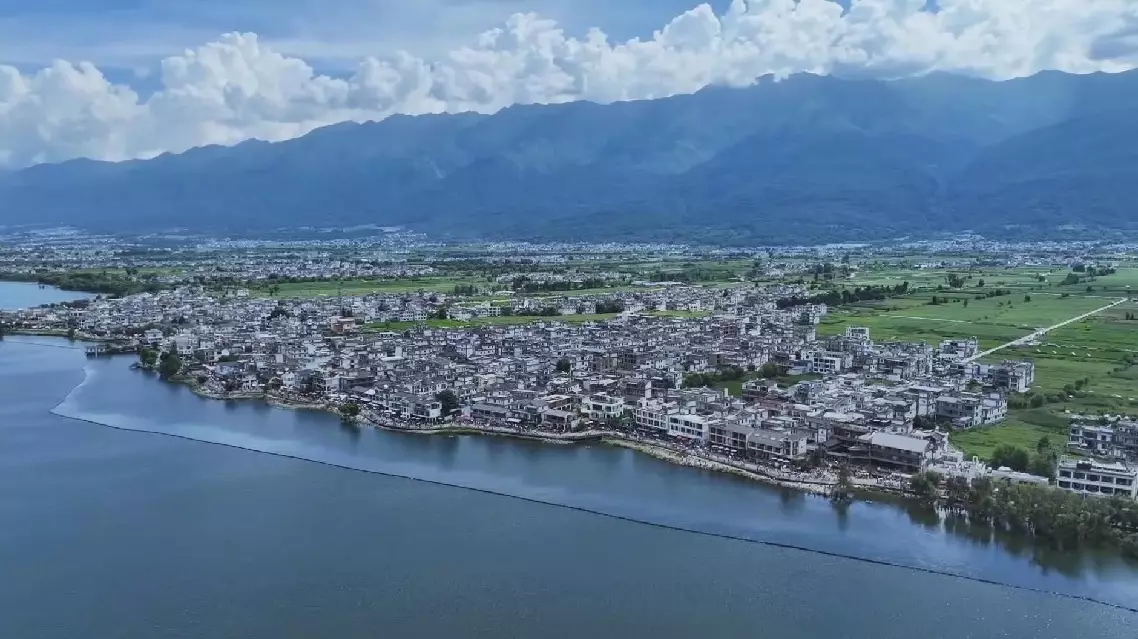
People in southwest China's Yunnan have gradually restored the iconic Erhai Lake to pristine ecological condition, with the lake's rejuvenated shores drawing flocks of tourists following years of dedicated anti-pollution efforts.
Located in the province's Dali Bai Autonomous Prefecture, Erhai Lake is one of China's largest freshwater lakes, and sits at some 2,000 meters above sea level and stretches more than 250 square kilometers.
A major tourist draw, the ear-shaped freshwater lake has attracted tens of millions of tourists every year since local tourism began flourishing in the 1990s.
"It's totally worth visiting. It is very clean and bright. I feel so comfortable here," said Deng Debiao, a tourist who was sitting at the lake bank and enjoying the beautiful natural scenery.
In late 1990s, the body of water was plagued by algae and pollution. Large outbreaks of toxic blue-green algae occurred in the lake in 2003 and 2013, turning the picturesque lake in green and with pungent smell.
In 2015, during an inspection tour of Yunnan, Chinese President Xi Jinping, who is also general secretary of the Communist Party of China Central Committee, visited a village near the lake and called on the residents and the local government to protect it.
"In 2017 and 2018, the average total phosphorus concentration across Erhai Lake was 29 micrograms per liter. This year, it's 20 micrograms per liter. While it seems like just a nine-microgram drop, this is a hard-won and remarkable achievement. A decrease in total phosphorus means a clear reduction in algae in the lake," said Wang Xinze, director of Shanghai Jiao Tong University Yunnan Dali Research Institute.
In recent years, Yunnan's local government and ecological management companies have been tirelessly working to intercept pollution at its source, protecting the province's natural treasures.
"Upon the operation of the project, the full collection and treatment of wastewater from all the villages and townships around Erhai Lake can be covered," Li Jianjun, general manager of China Water Environment Group Dali Erhai Branch.
More than 100,000 septic tanks were installed in villages, and thousands of kilometers of pipes were laid, which means that wastewater that once flowed into the lake is now cleaned, and even after treatment, it doesn't reach the lake.
This system's success depends on engineering projects, scientific support, and the cooperation of every household.
"The Dali Bai Autonomous Region proposed four governance measures and one network on Erhai Lake protection. Specifically, the lake should be managed and protected through engineering subjects, according to the laws, in scientific methods, and with joint efforts of all people here. Plus, we have introduced grid-based management system for the lake protection," said Wang.
The restored ecological environment around the lake also brought confidence to many business runners.
"Investing in an upscale guesthouse requires a significant commitment. But Erhai now has been well-managed, and the government gives us dedicated support, which brings us much confidence moving forward," said Fu, a leisure home-stay hotel owner.
Besides engineering projects, scientific methods and joint efforts make by local government and residents, the law-based governance also plays a crucial role in the ecological restoration of Erhai.
"Erhai has its own protection regulations clearly outlining what is prohibited and what is allowed. We always strictly review everything according to these laws and regulations," said Sun Xiao, deputy director of Erhai Administration Bureau.
Erhai Lake in Yunnan shines as China’s success in ecological restoration