President Donald Trump is taking a new look at reclassifying marijuana as a less dangerous drug in a move that could nudge the federal government closer to an approach already embraced in many states.
Trump said Monday that he hopes to decide in the coming weeks about whether to support changes to the way marijuana is regulated. The renewed focus on marijuana comes more than a year after former President Joe Biden's administration formally proposed reclassifying marijuana. No decision was made before Biden left office.
Meanwhile, many states have already gone further than the federal government by legalizing the recreational use of marijuana for adults or allowing it for medical purposes.
Possessing marijuana remains a federal crime punishable by fines and prison time. Selling or cultivating marijuana is a more serious offense, punishable by prison sentences of five years to life, depending on the quantity of the drug.
The Justice Department last year proposed to reclassify marijuana from a Schedule I drug, alongside heroin and LSD, to a less dangerous Schedule III substance, which includes such things as ketamine and some anabolic steroids. But that switch involved a lengthy bureaucratic process.
Nearly 43,000 public comments were submitted to the federal government about the proposed change. The Drug Enforcement Administration was still in the review process when Trump succeeded Biden in January, triggering a re-examination of policies across the federal government.
Reclassifying marijuana would not make it legal for recreational use by adults nationwide. Rather, it would change the way it's regulated and taxed.
Federal income tax deductions for business expenses aren’t available to enterprises involved in “trafficking” any Schedule I or II drug. Changing marijuana to a Schedule III drug could mean significant tax savings for businesses licensed to sell marijuana in states where it is legal.
It also could make it easier to research marijuana, since it’s very difficult to conduct authorized clinical studies on Schedule I substances.
Due to the potential for federal penalties, many banks and financial institutions don't provide debit or credit services, loans or other common banking products to marijuana businesses authorized under state laws. That's unlikely to change merely by rescheduling marijuana under the federal Controlled Substances Act, according to a Congressional Research Service report.
Trump is weighing the pros and cons of a marijuana policy change, noting it's a "very complicated subject.”
“I’ve heard great things having to do with medical" use of marijuana and "bad things having to do with just about everything else,” Trump said Monday.
Marijuana advocacy groups have long pushed for the federal government to soften its stance. As a candidate, Trump appeared open to relaxed regulation, posting on his social media platform last year that he would “focus on research to unlock the medical uses of marijuana to a Schedule 3 drug."
But reclassification faces resistance from some conservatives and law enforcement groups. The National Sheriffs' Association was among those submitting written opposition, highlighting prior determinations that marijuana has a “high abuse potential” and pointing to cases of “extreme intoxication” and fatal vehicle crashes.
The medical use of marijuana is already allowed in 40 states and the District of Columbia. Over the past dozen years, the number of jurisdictions legalizing recreational marijuana for adults rose rapidly to 24 states and the District of Columbia.
But the movement suffered some recent setbacks.
Ballot measures to legalize recreational marijuana failed last fall in Florida, North Dakota and South Dakota. Florida's measure received a majority vote, which would have been sufficient in most states, but fell short of the 60% threshold needed to approve amendments to the state constitution.
Idaho lawmakers this year referred a proposed constitutional amendment to the ballot that would forbid citizen initiatives to legalize marijuana and instead leave such decisions only to the Legislature.
Initiatives continue elsewhere to try to place recreational marijuana on the ballot, including in Oklahoma, where voters defeated a measure in 2023.
About 6 in 10 voters across the country said they favor legalizing recreational use nationwide, according to AP VoteCast, a survey of more than 120,000 U.S. voters conducted during last year's election.
Polling from Gallup shows support for marijuana legalization has grown significantly, from just 36% support in 2005 to 68% last year.
Marijuana use has also increased. More than 64 million Americans age 12 and older — or 22.3% of people — used marijuana during the past year, according to a 2024 national survey released recently by the federal Substance Abuse and Mental Health Services Administration. That was up from 19% of people in 2021.
The growth in marijuana use was driven by adults aged 26 and older, according to the survey. However, people ages 18-25 remained the most likely to partake in marijuana, with 35% reporting use during the past year.
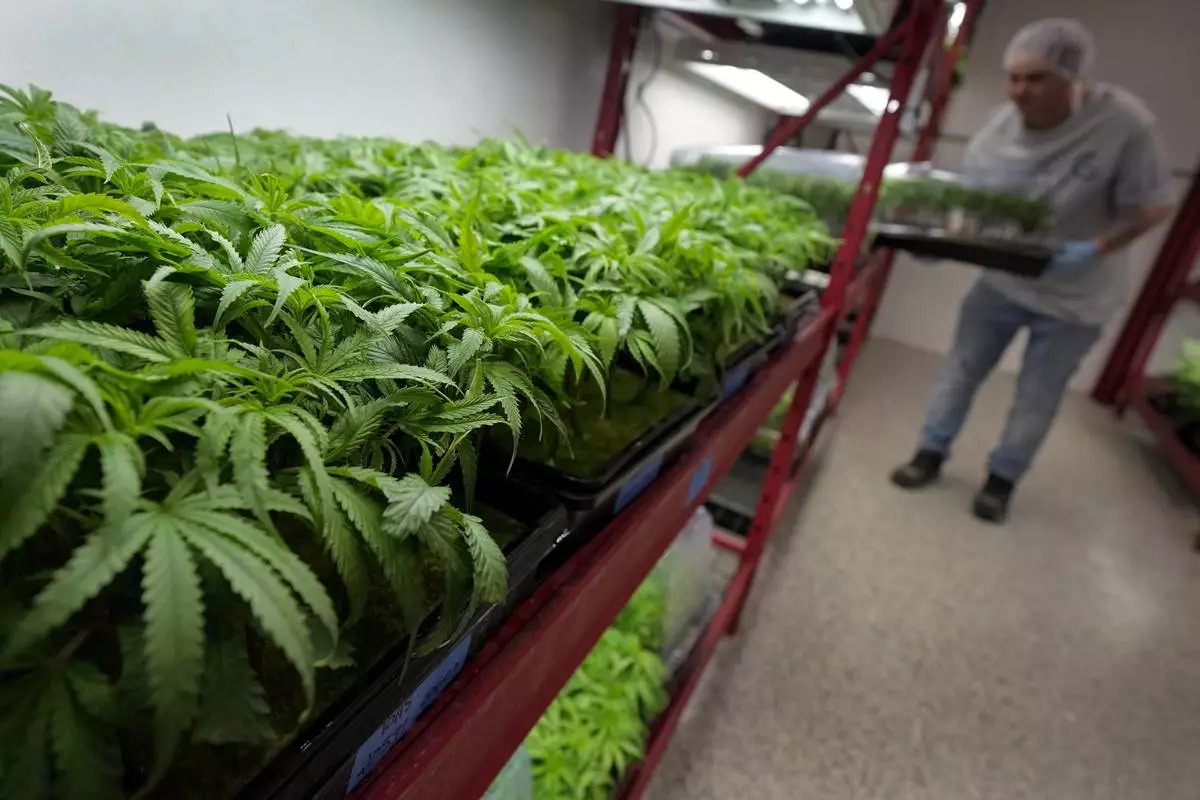
FILE- Michael Stonebarger sorts young cannabis plants at a marijuana farm operated by Greenlight, Monday, Oct. 31, 2022, in Grandview, Mo. (AP Photo/Charlie Riedel, file)