|
Latest report shows user experience driving digital migration
SINGAPORE, Aug. 13, 2025 /PRNewswire/ -- Visa, a world leader in digital payments, today announced results from its annual Money Travels: 2025 Digital Remittances Adoption Report based on responses from 44,000 senders and receivers across 20 countries and territories. The report tracks remittance trends around the world, including Asia Pacific, a key region in the $905 billion[i] global remittance landscape.
Key findings in this year's survey show digital applications as the most popular method for sending and receiving remittances, and ease of use, safety, privacy, and security as the top four user experience benefits driving such preference.
"Remittances have long driven growth across Asia Pacific, uplifting many economies in the region," said Chavi Jafa, Senior Vice President, Head of Commercial and Money Movement Solutions, Asia Pacific, Visa. "The clear shift to app-based remittances reflects the region's demographics, the growing prominence of digital payment modes, as well as user preferences for easy, safe and quick ways to send and receive money. This shift is an important one for banks, remitters and fintechs to note as it will shape how they engage and serve evolving consumer expectations."
Key findings for Asia Pacific
Digital apps remain the most popular and are perceived as the fastest option
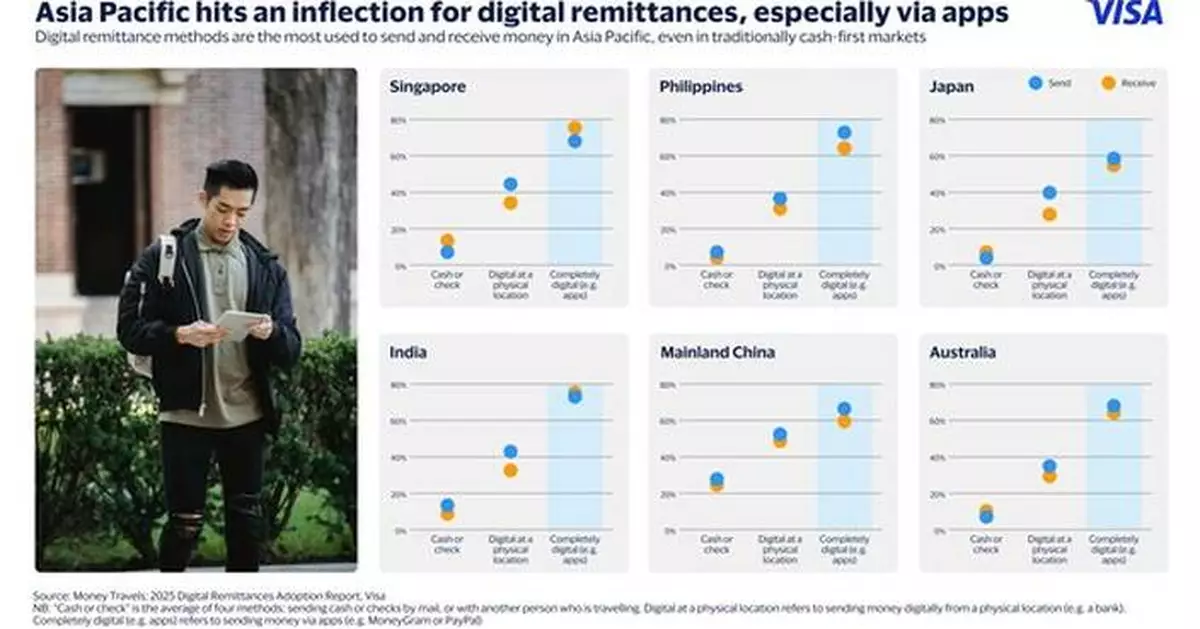
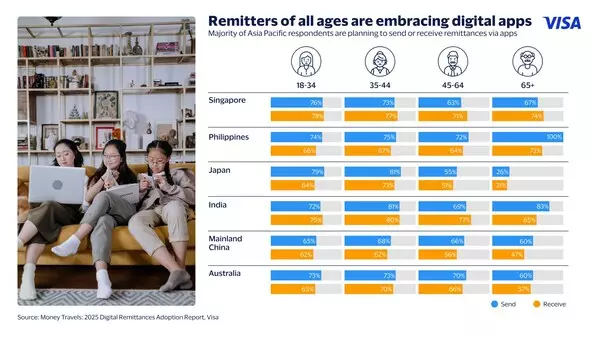
- Digital apps are the most preferred channel to send/receive remittances in Asia Pacific, with usage rates reaching its highest in India (74%/76%), the Philippines (74%/66%), and Singapore (70%/75%).
- Japan is also seeing steady growth, with digital app usage rising by 10% (58%/56%) in 2025 compared to the previous year.
- Over half of the respondents in the Philippines (73%/73%), Australia (58%/55%), Singapore (67%/66%), and India (55%/53%) perceive digital payments as fastest way to access funds (73%).
- Most Asia Pacific remittance users surveyed report experiencing no issues with sending/receiving digital remittance transfers across all Asian markets, most positively in Australia (48%/53%), Japan (37%/41%), Singapore (36%/37%), and Mainland China (38%/31%, rising significantly since 2024 at +13%/+8%).
Remittance rationale varies across the region
- Contributing to accounts/investments is a primary reason to send/receive remittances across several markets including Mainland China (45%/36%), Singapore (38%/33%), and Japan (27%/23%).
- Sending for general/specific humanitarian need is a key reason for remittances, cited by respondents in Mainland China (45%/33%), India (40%), Singapore (27%), and Australia (25%).
- Sending remittances for an unexpected need was highest in India (44%), the Philippines (41%), and Australia (31%).
- Receiving regular remittances was cited by approximately a third of respondents in the Philippines (39%), Mainland China (34%), and India (30%).
Security and convenience outweigh pain points such as fees
- Digital apps are viewed as the most secure way to send/receive remittances in Asia Pacific, with top responses from India (50%/53%), Australia (49%/45%), and Singapore (44%/42%).
- Ease of use to send/receive digital remittances was noted most by respondents in Singapore (51%/51%) the Philippines (48%/54%), Japan (47%/42%), and Australia (42%/40%).
- Digital app fees for sending/receiving remittances were highlighted as a top pain point across Asia Pacific, led by the Philippines (43%/30%), India (36%/33%), and Singapore (32%/32%).
- Similarly, high fees were noted as the top pain point for sending physical remittances across all markets, with top responses from the Philippines (45%/29%), India (41%/37%), Singapore (38%/30%), Australia (29%/30%).
- Inconvenience and long travel distances remain key challenges for sending physical remittances, with respondents in India (36%) and Mainland China (27%) citing travel as a barrier. In Australia and Singapore, 29% of respondents each noted the physical remittance process as inconvenient and time-consuming alongside concerns about high fees.
- Across most Asia Pacific countries surveyed, the perceived security of physical remittances was low (3%-6%), with Mainland China reporting slightly higher levels of confidence (10%-12%).
With one billion people relying every year on remittance services and platforms[ii], Visa continues to innovate and build solutions to enable payments businesses to enhance operational efficiency in money movement and broaden financial access for their customers.
"Remittances have long been a lifeline across Asia Pacific, and they will continue to play a vital role in uplifting communities and livelihoods. At the same time, many small businesses are also beneficiary of remittances driving local growth in local economies," said Rhidoi Krishnakumar, Vice President, Head of Visa Direct, Asia Pacific, Visa. "At Visa, we recognise the enduring purpose of our role in delivering remittances on behalf of our clients and continue to innovate and build solutions to enable more efficient, reliable and secure ways to move money."
Visa works in collaboration with global remitters, such as MOIN, WireBarley, Money Chain World Remittance and EzRemit, to help enable efficient money movement through digitised remittances.
About Visa
Visa (NYSE: V) is a world leader in digital payments, facilitating transactions between consumers, merchants, financial institutions and government entities across more than 200 countries and territories. Our mission is to connect the world through the most innovative, convenient, reliable and secure payments network, enabling individuals, businesses and economies to thrive. We believe that economies that include everyone everywhere, uplift everyone everywhere and see access as foundational to the future of money movement. Learn more at Visa.com.
Latest report shows user experience driving digital migration
SINGAPORE, Aug. 13, 2025 /PRNewswire/ -- Visa, a world leader in digital payments, today announced results from its annual Money Travels: 2025 Digital Remittances Adoption Report based on responses from 44,000 senders and receivers across 20 countries and territories. The report tracks remittance trends around the world, including Asia Pacific, a key region in the $905 billion[i] global remittance landscape.
Key findings in this year's survey show digital applications as the most popular method for sending and receiving remittances, and ease of use, safety, privacy, and security as the top four user experience benefits driving such preference.
"Remittances have long driven growth across Asia Pacific, uplifting many economies in the region," said Chavi Jafa, Senior Vice President, Head of Commercial and Money Movement Solutions, Asia Pacific, Visa. "The clear shift to app-based remittances reflects the region's demographics, the growing prominence of digital payment modes, as well as user preferences for easy, safe and quick ways to send and receive money. This shift is an important one for banks, remitters and fintechs to note as it will shape how they engage and serve evolving consumer expectations."
Key findings for Asia Pacific
Digital apps remain the most popular and are perceived as the fastest option
- Digital apps are the most preferred channel to send/receive remittances in Asia Pacific, with usage rates reaching its highest in India (74%/76%), the Philippines (74%/66%), and Singapore (70%/75%).
- Japan is also seeing steady growth, with digital app usage rising by 10% (58%/56%) in 2025 compared to the previous year.
- Over half of the respondents in the Philippines (73%/73%), Australia (58%/55%), Singapore (67%/66%), and India (55%/53%) perceive digital payments as fastest way to access funds (73%).
- Most Asia Pacific remittance users surveyed report experiencing no issues with sending/receiving digital remittance transfers across all Asian markets, most positively in Australia (48%/53%), Japan (37%/41%), Singapore (36%/37%), and Mainland China (38%/31%, rising significantly since 2024 at +13%/+8%).
Remittance rationale varies across the region
- Contributing to accounts/investments is a primary reason to send/receive remittances across several markets including Mainland China (45%/36%), Singapore (38%/33%), and Japan (27%/23%).
- Sending for general/specific humanitarian need is a key reason for remittances, cited by respondents in Mainland China (45%/33%), India (40%), Singapore (27%), and Australia (25%).
- Sending remittances for an unexpected need was highest in India (44%), the Philippines (41%), and Australia (31%).
- Receiving regular remittances was cited by approximately a third of respondents in the Philippines (39%), Mainland China (34%), and India (30%).
Security and convenience outweigh pain points such as fees
- Digital apps are viewed as the most secure way to send/receive remittances in Asia Pacific, with top responses from India (50%/53%), Australia (49%/45%), and Singapore (44%/42%).
- Ease of use to send/receive digital remittances was noted most by respondents in Singapore (51%/51%) the Philippines (48%/54%), Japan (47%/42%), and Australia (42%/40%).
- Digital app fees for sending/receiving remittances were highlighted as a top pain point across Asia Pacific, led by the Philippines (43%/30%), India (36%/33%), and Singapore (32%/32%).
- Similarly, high fees were noted as the top pain point for sending physical remittances across all markets, with top responses from the Philippines (45%/29%), India (41%/37%), Singapore (38%/30%), Australia (29%/30%).
- Inconvenience and long travel distances remain key challenges for sending physical remittances, with respondents in India (36%) and Mainland China (27%) citing travel as a barrier. In Australia and Singapore, 29% of respondents each noted the physical remittance process as inconvenient and time-consuming alongside concerns about high fees.
- Across most Asia Pacific countries surveyed, the perceived security of physical remittances was low (3%-6%), with Mainland China reporting slightly higher levels of confidence (10%-12%).
With one billion people relying every year on remittance services and platforms[ii], Visa continues to innovate and build solutions to enable payments businesses to enhance operational efficiency in money movement and broaden financial access for their customers.
"Remittances have long been a lifeline across Asia Pacific, and they will continue to play a vital role in uplifting communities and livelihoods. At the same time, many small businesses are also beneficiary of remittances driving local growth in local economies," said Rhidoi Krishnakumar, Vice President, Head of Visa Direct, Asia Pacific, Visa. "At Visa, we recognise the enduring purpose of our role in delivering remittances on behalf of our clients and continue to innovate and build solutions to enable more efficient, reliable and secure ways to move money."
Visa works in collaboration with global remitters, such as MOIN, WireBarley, Money Chain World Remittance and EzRemit, to help enable efficient money movement through digitised remittances.
About Visa
Visa (NYSE: V) is a world leader in digital payments, facilitating transactions between consumers, merchants, financial institutions and government entities across more than 200 countries and territories. Our mission is to connect the world through the most innovative, convenient, reliable and secure payments network, enabling individuals, businesses and economies to thrive. We believe that economies that include everyone everywhere, uplift everyone everywhere and see access as foundational to the future of money movement. Learn more at Visa.com.
[i] World Bank Blogs - In 2024, remittance flows to low- and middle-income countries are expected to reach $685 billion, larger than FDI and ODA combined
[ii] IFAD - 14 reasons why remittances are important
** The press release content is from PR Newswire. Bastille Post is not involved in its creation. **
Visa Releases Money Travels 2025 Remittances Report for Asia Pacific
Visa Releases Money Travels 2025 Remittances Report for Asia Pacific
- New framework brings together Aon's Risk Capital and Human Capital data with public sentiment analysis from Gallup to create a portfolio view of risk
- Creates further clarity into how risks compound across four megatrends, how resilience is built and activated and where targeted actions can most effectively influence performance
DUBLIN, Jan. 16, 2026 /PRNewswire/ -- Aon plc (NYSE: AON), a leading global professional services firm, announced today that it is releasing insights from a new, data-driven tool to help organizations build sustainable resilience and unlock growth: Aon's Resilience Quotient.
Developed in collaboration with Gallup, Aon's Resilience Quotient responds to a critical insight: in a time of increasing populism and fragmented sources of information, quantitative data alone is not enough to make long-term decisions. Combining public sentiment on global issues with risk and people data and analytics enables greater clarity and confidence to invest and grow amidst uncertainty and volatility.
By integrating Aon's proprietary Risk Capital and Human Capital analytics with the results of Gallup's World Poll covering 140 countries for more than 20 years, the firm's Resilience Quotient captures both objective conditions and subjective sentiment, revealing where sentiment signals hidden risks and potential opportunities to achieve greater resilience. This system-level view enables leaders to spot emerging risks sooner, prioritize resilience investments and move from reactive risk management to proactive decision-making.
"When making decisions around investment, workforce or managing geopolitical risk, a portfolio view is far superior to a siloed perspective," said Greg Case, president and CEO of Aon. "Understanding sentiment can be an opportunity signal or an early warning. Leaders who are limited to only some of the relevant metrics risk missing the signals that matter most. Aon's Resilience Quotient delivers an integrated view to help organizations act decisively, strengthen resilience and unlock sustainable growth."
Four interconnected megatrends – Trade, Technology, Weather and Workforce – are reshaping the global operating environment in ways that traditional models struggle to anticipate. Aon's Resilience Quotient provides a clearer view of the tradeoffs within these interactions: how trade volatility can amplify technology risk, how climate pressures influence workforce mobility and how sentiment can either reinforce resilience or heighten operational risk, even when the fundamentals appear strong.
To illustrate the insights from its Resilience Quotient, the firm published three case studies addressing some of the most relevant and urgent issues facing the 2026 global economy:
- Realizing the Opportunity of AI: Securing Data Center Growth
Data centers are the backbone of the digital economy and with nearly $1.3 trillion projected to be invested globally in data centers by 2030, their rapid expansion brings unprecedented risks. Aon's Resilience Quotient shows that resilience varies sharply at the sub-national level, often more than underlying risk. Within the U.S., Iowa emerges as the most resilient destination for data center development, combining very low overall risk with exceptionally strong trade and weather resilience. "Aon's Resilience Quotient shows that Iowa's resilience–risk balance is roughly twice the national median, demonstrating how governance quality, institutional confidence and preparedness materially shape long-term infrastructure outcomes," said Joe Peiser, CEO of Commercial Risk Solutions at Aon. "This underscores the opportunity for leaders who understand the combined effect of low risk, resilient trade and weather systems and a strong foundation of public trust — factors that ultimately determine where AI infrastructure can grow at scale."
DUBLIN, Jan. 16, 2026 /PRNewswire/ -- Aon plc (NYSE: AON), a leading global professional services firm, announced today that it is releasing insights from a new, data-driven tool to help organizations build sustainable resilience and unlock growth: Aon's Resilience Quotient.
Developed in collaboration with Gallup, Aon's Resilience Quotient responds to a critical insight: in a time of increasing populism and fragmented sources of information, quantitative data alone is not enough to make long-term decisions. Combining public sentiment on global issues with risk and people data and analytics enables greater clarity and confidence to invest and grow amidst uncertainty and volatility.
By integrating Aon's proprietary Risk Capital and Human Capital analytics with the results of Gallup's World Poll covering 140 countries for more than 20 years, the firm's Resilience Quotient captures both objective conditions and subjective sentiment, revealing where sentiment signals hidden risks and potential opportunities to achieve greater resilience. This system-level view enables leaders to spot emerging risks sooner, prioritize resilience investments and move from reactive risk management to proactive decision-making.
"When making decisions around investment, workforce or managing geopolitical risk, a portfolio view is far superior to a siloed perspective," said Greg Case, president and CEO of Aon. "Understanding sentiment can be an opportunity signal or an early warning. Leaders who are limited to only some of the relevant metrics risk missing the signals that matter most. Aon's Resilience Quotient delivers an integrated view to help organizations act decisively, strengthen resilience and unlock sustainable growth."
Four interconnected megatrends – Trade, Technology, Weather and Workforce – are reshaping the global operating environment in ways that traditional models struggle to anticipate. Aon's Resilience Quotient provides a clearer view of the tradeoffs within these interactions: how trade volatility can amplify technology risk, how climate pressures influence workforce mobility and how sentiment can either reinforce resilience or heighten operational risk, even when the fundamentals appear strong.
To illustrate the insights from its Resilience Quotient, the firm published three case studies addressing some of the most relevant and urgent issues facing the 2026 global economy:
"Aon's Resilience Quotient shows that Iowa's resilience–risk balance is roughly twice the national median, demonstrating how governance quality, institutional confidence and preparedness materially shape long-term infrastructure outcomes," said Joe Peiser, CEO of Commercial Risk Solutions at Aon. "This underscores the opportunity for leaders who understand the combined effect of low risk, resilient trade and weather systems and a strong foundation of public trust — factors that ultimately determine where AI infrastructure can grow at scale."
- Workforce Transformation: AI Adoption and the Next Generation Workforce
The acceleration of AI adoption is transforming the workforce, but most organizations face a critical gap between the demand for AI skills and their readiness to adapt. The Resilience Quotient highlights how workforce engagement, trust and institutional preparedness are essential to harnessing AI's potential, making resilience the key differentiator between organizations that thrive through change and those that risk falling behind. "Aon's Resilience Quotient equips leaders to navigate rapid AI change with confidence," said Lisa Stevens, chief administrative officer at Aon. "These insights help create the conditions for early‑career employees to build the skills and confidence they need — so instead of losing a generation of talent, we cultivate one that is more capable and resilient than ever."
"Aon's Resilience Quotient equips leaders to navigate rapid AI change with confidence," said Lisa Stevens, chief administrative officer at Aon. "These insights help create the conditions for early‑career employees to build the skills and confidence they need — so instead of losing a generation of talent, we cultivate one that is more capable and resilient than ever."
- Rethinking Humanitarian Finance: A New Approach to Forced Migration
Over 120 million people are currently displaced by conflict, climate and systemic crises, reshaping societies and economies worldwide. Aon's Resilience Quotient highlights Venezuela and Colombia to illustrate the tradeoffs between investing resources at the source of migration — supporting those facing institutional erosion, food insecurity and economic collapse — or directing investment to more stable countries like Colombia that are absorbing people fleeing unlivable conditions. "Forced displacement results from extreme weather and man-made disasters like conflict and economic failure," said Bridget Gainer, chief public affairs officer at Aon. "If we could leverage the forecasting and financial capability of insurance to better predict and more quickly mitigate the impact of this volatility, we could help create conditions that allow populations to remain and rebuild in their home countries."
"Forced displacement results from extreme weather and man-made disasters like conflict and economic failure," said Bridget Gainer, chief public affairs officer at Aon. "If we could leverage the forecasting and financial capability of insurance to better predict and more quickly mitigate the impact of this volatility, we could help create conditions that allow populations to remain and rebuild in their home countries."
"Resilience is not a single blueprint, it's the way systems mitigate, adapt and transform under pressure. Aon's Resilience Quotient functions as a pressure gauge, surfacing the trade‑offs and early signals that help leaders strengthen resilience where it matters most," said Joe Daly, managing partner at Gallup. "We're proud to collaborate with Aon to combine Gallup's global sentiment analytics with Aon's Risk Capital and Human Capital data, turning confidence into actionable insight."
New insights from Aon's Resilience Quotient suggest that going forward, resilience priorities will shift from static risk management to dynamic, localized strategies. As disruptions become more complex and frequent, organizations will need to tailor resilience investments to specific geographies, sectors and even sub-regional contexts. Aon's Resilience Quotient is supported with a real-time analytics and AI-enabled insights platform, built by Quantum Rise, providing deeper visibility into evolving risk and resilience signals as conditions change.
Aon and Gallup will join global decision-makers at the World Economic Forum Annual Meeting to advance these critical discussions on restoring confidence and unlocking sustainable growth.
Learn more about Aon's Resilience Quotient and explore the case studies here.
About Aon
Aon plc (NYSE: AON) exists to shape decisions for the better — to protect and enrich the lives of people around the world. Through actionable analytic insight, globally integrated Risk Capital and Human Capital expertise, and locally relevant solutions, our colleagues provide clients in over 120 countries with the clarity and confidence to make better risk and people decisions that help protect and grow their businesses.
Follow Aon on LinkedIn, X, Facebook and Instagram. Stay up-to-date by visiting Aon's newsroom and sign up for news alerts here.
Media Contact
mediainquiries@aon.com
Toll-free (U.S., Canada and Puerto Rico): +1 833 751 8114
International: +1 312 381 3024
** The press release content is from PR Newswire. Bastille Post is not involved in its creation. **

Aon's Resilience Quotient Cuts Through Uncertainty and Volatility to Help Businesses Move from Risk to Resilience and Growth