Decades of extraordinary efforts made by three generations of Chinese people have turned Saihanba in north China's Hebei Province from a windswept wilderness to the world's largest man-made forest.
By the late 1950s, centuries of overgrazing, logging, and war had degraded the area into desert. With sandstorms threatening the nation's capital Beijing and other northern cities, China decided to bring it back to life.
In 1962, the Saihanba mechanized forest farm was founded. The first batch of foresters consisted of 369 people from 18 provinces nationwide, who were mostly in their 20s.
Over half a century, three generations turned the forest coverage from 11 percent to 82 percent.
In 2017, Saihanba won the United Nations' highest environmental honor, the Champion of the Earth.
"This is a fantastic achievement for the people of Saihanba in northern China, but also an inspiring example for the rest of the world," said Erik Solheim, then executive director of United Nations Environment Program (UNEP).
In the same year, President Xi Jinping praised Saihanba's builders for turning the idea that "lucid waters and lush mountains are invaluable assets" into reality.
And for the first time, he put forward the concept of the "Saihanba Spirit", which features staying true to the original aspiration, being hardworking and enterprising, and pursuing green development.
Now, its experience and advanced techniques have been shared across China, as well as with countries including Mongolia, Ethiopia and Sri Lanka.
In August 2021, President Xi inspected the Saihanba Forest Farm.
"The Saihanba Spirit is part of our Chinese civilization. It has an inspiring power. The whole nation should carry it forward," he said during the visit.
Among those he met was Liu Jun and his wife Wang Juan, second-generation foresters who have spent over a decade as fire lookouts.
"The Saihanba Spirit means dedication and selfless contribution. Working in the forest every day, you have to endure loneliness and be ready to work hard, no matter the conditions," said Liu.
President Xi called on the people of Saihanba to redouble their efforts and carry forward reforestation.
Today, a new generation is taking on new challenges. Among them, Yuan Zhongwei is leading under-canopy planting.
"See this little sapling? We planted it this spring, spruce and birch growing under the larch, building a mixed forest. We have a better environment than our fathers and grandfathers. Our key task now is managing the forest well, so it can grow healthier and sustain high-quality development," said Yuan, a third-generation forester.
Mixed forests are more resilient to fire, pests and climate change. Since 2023, Saihanba has made them standard in all its planting projects.
Others are tackling "hard" forests: steep, rocky slopes with thin soil and little rainfall.
"We bring in good-quality soil by hand, cover it with protective film to retain moisture, and shape the pits like bowls so rainwater stays with the trees," said Sun Chaohui, another third-generation forester.
Now, every such rocky sunny slope in Saihanba has been greened, with survival rates above 98 percent.
Today, the forest covers 760 square kilometers -- the size of over 100,000 soccer fields. Saihanba stands a powerful symbol of China's ecological conservation and proof that determination, science and long-term vision can turn deserts into oases.
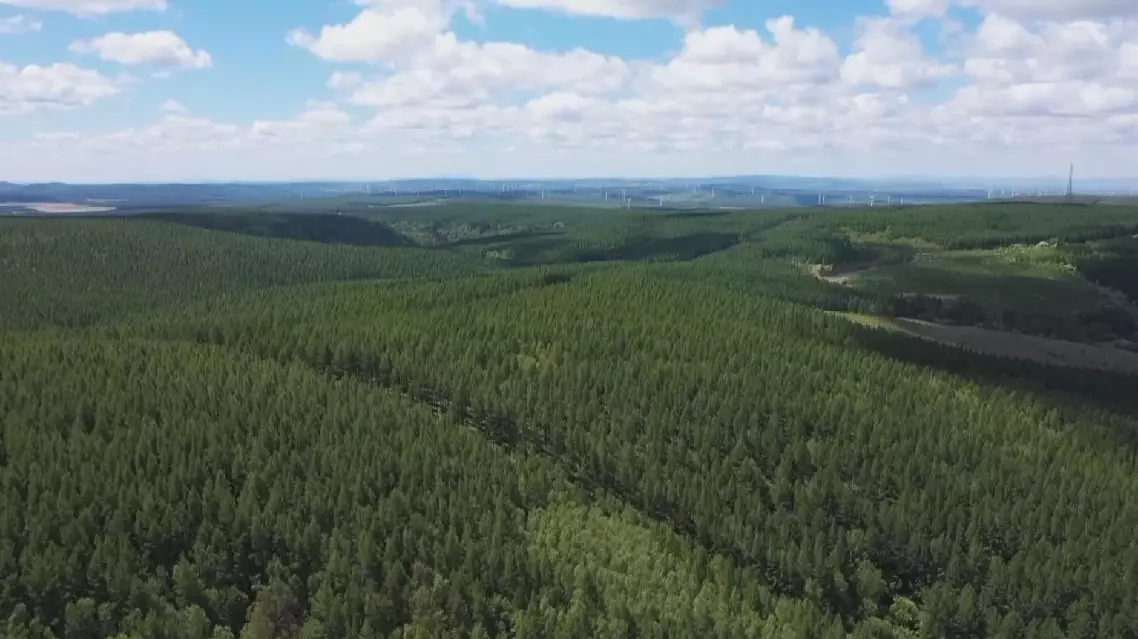
From barren land to global model: Saihanba's green miracle