SAN JUAN, Puerto Rico (AP) — The security firm of former U.S. Navy Seal Erik Prince will soon deploy nearly 200 personnel from various countries to Haiti as part of a one-year deal to quell gang violence there, a person with knowledge of the plans said Thursday.
The deployment by Vectus Global is meant to help the government of Haiti recover vast swaths of territory seized in the past year and now controlled by heavily armed gangs, said the person, speaking to The Associated Press on condition of anonymity to discuss the plans.
The company, which provides logistics, infrastructure, security and defense, is run by Prince, a major donor to U.S. President Donald Trump. Prince previously founded the controversial security firm Blackwater.
The deployment was first reported by Reuters.
Vectus Global also will assume a long-term role in advising Haiti’s government on how to restore revenue collection capabilities once the violence subsides, the person said.
In June, Fritz Alphonse Jean, then-leader of Haiti’s transitional presidential council, confirmed that the government was using foreign contractors. He declined to identify the firm or say how much the deal was worth.
Romain Le Cour Grandmaison, head of Haiti Observatory at the Global Initiative Against Transnational Organized Crime, said the operations would violate U.S. law unless the U.S.-based private military company had permission from the U.S. government to work in Haiti.
“In the absence of a coherent, jointly led Haitian and international strategy, the use of private firms is more likely to fragment authority and sovereignty than to advance resolution of the crisis,” he said.
A Trump administration official said the U.S. government has no involvement with the hiring of Vectus Global by the Haitian government. The U.S. government is not funding this contract or exercising any oversight, said the official, who requested anonymity to discuss the situation.
The office of Haiti's prime minister did not return a message for comment, nor did members of Haiti's transitional presidential council.
The private contractors, which will come from the United States, Europe and other regions, are expected to advise and support Haiti’s National Police and a U.N.-backed mission led by Kenyan police officers that is struggling to suppress gang violence.
The U.N.-backed mission has 991 personnel, far less than the 2,500 envisioned, and some $112 million in its trust fund — about 14% of the estimated $800 million needed a year, according to a recent U.N. report.
The upcoming deployment of private contractors comes after the recent appointment of André Jonas Vladimir Paraison as the country’s new police director general.
Paraison once served as head of security for Haiti’s National Palace and was involved in a new task forced created earlier this year made up of certain police units and private contractors. The task force has operated outside the oversight of Haiti’s National Police and employed the use of explosive drones, which some human rights activists have criticized.
Diego Da Rin, an analyst with the International Crisis Group, said that while there’s an obvious need for more anti-gang operations, “there is a risk of escalating the conflict without having enough personnel to extinguish the fires that Viv Ansanm can ignite in many places.”
Viv Ansanm is a powerful gang federation created in September 2023 that saw the merging of gangs, including G-9 and G-Pèp — once bitter enemies. The United States designated it as a foreign terrorist organization earlier this year.
The gang federation was responsible for coordinating a series of large-scale attacks early last year that included raids on Haiti’s two biggest prisons that led to the release of some 4,000 inmates. Viv Ansanm also forced the closure of Haiti’s main international airport for nearly three months, with the violence eventually prompting then-Prime Minister Ariel Henry to resign.
Jimmy Chérizier, a leader of Viv Ansanm and best known as Barbecue, recently threatened Paraison.
“Viv Ansanm has a military might that they don’t always show,” said Da Rin, the analyst.
At least 1,520 people were killed and more than 600 injured from April to the end of June across Haiti. More than 60% of the killings and injuries occurred during operations by security forces against gangs, with another 12% blamed on self-defense groups, according to the United Nations Integrated Office in Haiti.
Gang violence also has displaced some 1.3 million people in recent years.
Associated Press writer Joshua Boak in Washington contributed to this report.
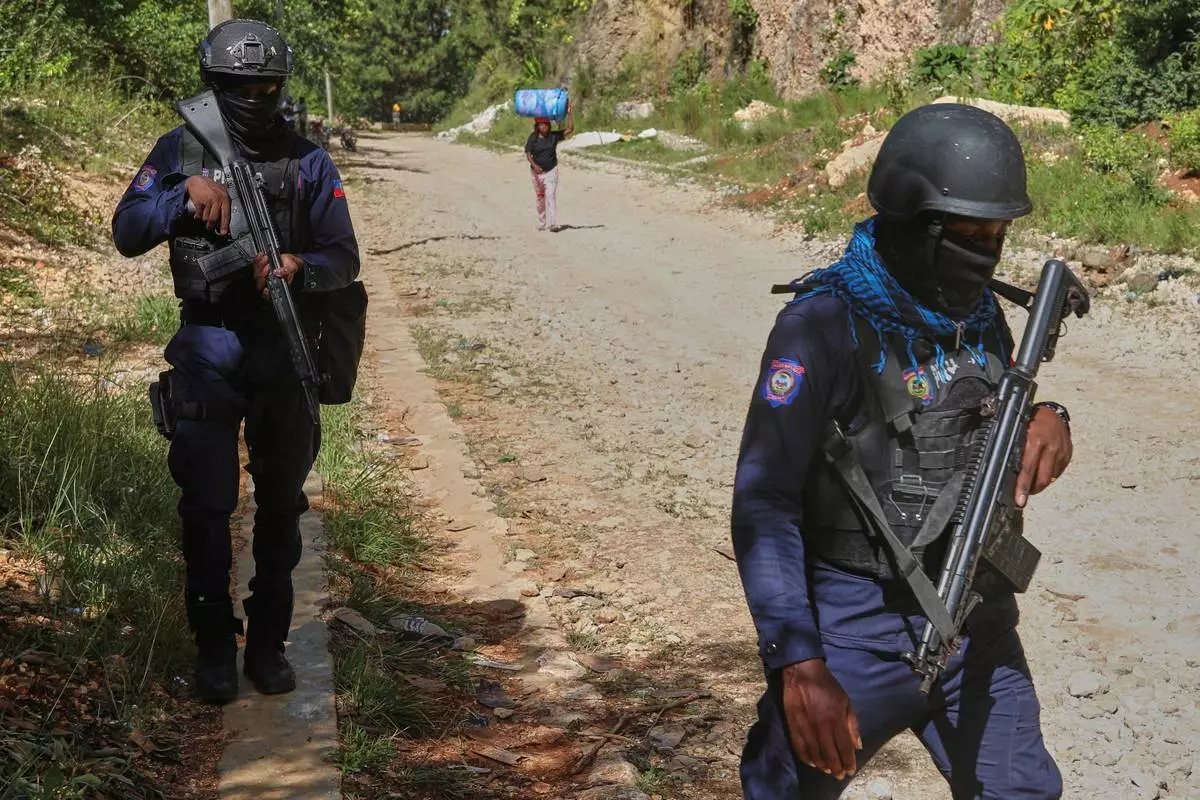
Police officers patrol the area near the Saint-Helene orphanage in the Kenscoff neighborhood of Port-au-Prince, Haiti, Monday, Aug. 4, 2025. (AP Photo/Odelyn Joseph)