Once blanketed in quarry dust, Yucun Village in Anji County, east China's Zhejiang Province, is now celebrated for its crystal-clear waters and lush mountains, earning a place among the world's best tourism villages.
This village is also where Chinese President Xi Jinping, then secretary of the Zhejiang Provincial Committee of the Communist Party of China (CPC), first introduced the concept that "lucid waters and lush mountains are invaluable assets" in 2005.
The concept, later developed into Xi's thought on ecological civilization, has encouraged numerous Chinese cities and villages to pursue high-quality and sustainable growth through protecting the environment and developing green industries.
At the beginning of the 1990s, Yucun village decided to end poverty by tapping the potential of its natural resources.
By mining for limestone and manufacturing cement, Yucun became one of China's richest villages with an annual revenue of more than 3 million yuan (460,000 U.S. dollars).
"We have valuable resources here, particularly our stone mines. The quality of the stones at the foot of the mountains is quite good; they can be used to produce cement and lime. In 1994, our net profit submitted to the village exceeded 2 million yuan. Our village is home to 200 households, with around 60 to 70 people working in the mines," said Hu Jiaren, former secretary of the Yucun Village Committee of the CPC.
However, it was not long before the villagers found it a Faustian bargain. Their hometown turned into a real eyesore with its pitted land, turbid rivers and dust haze.
"When we opened the door, everything was gray and hazy. The bamboo forest, the sky, and the treetops all appeared that way. This was due to the dust pollution from the cement factory. The shirts we bought were either black or gray because a white shirt would turn gray when you wore it for half an hour," Pan Chunlin, a villager, recalled.
Yucun was not the only village in Zhejiang that had seen its eco-system degrading. To address the ever deteriorating problem, the province committed itself to building an "ecological province" in 2003.
Within three years, Yucun shut down three limestone quarries and a cement factory, which accounted for 95 percent of its annual income, causing much fear amongst the villagers.
A heated debate emerged about the relationship between economic development and environmental protection -- a relationship that was inevitably rocky during industrialization across the world.
In April 2003, Xi made his first trip to Anji County, proposing that the main focus should be on the harmony between humans and nature and on fostering an ecological culture.
Six months later, he published an article titled "Ecological Prosperity Leads to Civilizational Prosperity" in the Qiushi Journal, a flagship magazine of the CPC Central Committee. The article pointed out that promoting ecological conservation to create a green Zhejiang is an objective necessity for protecting and boosting productivity.
In April 2005, Xi further elaborated on the green concept during a provincial study session.
"Nature has different seasons, earth has valuable resources, and human can make good use of them to achieve a harmony between people and nature. This is the implication from our ancient philosophy, and we can draw nourishment from it."
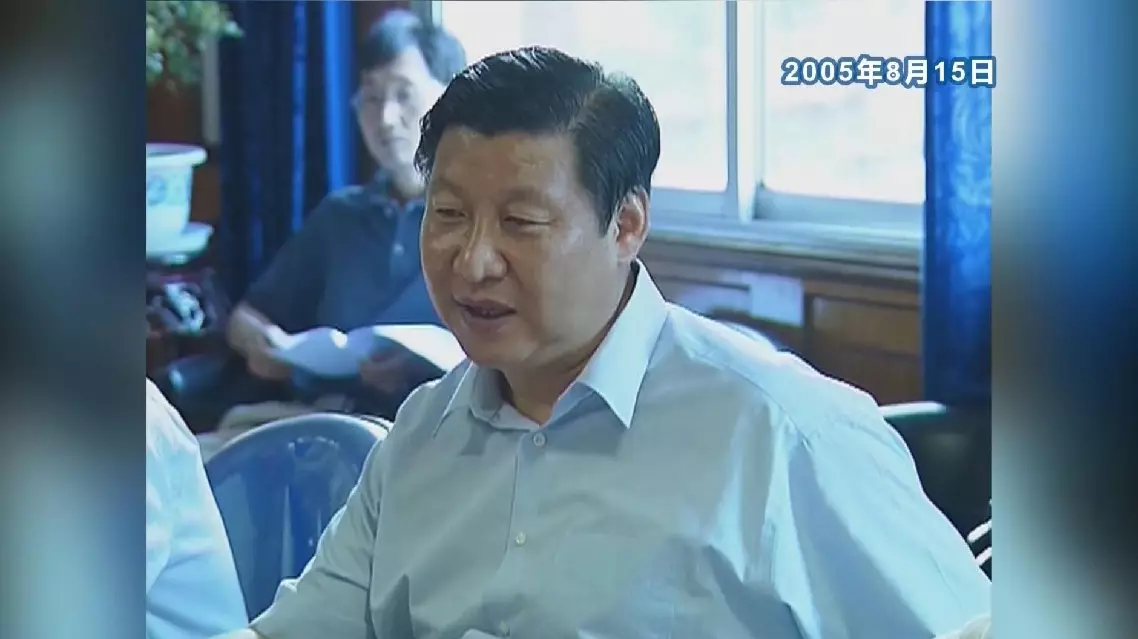
On Aug 15, 2005, Xi visited Anji County again. In Yucun, he assured the villagers that their decision to close those factories was "wise."
"Never try to follow the same old path or hesitate to let go of the old development mode. You mentioned earlier that you had decided to shut down some mines. I think that's wise. Lucid waters and lush mountains are invaluable assets," Xi said at the village's simple and humble meeting room.
Guided by the theory, the villagers made the final decision to conserve local environment and adjust their development strategy.
"After Secretary Xi came, he said, 'Lucid waters and lush mountains are invaluable assets.' This statement awakened many people. Relying on the mountains does not mean depleting them; we still need to protect our natural resources. Secretary Xi's words were like a reassuring promise for the villagers," said Bao Xinmin, former secretary of the Yucun Village Committee of the CPC.
Today, Yucun has become a popular and well-known scenic spot. The site of the demolished cement factory has been transformed into a plantation and a large stretch of land has turned into rapeseed fields and lotus ponds. New business models, such as camping bases and cultural and creative industrial parks, have also been introduced into the village.
In 2024 alone, the village registered a tourist arrival of 1.22 million, achieving a collective economic income of 22.05 million yuan (around 3.1 million U.S. dollars). With over 1,000 villagers, the per capita income hit 74,000 yuan, while annual dividends per person surged from 600 yuan in 2020 to 3,000 yuan – a fivefold increase.
Xi's green vision brings new life to east China city