DENVER (AP) — Arizona, Nevada and Mexico will again live with less water from the Colorado River as drought lingers in the West, federal officials announced Friday.
The Colorado River is a critical lifeline to seven U.S. states, 30 Native American tribes, and two Mexican states. The cuts are based on projections for levels at federal reservoirs — chief among them Lake Powell and Lake Mead — released every August by the U.S. Bureau of Reclamation.
Arizona will again go without 18% of its total Colorado River allocation, while Mexico loses 5%. The reduction for Nevada — which receives far less water than Arizona, California or Mexico — will stay at 7%. California won't face any cuts because it has senior water rights and is the last to lose in times of shortage.
Decades of overuse and the effects of long-term drought worsened by climate change means there’s far more demand for water than what actually flows through the river. Low reservoir levels at Lake Mead have triggered mandatory cutbacks every year since 2022, with the deepest cuts in 2023, which hit farmers in Arizona the hardest.
Meanwhile, the states are working to reach agreement by next year on new long-term rules to govern the river in dry years. The Trump administration gave a mid-November deadline for states to reach a preliminary agreement, or risk federal intervention. Negotiations have faced delays as states push back against how much water they should each give up.
The original 1922 Colorado River Compact was calculated based on an amount of water that doesn't exist in today's climate. That leaves the Upper Basin states of New Mexico, Colorado, Wyoming and Utah to share far less water after the required amount is sent to the to the “Lower Basin” states of Nevada, Arizona and California. Lots of water is also lost to evaporation and leaky infrastructure.
Fairly splitting the river's water in the era of climate change has been vexing for years, with all of the major users hesitant to give anything up as they anticipate a drier future. There has to be enough water in the reservoirs to reach the tunnels that usher water downstream, and ideally, even more water for hydropower generation. Key infrastructure like the Hoover Dam rely on certain water levels in Lake Mead to generate electricity.
Mandatory cuts and emergency water releases are “reactive," said John Berggren, a regional policy manager at Western Resource Advocates, a nonprofit focused on climate change.
“If we are going to be able to have a sustainable Colorado River and not just be responding to crisis after crisis, we need large amounts of flexibility built into this new set of guidelines," he said.
“We can and must do better. Nature isn’t waiting for us,” said Becky Mitchell, Colorado’s commissioner in the Upper Colorado River Commission.
States are considering a so-called natural flow approach to managing the river — where the Lower Basin would receive a certain percentage of the average natural flow from the prior few years.
The Lower Basin states have helped stave off deeper cuts by coming up with voluntary conservation plans.
“Absent all of those measures, the river would be in a very bad place,” said J.B. Hamby, chairman of the Colorado River Board of California and a board member for the Imperial Irrigation District, the largest user of the river's water. Still, he knows California, like others, will likely have to give up more in the negotiations.
Dozens of conservation projects along for Upper Basin states and tribes are in limbo. President Donald Trump froze yet-to-be-distributed Inflation Reduction Act funds on his first day in office, which included nearly $400 million for those projects. The entire Colorado congressional delegation signed a letter earlier this month urging the release their portion of those funds.
Associated Press journalists Amy Taxin in Tustin, California, and Mead Gruver in Fort Collins, Colorado, contributed to this report.
The Associated Press receives support from the Walton Family Foundation for coverage of water and environmental policy. The AP is solely responsible for all content. For all of AP’s environmental coverage, visit https://apnews.com/hub/climate-and-environment

FILE - Lake Mead at Hoover Dam, Thursday, Aug. 22, 2024, near Boulder City, Nev. (AP Photo/Julia Demaree Nikhinson, file)
COPENHAGEN, Denmark (AP) — More than 200 years after being sunk by Adm. Horatio Nelson and the British fleet, a Danish warship has been discovered on the seabed of Copenhagen Harbor by marine archaeologists.
Working in thick sediment and almost zero visibility 15 meters (49 feet) beneath the waves, divers are working against the clock to unearth the 19th-century wreck of the Dannebroge before it becomes a construction site in a new housing district being built off the Danish coast.
Denmark’s Viking Ship Museum, which is leading the monthslong underwater excavations, announced its findings on Thursday, 225 years to the day since the Battle of Copenhagen in 1801.
“It’s a big part of the Danish national feeling,” said Morten Johansen, the museum’s head of maritime archaeology.
A great deal has been written about the battle “by very enthusiastic spectators, but we actually don’t know how it was to be onboard a ship being shot to pieces by English warships and some of that story we can probably learn from seeing the wreck, Johansen said.
In the Battle of Copenhagen, Nelson and the British fleet attacked and defeated Denmark’s navy as it formed a protective blockade outside the harbor.
Thousands were killed and wounded during the brutal hourslong naval clash, considered one of Nelson’s “great battles.” The intention was to force Denmark out of an alliance of Northern European powers, including Russia, Prussia and Sweden.
At the center of the fighting was the Danish flagship, the Dannebroge, commanded by Commodore Olfert Fischer.
The 48-meter (157-foot) Dannebroge was Nelson’s main target. Cannon fire tore through its upper deck before incendiary shells sparked a fire aboard.
“(It was) a nightmare to be on board one of these ships,” Johansen said. “When a cannonball hits a ship, it’s not the cannonball that does the most damage to the crew, it’s wooden splinters flying everywhere, very much like grenade debris.”
The battle also is believed to have inspired the phrase “to turn a blind eye.” After deciding to ignore a superior’s signal, Nelson, who had lost sight in his right eye, reportedly remarked: “I have only one eye, I have a right to be blind sometimes.”
Nelson eventually offered a truce and a ceasefire was later agreed with Denmark’s Crown Prince Frederik.
The stricken Dannebroge slowly drifted northward and exploded. Records say the sound created a deafening roar across Copenhagen.
Marine archaeologists have discovered two cannons, uniforms, insignia, shoes, bottles and even part of a sailor’s lower jaw, perhaps one of the 19 unaccounted-for crew members who likely lost their lives that day.
The dig site will soon be enveloped by construction work for Lynetteholm, a megaproject to build a new housing district in the middle of Copenhagen Harbor that is expected to be completed by 2070.
Marine archaeologists began surveying the area late last year, targeting a spot thought to match the flagship’s final position.
Experts say the sizes of the wooden parts found match old drawings. Dendrochronological dating, the method of using tree rings to establish the age of wood, match the year the ship was built. They also say the darkened dig site is full of cannonballs, a hazard for divers navigating waters darkened by clouds of silt stirred up from the seabed.
“Sometimes you can’t see anything, and then you really have to just feel your way, look with your fingers instead of with your eyes,” diver and maritime archaeologist Marie Jonsson said.
Chronicled in books and painted on canvases, the 1801 battle is deeply embedded in Denmark’s national story.
Archaeologists hope their discoveries may help reexamine the event that shaped the Scandinavian country and perhaps uncover personal stories of those who went into battle on that day 225 years ago.
“There are bottles, there are ceramics, and even pieces of basketry,” Jonsson said. “You get closer to the people onboard.”
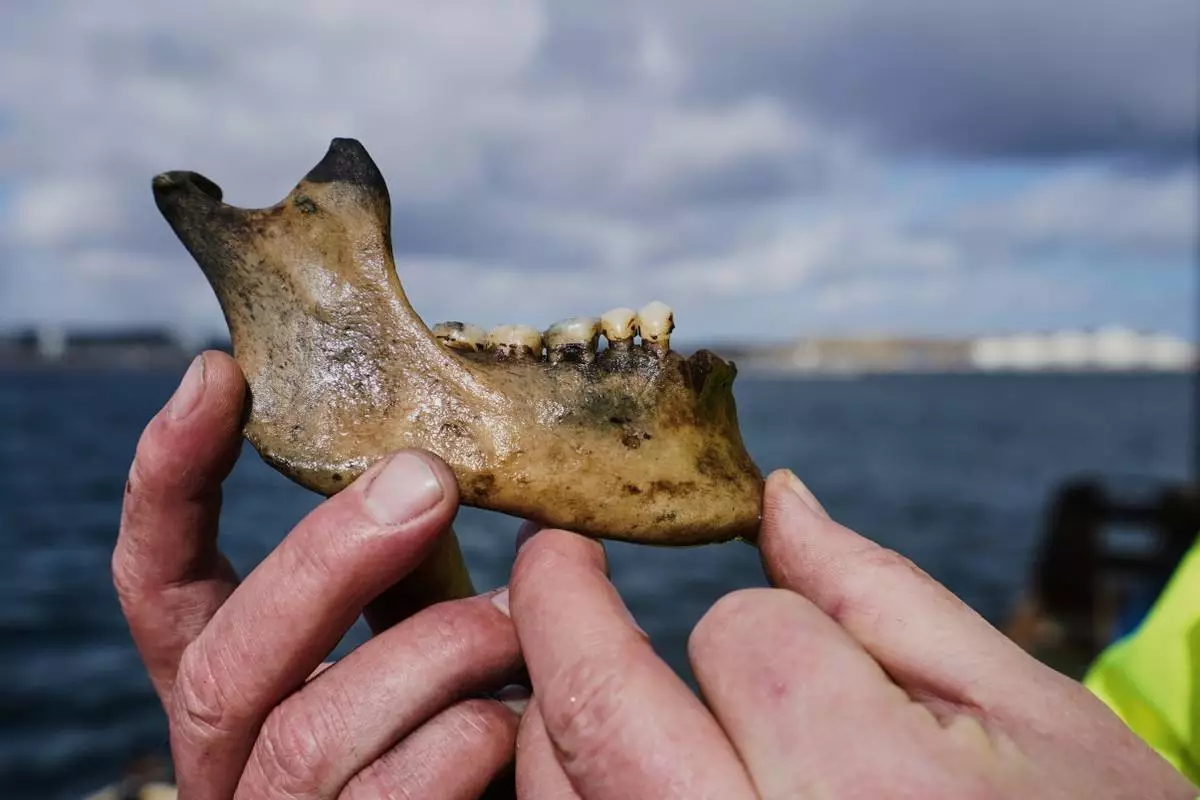
Morten Johansen, head of maritime archaeology at Denmark's Viking Ship Museum, shows part of a human lower jawbone recovered from the wreck of Danish flagship "Dannebroge" that sank during the Battle of Copenhagen in 1801, in Copenhagen, Denmark, Tuesday, March 31, 2026. (AP Photo/James Brooks)
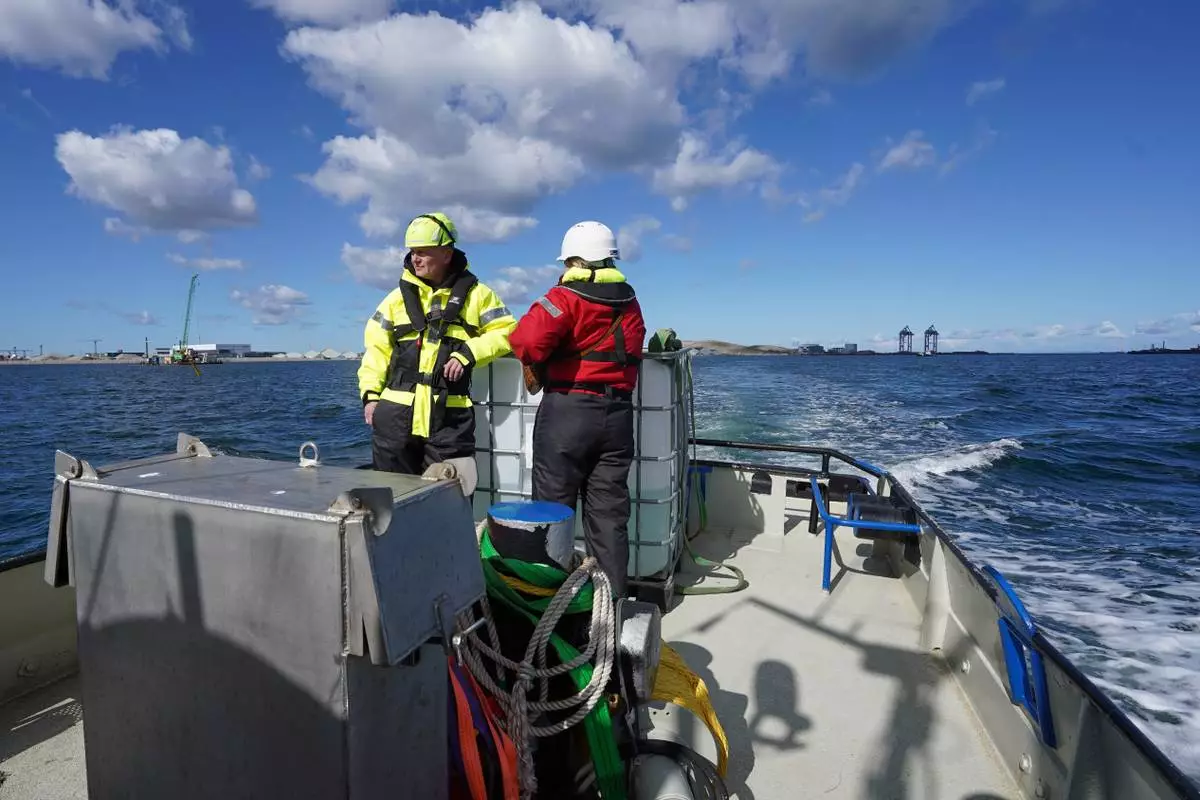
Archaeologists sail with boat through the harbor in Copenhagen, Denmark, Tuesday, March 31, 2026. (AP Photo/James Brooks)

An archaeologist points to a computer screen, showing a map of the wreck of Danish flagship "Dannebroge" that sank during the Battle of Copenhagen in 1801. in Copenhagen, Denmark, Tuesday, March 31, 2026. (AP Photo/James Brooks)
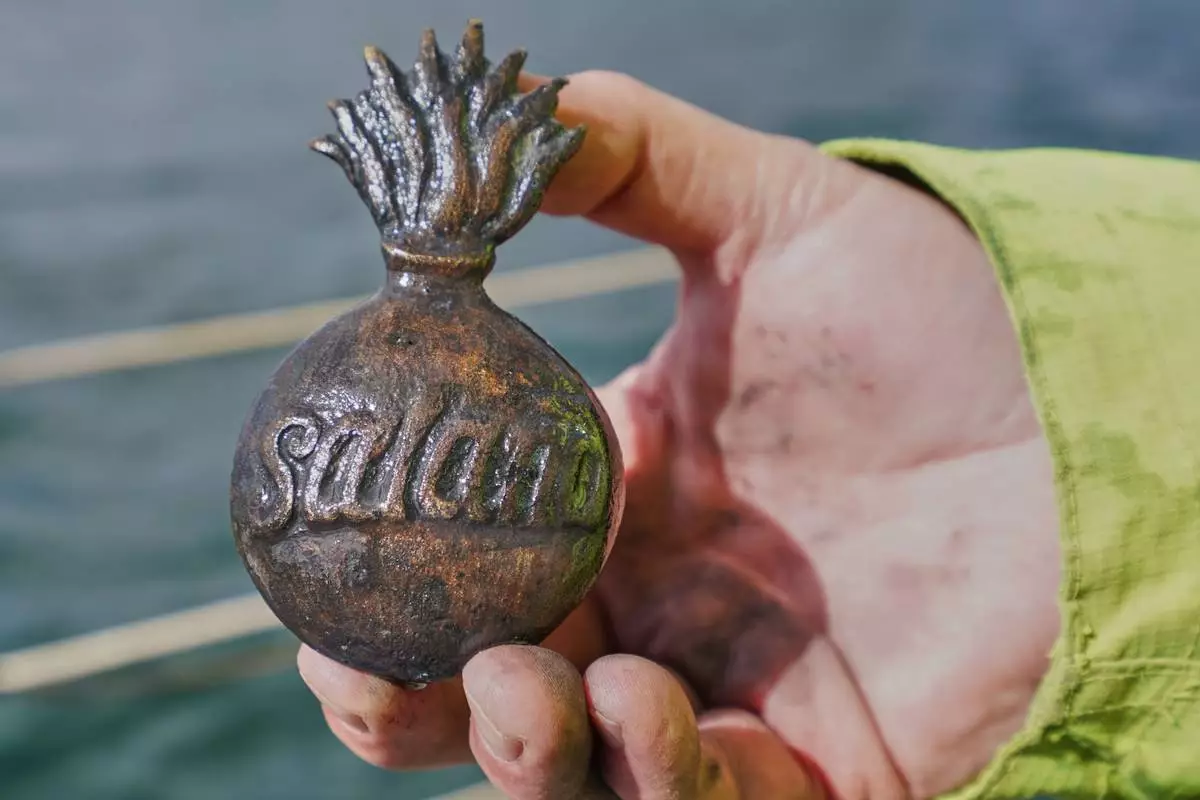
Morten Johansen, head of maritime archaeology at Denmark's Viking Ship Museum, shows a metal insignia recovered from the wreck of Danish flagship "Dannebroge" that sank during the Battle of Copenhagen in 1801, in Copenhagen, Denmark, Tuesday, March 31, 2026. (AP Photo/James Brooks)
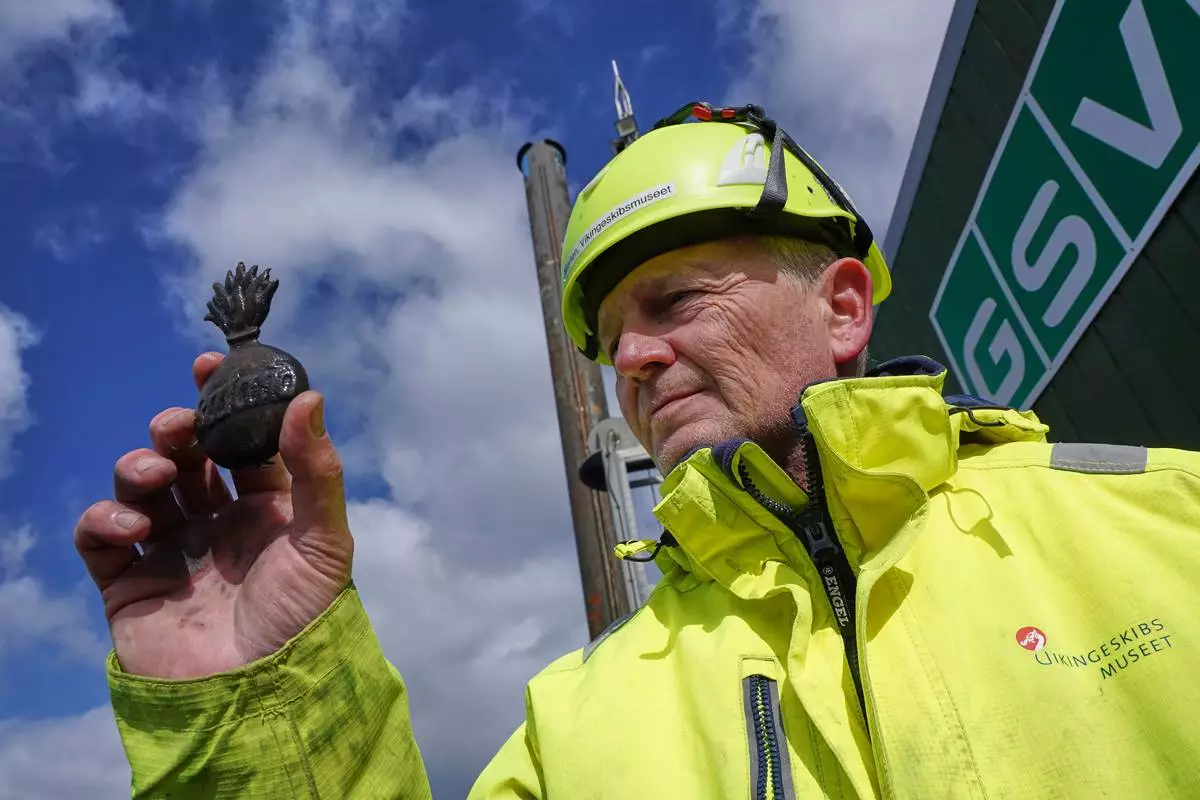
Morten Johansen, head of maritime archaeology at Denmark's Viking Ship Museum, shows a metal insignia recovered from the wreck of Danish flagship "Dannebroge" that sank during the Battle of Copenhagen in 1801, in Copenhagen, Denmark, Tuesday, March 31, 2026. (AP Photo/James Brooks)